


PALM BAY, FL (The Palm Bayer) — Municipal governance requires clear charter knowledge, fiscal discipline, and adherence to constitutional limits. The Palm Bayer submitted a 9-question Candidate Readiness Assessment to all six qualified candidates for Palm Bay City Council Seats 4 and 5. The assessment evaluated candidate positions across local charter mechanics, budget tradeoffs, development concurrency, surveillance policy, and leadership philosophy.
Three candidates submitted completed responses: incumbent Councilman Kenny Johnson (Seat 4), incumbent Deputy Mayor Mike Jaffe (Seat 5), and challenger Eduardo Macaya (Seat 5). Three candidates failed to participate: Alfred Agarie (Seat 4), Michael Bruyette (Seat 4), and Santa Isabel Wright (Seat 5). Following written reminders delivered on July 7 and July 17, non-participating candidates received blank exam notations under established evaluation ground rules.
Primary Source Document Download: Readers and voters can download the complete, unabridged side-by-side transcripts of all 9 questions and raw candidate responses: 👉 Download 2026 Candidate Readiness Assessment Master Transcripts (14-Page PDF)
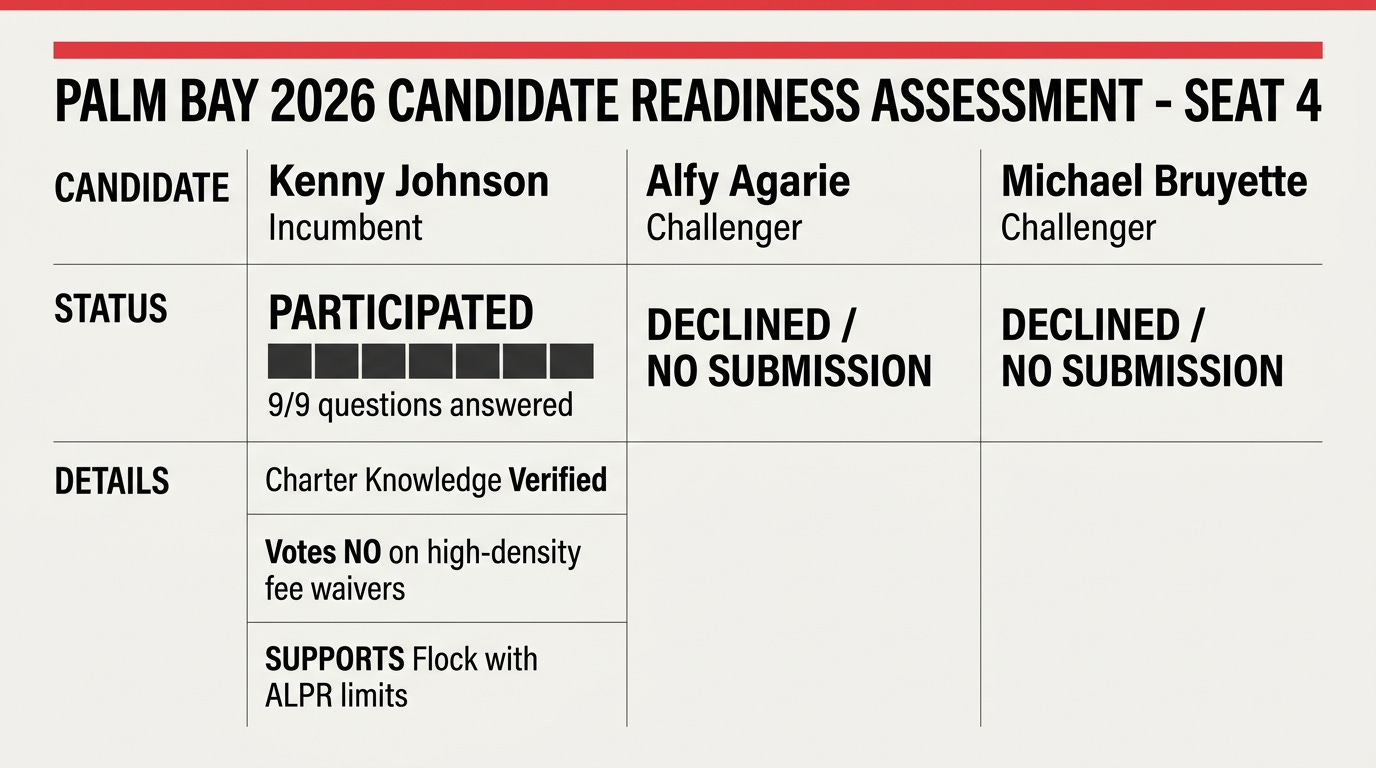
Seat 4 Candidate Evaluation Record
In Seat 4, incumbent Kenny Johnson completed the full evaluation. His responses emphasized administrative audit practices, strict limits on automated license plate readers, and developer accountability for infrastructure concurrency.
Challengers Alfred Agarie and Michael Bruyette declined to return the assessment. Written notices were sent on July 7 and July 17. Neither candidate submitted answers before the publication deadline. Under the ground rules of this assessment, both receive blank exam designations in the official record.
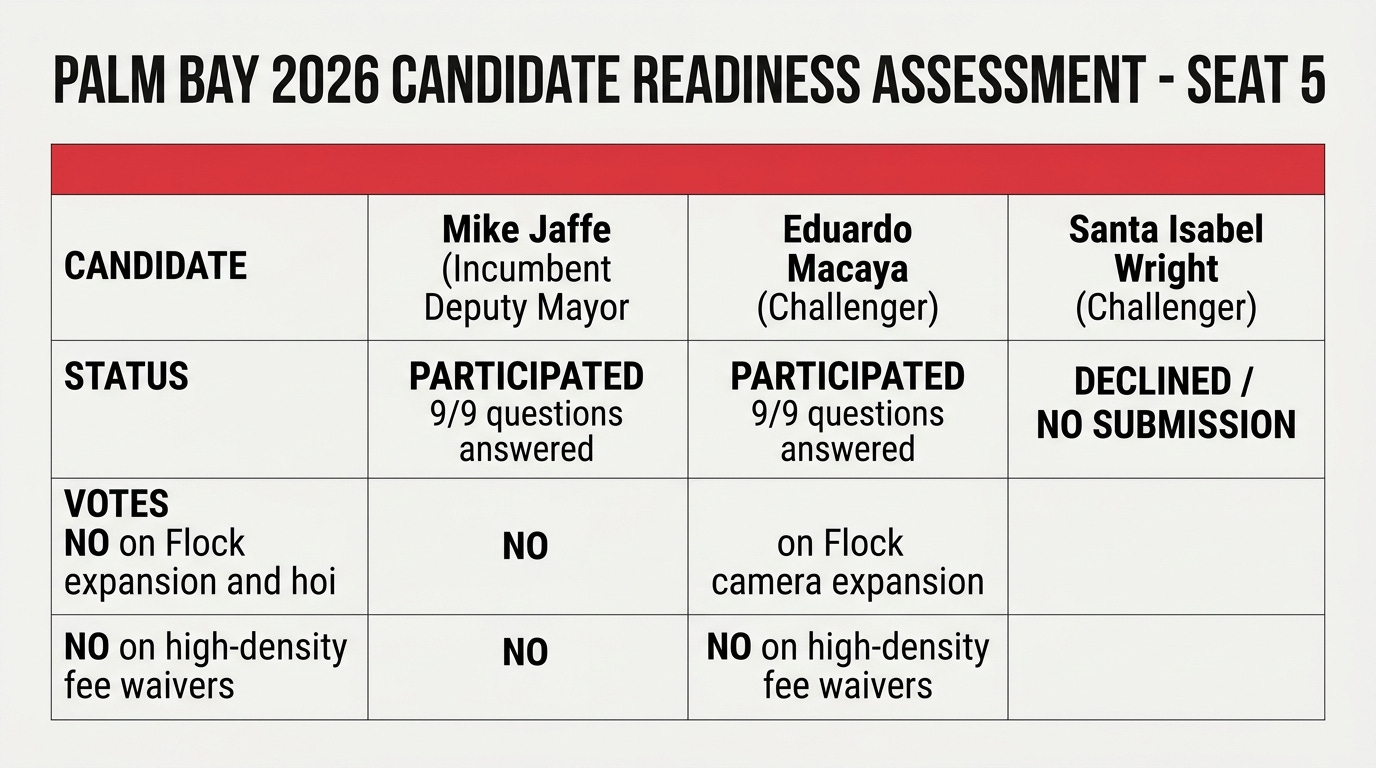
Seat 5 Candidate Evaluation Record
In Seat 5, incumbent Deputy Mayor Mike Jaffe and challenger Eduardo Macaya completed the assessment. Both candidates demonstrated thorough charter literacy and opposed expanding automated surveillance networks into private residential feeds.
Challenger Santa Isabel Wright declined to participate. Delivery confirmation records show assessment forms were received, with follow-up notices sent on July 7 and July 17. No submission was received. Wright receives a blank exam designation in the official record.
Part 1: Charter Governance and Municipal Realities
Question 1 examined candidate understanding of the Council-Manager form of government under the Palm Bay City Charter. All three participating candidates accurately identified the explicit boundary between policy creation and daily administrative control.
Johnson, Jaffe, and Macaya confirmed that City Council sets policy, adopts budgets, and appoints three charter officers: the City Manager, City Attorney, and City Clerk. All three noted that the City Manager holds sole charter authority to hire, fire, and direct municipal staff, including the Police Chief and Public Works Director. Each candidate cited charter provisions prohibiting council members from issuing orders directly to city employees.
Question 2 evaluated fiscal priorities regarding the city’s 6.7339 millage rate and $155 million General Fund. Public safety funding accounts for the largest share of General Fund expenditures. All three candidates stated that frontline police and fire services must remain protected.
To fund expanded road repaving and stormwater projects, candidates proposed targeted administrative cuts rather than public safety reductions. Johnson advocated eliminating non-essential travel, auditing consultant contracts, and delaying discretionary equipment purchases. Macaya proposed streamlining procurement and reducing administrative overhead. Jaffe pointed to binding salary commitments in existing collective bargaining agreements with NAGE, FOP, and IAFF. To protect core infrastructure, Jaffe explicitly advocated cancelling or deferring any capital projects that fall outside the adopted five-year Capital Improvement Plan, focusing limited city funds strictly on roads, stormwater, and essential facilities.
Question 3 addressed the historic infrastructure deficit in Southwest Palm Bay. Participating candidates correctly identified unpaved roads and missing utilities as legacy issues stemming from 1970s land platting. Private developers platted thousands of residential lots without constructing roads, drainage networks, or utility infrastructure.
To fund infrastructure stabilization without shifting costs onto residents in other quadrants, candidates proposed combined revenue strategies. Johnson and Macaya advocated pursuing state and federal infrastructure grants, utilizing legal impact fees, and requiring new developments to fund their proportionate share of improvements. Jaffe recommended a multi-year capital financing model incorporating impact fees, utility assessments where appropriate, and data-driven asset management through the Capital Improvement Plan.
Part 2: Scenarios and the Surveillance Policy Split
Question 4 presented a scenario involving a proposed 300-unit apartment complex requesting impact fee waivers and zoning variances while adjacent roads operate at a failing Level of Service (LOS). Participating candidates voted unanimously against the requested fee waivers and zoning variances unless developer mitigation resolves the infrastructure deficits first.
Johnson stated that growth must pay for itself and refused to shift developer costs onto taxpayers. Jaffe noted that residential impact fee waivers deplete essential infrastructure funds and stated that zoning variances must meet strict criteria in the Land Development Code rather than serving as financial incentives. Macaya stated that approving high-density development on failing infrastructure creates compounding future costs for current residents.
Question 5 examined budget tradeoffs between neighborhood road repaving matrices and employee cost-of-living adjustments (COLA). Candidates outlined specific metrics used to evaluate competing funding priorities.
Jaffe noted that collective bargaining commitments dictate baseline salary structures and urged data-driven evaluations of turnover and recruitment before making adjustments. Johnson prioritized auditing non-essential line items first, using pavement condition indexes to prioritize roads while evaluating vacancy rates to protect key staff. Macaya advocated protecting public safety compensation where turnover impacts essential service delivery while prioritizing high-traffic roads with severe safety hazards.
Question 6 revealed a major policy split regarding Flock Safety automated license plate reader (ALPR) cameras and the integration of private HOA camera feeds into police databases. The debate directly intersects municipal actions on August 7, when the city executed an emergency suspension and physical hooding of citywide Flock cameras due to FDOT crash safety non-compliance in the public right-of-way.
Johnson supported using Flock ALPR technology for criminal investigations, stolen vehicle tracking, and active felony cases, provided strict safeguards remain in place. Johnson opposed facial recognition and behavioral tracking. He opposed unrestricted HOA network integration, requiring formal agreements and audit oversight before connecting private feeds.
Jaffe and Macaya opposed camera expansion and private feed integration on constitutional grounds. Jaffe noted that former police leadership initiated the original Flock contract via consent agenda. Following the August 7 camera hooding, Jaffe supported auditing data handling and stated he favors complete removal of the system if privacy protections are compromised. Macaya voted against purchasing additional Flock cameras and opposed HOA database integration, citing Fourth Amendment protections against mass surveillance without individualized suspicion.
Part 3: Leadership Philosophy and Governance Dynamics
Question 7 evaluated candidate decisions when facing 75 vocal protesters opposing a stormwater project required to prevent severe flooding in an adjacent, lower-income neighborhood. All three candidates voted to approve the project based on technical engineering data.
Johnson, Jaffe, and Macaya stated that elected officials represent all 160,000 residents, not only those present in council chambers. Each candidate affirmed that engineering data and public safety must override crowd pressure. All three committed to meeting with protesting residents after the vote to explain the data and explore localized mitigation options.
Question 8 asked candidates to describe instances where new data prompted a public change of position. Jaffe cited his vote regarding public comment rules, where he initially supported restricting comment periods but later reversed his position to restore public access and broadcast transparency. Johnson emphasized that leaders must adjust when new legal or financial facts emerge, stating that consistency should not override sound decision-making. Macaya affirmed that loyalty belongs to constitutional standards and factual evidence rather than political pride.
Question 9 examined candidate strategies when operating on the losing side of a 4-1 council split. All three candidates rejected grandstanding or obstructing city business. Johnson, Jaffe, and Macaya emphasized building professional relationships, offering constructive amendments, and clearly explaining dissent on the public record while respecting majority votes.
Summary of Candidate Non-Participation
Public accountability requires complete transparency regarding candidate participation in pre-election evaluations. Candidate readiness assessments provide voters with verifiable records of charter knowledge and policy positions prior to casting ballots.
Alfred Agarie (Seat 4), Michael Bruyette (Seat 4), and Santa Isabel Wright (Seat 5) received questionnaire forms with explicit instructions and submission guidelines. Follow-up notifications were delivered on July 7 and July 17. None of the three candidates submitted responses or requested extensions.
Under the ground rules established for this assessment, non-participating candidates are recorded as blank submissions. Voters evaluating Seats 4 and 5 may review participating candidate responses and comparison cards in the official records published by The Palm Bayer.


