


Listen to this article
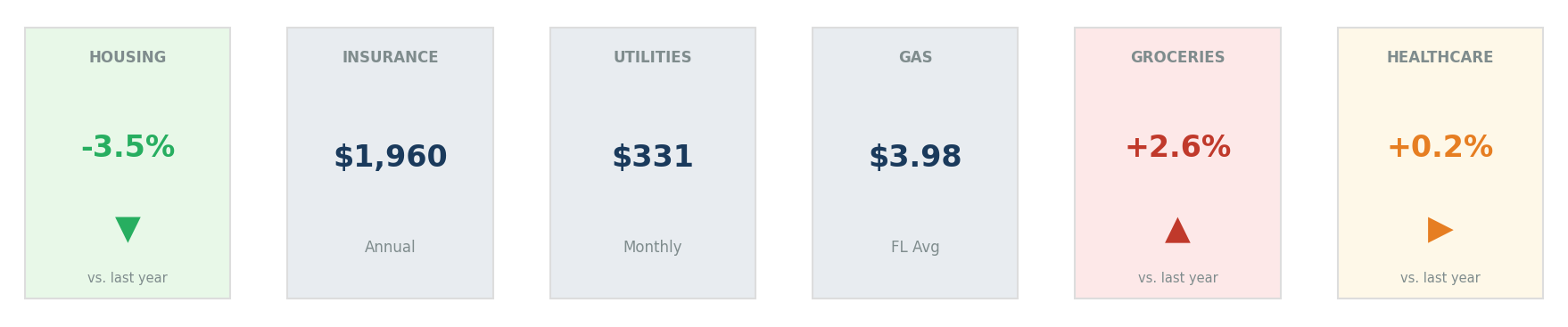
Palm Bay, FL -- Home values here have fallen more than 3.5% over the past year, rents are essentially flat, and the city’s overall cost of living runs 6.2% below the national average. For anyone looking to buy or rent in Palm Bay right now, the numbers are the most favorable they’ve been in several years. The complication is wages. Local earners trail the national average by nearly the same percentage that costs undercut it, which means the paper advantage doesn’t land in your pocket the way it looks on a chart.
This is the first edition of The Palm Bay Cost of Living Tracker, a new monthly series. Each edition will update housing, utilities, insurance, gas, groceries, healthcare, and wages so you can see what’s moving, what’s stable, and what’s worth watching. The data comes from Zillow Research, the Federal Reserve, AAA, FPL rate schedules, and the Bureau of Labor Statistics. All figures in this edition reflect data through February 2026 unless noted.
No jargon. No spin. Just the numbers, what they mean for a typical Palm Bay household, and how they stack up against the rest of the country.
The Composite Picture
Palm Bay’s cost index sits at 93.8 against a national baseline of 100. That means residents here spend roughly 6.2% less than the average American household across all major cost categories combined. You’re not in a bargain market by national standards, but you’re solidly on the affordable side of the line.
For a direct regional comparison: Port St. Lucie carries a cost index of 105.0. Residents there pay roughly 11% more than Palm Bay residents for equivalent housing and cost of living. Port St. Lucie’s median home runs $378,600 and median rent hits $2,302 per month.
The rent index tells a slightly different story. Palm Bay’s rent index is 99.6, meaning rents here are nearly at the national average. The bigger affordability edge shows up in home purchase prices, not monthly rent. If you’re comparing rent vs. rent, Palm Bay and the national median are essentially the same number.
Housing: Good for Buyers, Complicated for Owners
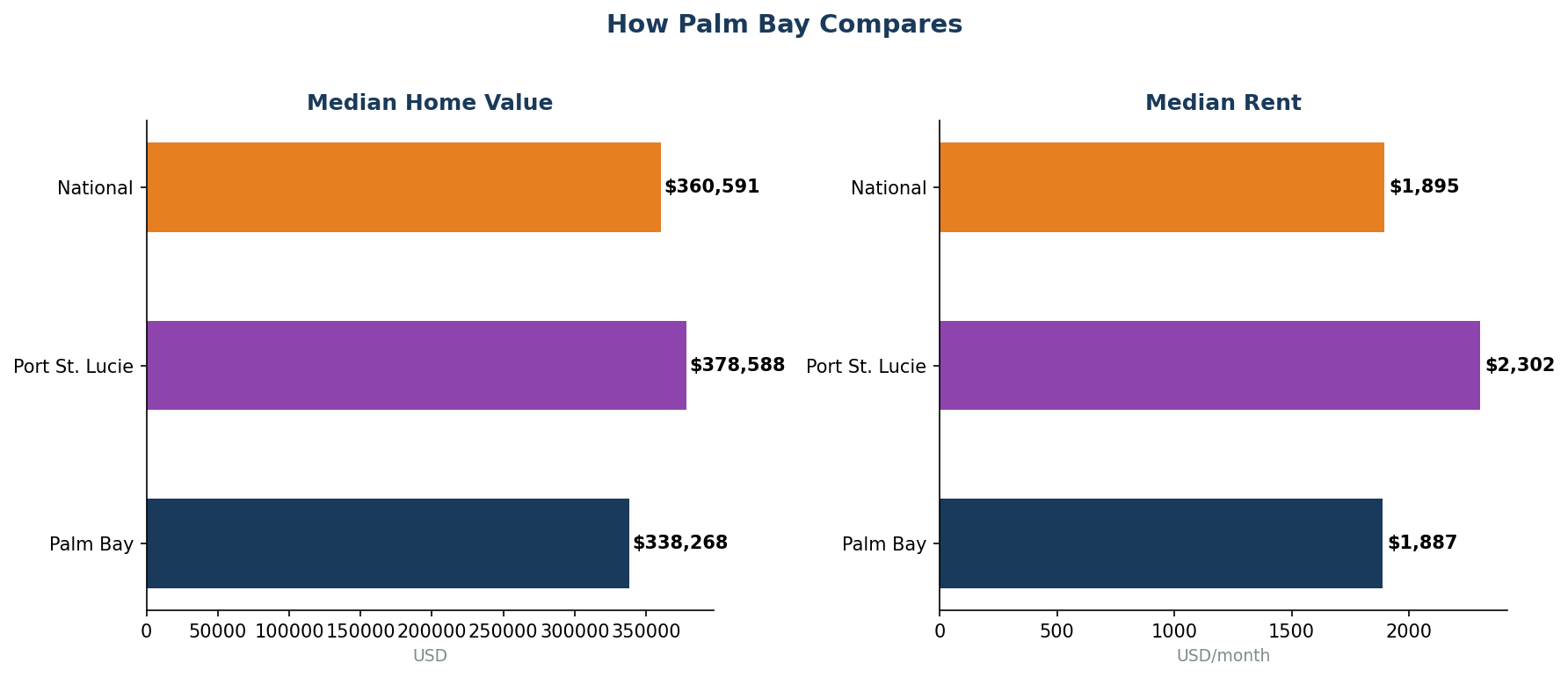
Palm Bay’s median home value is $338,268 as of February 2026, per Zillow’s Home Value Index. The national median is $360,591. Palm Bay runs about $22,000 below the national figure.
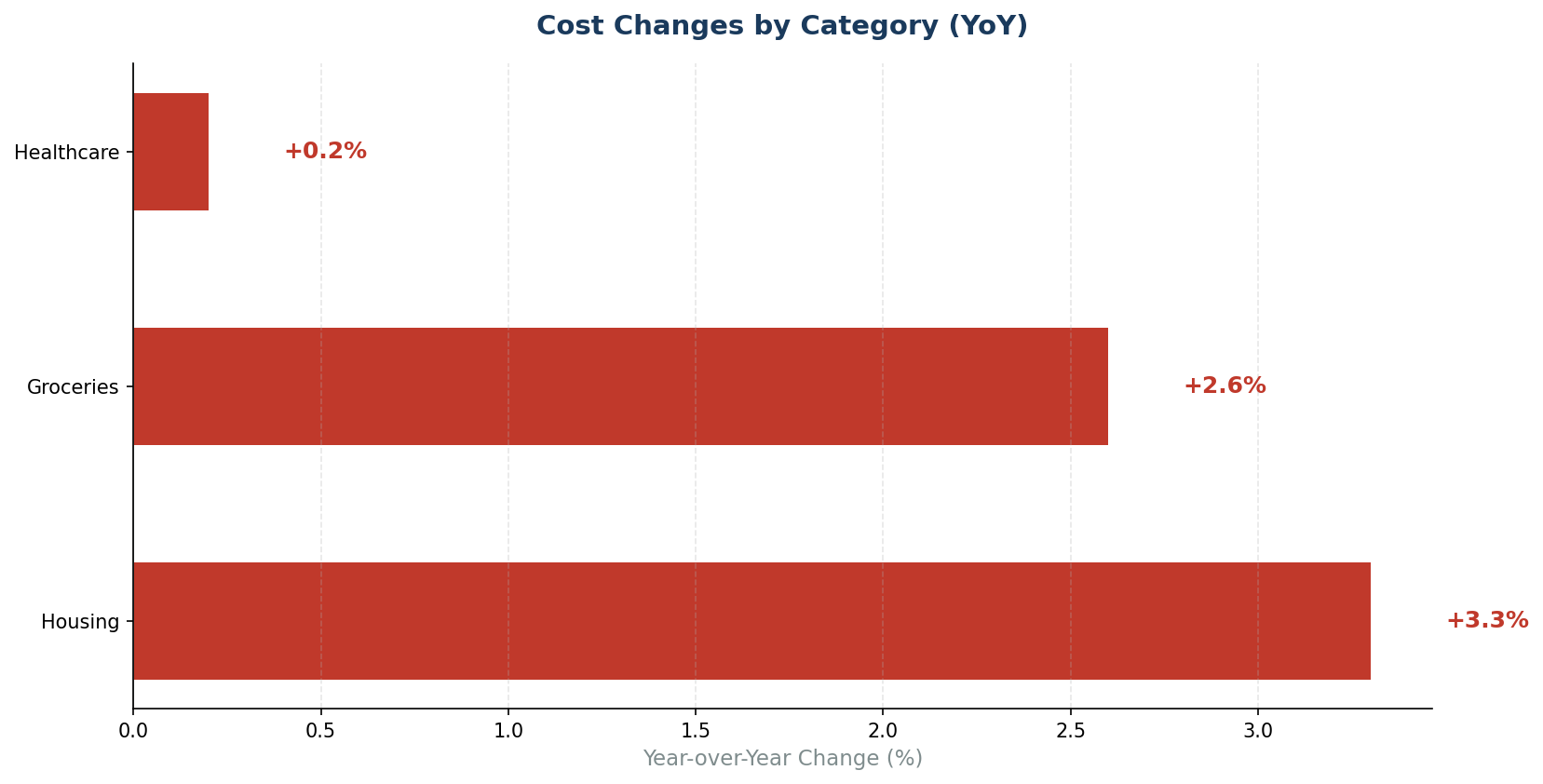
More significant than the current value is the direction. Palm Bay home values peaked above $350,000 in early 2025 and have been declining since. The January 2025 ZHVI reading was $351,203. By February 2026, it had dropped to $338,268. That’s a decline of roughly $12,900 over the period, or about 3.7%. Port St. Lucie followed a similar trajectory, falling from $396,475 in January 2025 to $378,588 in February 2026.
If you’re buying: the market has moved in your direction. If you own already: a $338,000 home that’s shed 3.7% in a year lost roughly $12,900 in equity. That matters if you had plans around a refinance, a home equity line, or a sale.
Renters are in a stable position. The median Palm Bay rent is $1,887 per month, nearly matching the national median of $1,895. Palm Bay rents have crept up from $1,868 in January 2025 to $1,887 in February 2026, a modest 1% gain over the period. For context, the national CPI shelter component rose 3.3% over the same window. Palm Bay rents grew at less than a third of the national rate.
How Palm Bay Compares
The numbers against national and regional peers:
Palm Bay - Median home value: $338,268 - Median monthly rent: $1,887 - Cost index: 93.8
Port St. Lucie - Median home value: $378,588 - Median monthly rent: $2,302 - Cost index: 105.0
National - Median home value: $360,591 - Median monthly rent: $1,895 - Cost index: 100.0
On housing purchase price, Palm Bay runs $22,000 below the national median and about $40,000 below Port St. Lucie. On rent, Palm Bay and the national figure are nearly identical; Port St. Lucie runs $415 per month higher.
One comparison we can’t make yet is Titusville. Titusville falls inside the same Palm Bay-Melbourne-Titusville metropolitan statistical area, which means Zillow and the Federal Reserve don’t separate out sub-market data. We’re working on sourcing Brevard County sub-market figures for future editions.
Your Monthly Costs
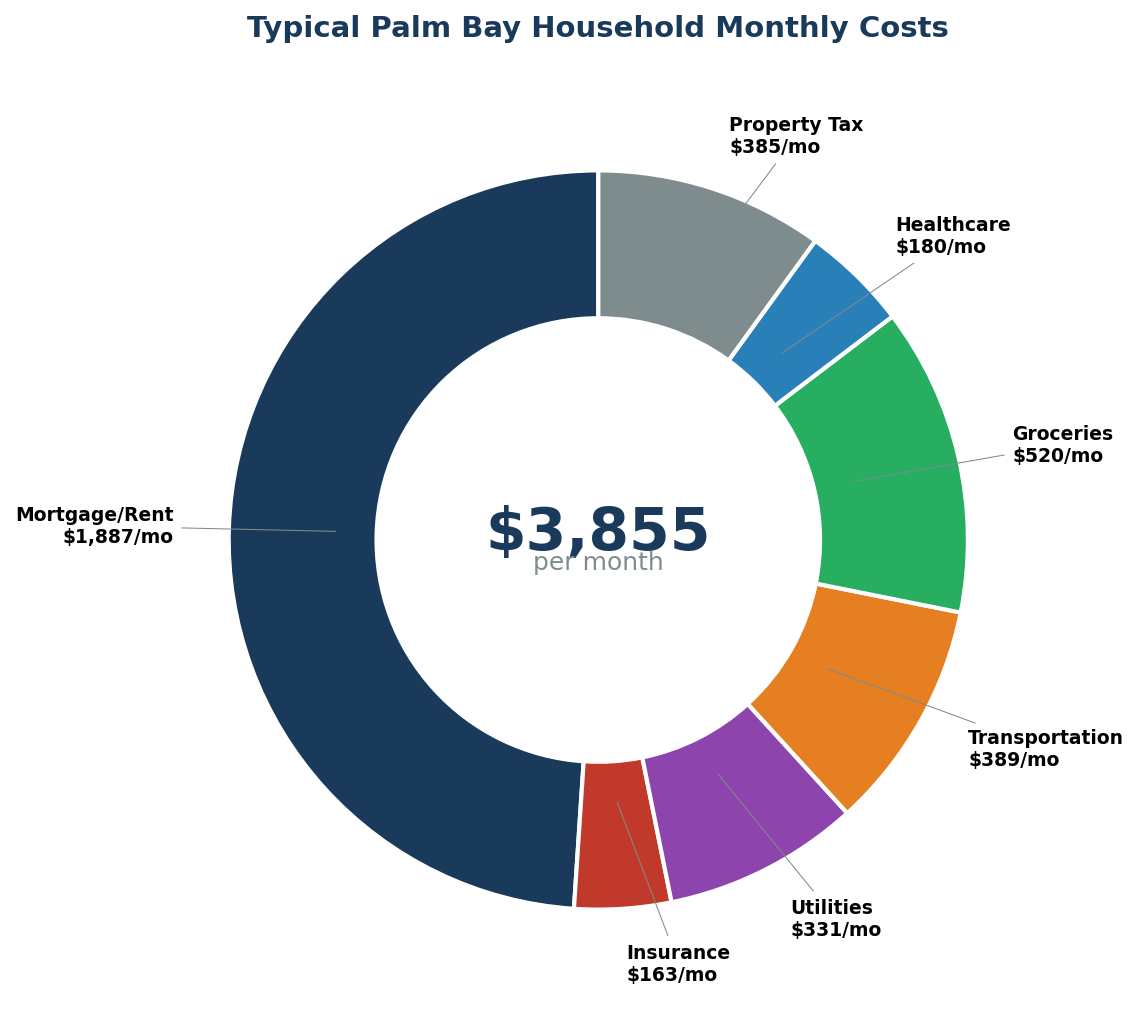
Here’s the estimated monthly budget for a typical Palm Bay household. These are medians and averages. Your costs will differ based on home size, family size, commute distance, and individual choices.
Housing (mortgage or rent): $1,887
Property tax (amortized, FY2026): $385
Homeowners insurance: $163
FPL electric (~1,400 kWh): $211
Water, sewer, and stormwater: $120
Groceries: $520
Healthcare: $180
Transportation (gas + vehicle): $389
Total: $3,855/month
The property tax figure uses Brevard County’s total millage rate with a $50,000 homestead exemption applied. Insurance is the Brevard County average of $1,960 per year ($163/month). That figure is well below Florida’s brutal statewide average of $7,136 annually. Brevard’s inland geography and distance from the most exposed Gulf and Southeast coastlines keeps insurance costs significantly lower than most Florida counties.
The water/sewer/stormwater estimate of $120 assumes 5,000 gallons per month, which is typical for a Palm Bay household. That includes base charges, per-gallon usage rates, and the $7.50 monthly stormwater fee. The FPL estimate of $211 uses an all-in blended rate of $0.143 per kilowatt-hour at 1,400 kWh, which includes base energy, fuel charges (which tier up above 1,000 kWh), conservation, capacity, environmental cost recovery, storm protection, and the clean energy transition rider, plus the $10.52 monthly customer charge. FPL’s own benchmark bill at 1,000 kWh is $136.64, but no single-family home running central A/C in Brevard County averages 1,000 kWh. Veterans with disability exemptions, seniors, and others with assessed-value reductions will see a lower property tax line.
The Wage Problem
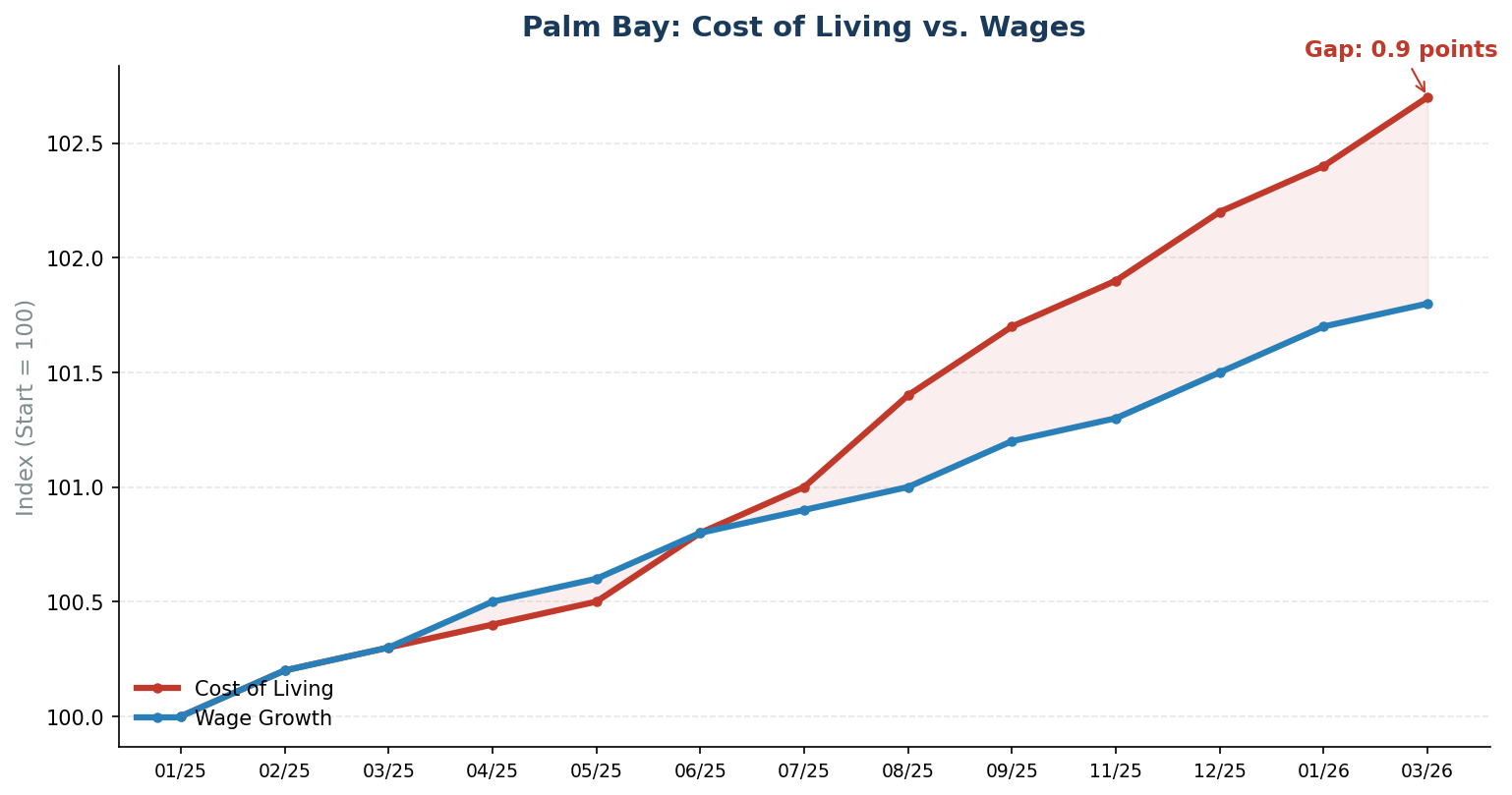
This is where the affordability picture gets complicated, and where Palm Bay residents should pay the most attention.
The national average hourly wage is $37.32 (Bureau of Labor Statistics, February 2026). Workers in the South Census Region, which covers Florida, average $35.16 per hour. That’s 5.8% below the national figure. Palm Bay-specific wage data isn’t tracked separately at the metropolitan level, so the South region rate is the closest available proxy.
The 5.8% wage gap nearly cancels out the 6.2% cost advantage. Palm Bay residents pay less than the national average, but they also earn less. The net difference is roughly half a percentage point. The city is affordable relative to its peers, but the affordability doesn’t translate into extra cash the way a 6.2% cost discount sounds.
Gas compounds the pressure. Florida’s average gas price hit $3.983 per gallon as of March 2026, per AAA. Earlier this month, Florida gas prices jumped roughly 84 cents in 12 days. For Palm Bay households with long commutes, which is common given the city’s spread-out geography and limited public transit, fuel costs are a meaningful budget line that the composite index doesn’t fully capture.
What to Watch in Coming Months
FPL rates. The PSC approved FPL’s four-year rate agreement in November 2025. The current benchmark bill at 1,000 kWh is $136.64, up from $134.14. Over the next three years, the benchmark will rise an additional $14. For Palm Bay households at 1,400+ kWh, that translates to bills pushing $230-240 by 2029. Any rate adjustment will show up in this tracker the month it takes effect.
Insurance market. The $1,960 Brevard County average reflects a market that’s better than the state norm but not immune to volatility. Several carriers have exited Florida entirely. A significant storm season or further carrier exits could push that figure higher.
Home value direction. The 3.7% year-over-year decline has been gradual, not a crash. Whether values stabilize, continue sliding, or reverse depends on mortgage rates, the pace of new construction in Palm Bay’s western sections, and broader Florida migration trends. We’ll track it every month.
Gas prices. The March spike may or may not hold. Spring refinery transitions typically bring some relief. We’ll have April data next month.
About This Tracker
The Palm Bay Cost of Living Tracker publishes around the end of each month as updated data becomes available. Data sources: Zillow Research (ZHVI and ZORI, housing), Federal Reserve Economic Data (CPI series, wages), AAA (Florida gas prices), Florida Office of Insurance Regulation (Brevard County insurance averages), FPL rate schedules (electric), City of Palm Bay utility rates (water/sewer), and Brevard County Property Appraiser (millage rates). All data in this edition reflects February 2026 figures unless otherwise noted. Wage data uses the South Census Region as a Palm Bay area proxy.
Questions, corrections, or tips on local cost trends? Write to us at ThePalmBayer.com.
Sources
Zillow Research, ZHVI and ZORI Data, February 2026
FRED (Federal Reserve Economic Data), accessed March 2026; CPI series CUSR0000SAH1 (Shelter), CUSR0000SAF (Food), CUSR0000SAM (Medical); South region average hourly earnings
AAA Florida Gas Prices, accessed March 2026
Florida Office of Insurance Regulation, homeowners insurance rate data, Brevard County average
FPL residential rate schedule RS-1, effective January 2026; all-in blended rate $0.143/kWh at 1,400 kWh, $10.52/month customer charge
City of Palm Bay utility rates, water/sewer monthly estimate $42
Brevard County Property Appraiser, FY2026 total millage rate
U.S. Bureau of Labor Statistics, Average Hourly Earnings, February 2026


