


Editor's note: Substack's email edition limits the length of our detailed reports. The complete article — including full documentation and all visuals — is available at news.thepalmbayer.com: Palm Bay Council’s $2.4M emergency wastewater vote.
Palm Bay, FL -- The City Council on April 16 authorized roughly $2.4 million in emergency procurement to finish the South Regional Water Reclamation Facility (SRWRF), waiving competitive bidding to put Cathcart Construction Company in charge of a 45-day push to accept flows before rainy season. The vote followed an on-record admission from City Manager Matthew Morton that the city violated its state wastewater permit last year and remains at risk of doing so again. RJ Sullivan Corporation, the original contractor since November 2020, was terminated by the city approximately 45 days ago. This is the first published account of that termination.
Morton framed the request in unusually direct terms. “We’re asking for a huge hand of public trust,” he told council. “I don’t know what else to do or I wouldn’t be here standing on this side of the dais tonight.” Mayor Rob Medina put the dollar figure plainly: “So we’re talking 2.4 million turnkey within 45 days.” Utilities Director Gabriel Bowden confirmed the target.

What the City Approved
The package combines roughly $900,000 remaining on the existing RJ Sullivan contract with up to $1.5 million in new authorization. Cathcart will be the lead general contractor on a time-and-materials basis. Wharton-Smith, the Phase 2 incumbent on the project, will send a representative weekly to advise. Meeks Plumbing and Razorback Construction round out the named support firms. The performance surety has assigned Kubota, the membrane bioreactor manufacturer, directly to the city, along with subcontractor Chin Shore. Morton said procurement will not pursue formal competitive quotes given the urgency.
The 45 days does not get the plant fully complete. It gets it to the point of accepting flows. “It would not be complete in 45 days,” Bowden said, “but accepting flows in 45 days.” Bowden told council privately he was hoping for 90 days but is now committing to 45 with the new contractor lineup. Site work, paving, landscaping, and parking are set aside. The mission is to divert flow off the over-pressured existing North Regional plant before June rains arrive.
The Permit Violation Admission
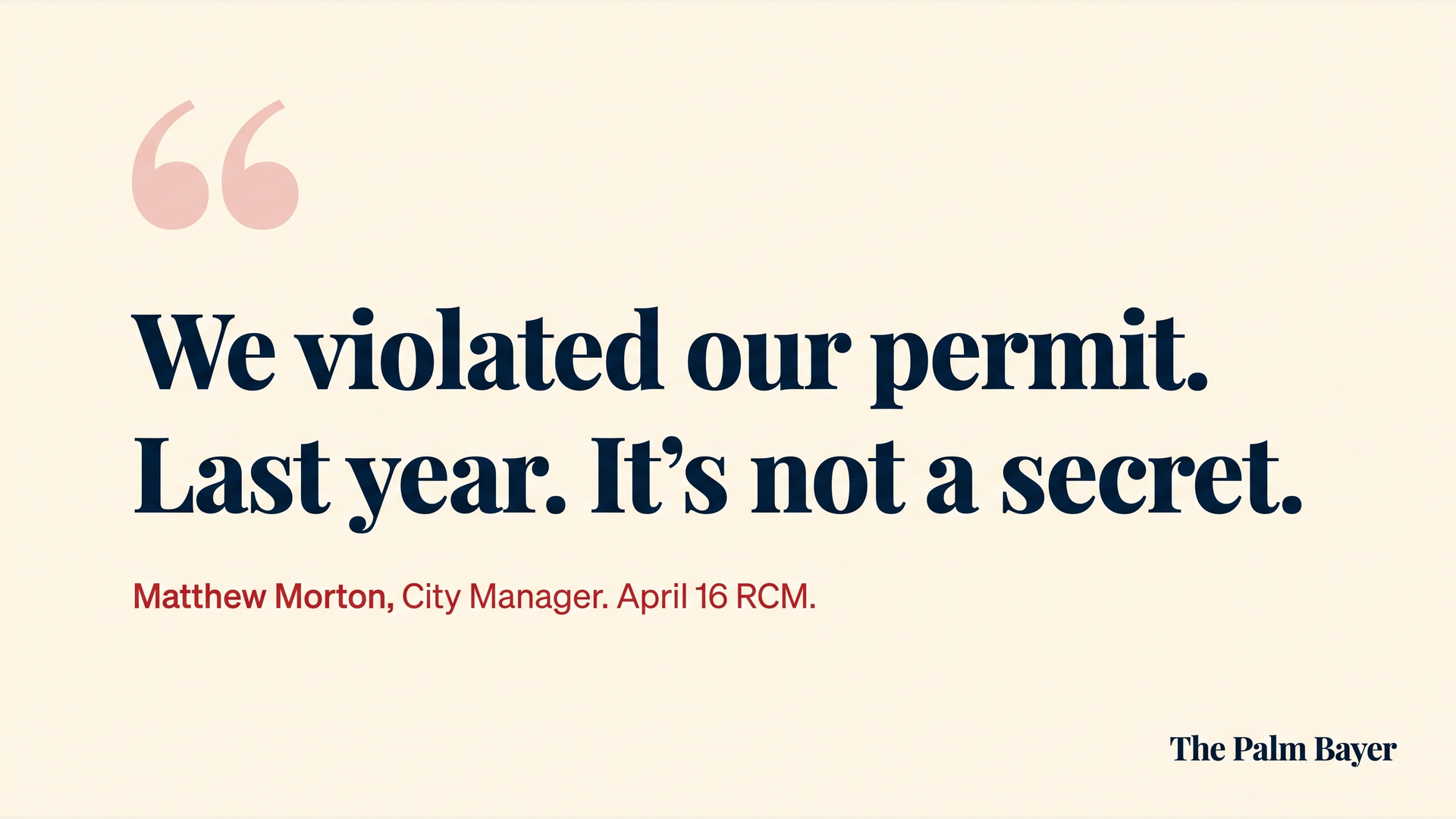
Morton’s most consequential statement was about the past, not the future. “We violated our permit. Last year. It’s not a secret. We are risking violating our permit today, just based on flows.”
The current permitted treatment capacity at the city’s North Regional facility is 5.2 million gallons per day. Bowden told council the plant exceeded that capacity in October 2025, treating flows above 5.4 MGD during a wetter-than-normal month. That breach is the central reason for tonight’s emergency action. If the city proceeds through standard competitive procurement, Morton said, completion slips by six to seven months, the rainy season hits a system already at peak stress, and the city faces three escalating consequences: regulatory action, additional spills, and a forced moratorium on new water meter issuance.
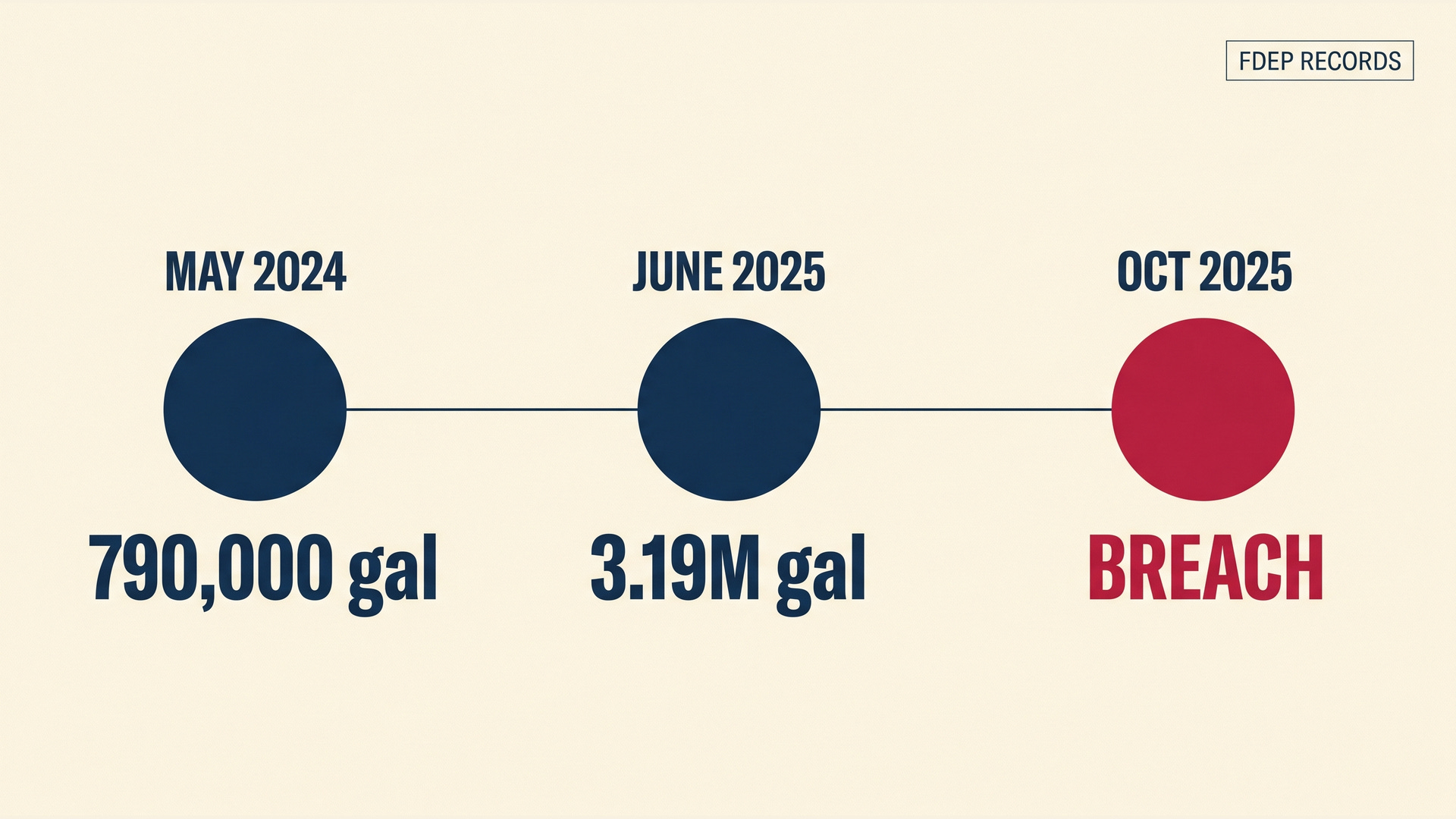
The permit violation Morton referenced has a paper trail. According to FDEP records reported by Florida Today, three discrete spills produced enforcement action: 790,000 gallons of raw sewage at 1105 Clearmont Street NE on May 10, 2024 after a vehicle struck a valve; a separate 13,400-gallon recovered leak on May 16, 2024; and 69,930 gallons of partially treated sewage from the same facility on April 24, 2025 due to pump failure. FDEP issued a consent order in March 2025 with a proposed $34,857 penalty. Palm Bay elected an in-kind alternative: roughly $54,200 in nitrogen-removal equipment installed at the North Regional facility instead of the cash penalty.
That consent order predates the larger event. On June 8, 2025, a 20-inch force main failed near 1050 Clearmont Street NE. The city’s own incident review found a 2-to-3-inch crack along the full length of a 20-foot pipe section that failed at year 37 of an 80-to-100-year design life. Roughly 3.19 million gallons released; about 1.19 million reached the environment. Cathcart was the emergency contractor on that response, paid roughly $1.124 million on a no-bid basis. Nine months later, no successor FDEP consent order or notice of violation has surfaced in public records covering either the June 2025 spill or the October 2025 capacity breach. The city told ClickOrlando in September it expected only “modest” fines.
Florida Code 62-600.405
Florida Administrative Code Chapter 62-600 governs domestic wastewater facilities. Rule 62-600.405 sets the planning thresholds. When three-month average daily flow exceeds 50 percent of permitted capacity, the permittee must file a capacity analysis report within 180 days. If that report projects capacity will be reached within four years, an engineer must certify expansion plans are underway. If projection is within three years, a complete permit application for expansion must be filed within 30 days.
Palm Bay began designing SRWRF in 2020 and let the original construction contract in November of that year. The standard reading of 62-600.405 places the 50 percent threshold trigger no later than 2022. The fact that the city is now invoking emergency procurement to finish an expansion plant in 2026, six years after award, places the timeline well outside the rule’s intent. Palm Coast, in a similar capacity bind, received an updated FDEP consent order in December 2024 requiring full compliance by December 28, 2028. Palm Bay has not been served with a comparable order publicly.
The warning signs were on the public record long before tonight. At the May 15, 2025 council meeting, Mike Demko of Wade Trim, the city’s engineering consultant on the SRWRF project, told council that RJ Sullivan was “having trouble developing a sufficient schedule for review” and that the contractor was “not meeting specification requirements.” Demko named the root causes as “supply chain issues, labor force and mis-management.” That was the consultant the city was paying for project oversight, on the record, using the word “mismanagement” almost a year before termination. The verbatim phrasing is sourced through the Palm Bayer’s NotebookLM corpus drawn from official meeting transcripts; The Palm Bayer has not independently verified the May 15, 2025 audio.
Jaffe Vindicated
Deputy Mayor Mike Jaffe advocated publicly for terminating RJ Sullivan in January 2026. The Palm Bayer reported on January 23 that Jaffe “expressed sharp frustration, noting he previously advocated for the contractor’s termination.” Three months later the city did exactly that. Bowden was direct on the contrast tonight: “I’ve always felt we were very close. If RJ Sullivan would just put a little bit more effort, and they never did. We have developed such a great relationship with Cathcart. They’ve proven themselves to put forth the effort that needs to be there.”
Mayor Medina was equally pointed about the surety delay. “We’ve been waiting on this for years. Literally. Unfortunately, we had to wait for some surety bond. I felt that this was an emergency long before.”
What Gets Counted
The original SRWRF contract to RJ Sullivan was $21,364,403.20 in November 2020 for a plant initially rated at 2 MGD, expandable to 12 MGD using membrane bioreactor technology. Cumulative change orders pushed the contract to $24,907,065 by May 2024, a 16.58 percent escalation. Another change order of $153,646 followed in May 2025. Engineering services on the project have totaled roughly $3.6 million on a $36 million borrowed-capital base. The Florida State Revolving Fund loan tied to the project has been increased twice; the loan balance now sits at $38.9 million per FDEP data, after sequential increases of $12 million and $6.9 million.
Context on one piece of the cost stack. Not every dollar tonight’s emergency action is solving traces back to RJ Sullivan. According to a December 2025 staff memorandum, the SRWRF was redesigned in 2017 without a permanent on-site sludge dewatering facility because flow projections at the time were considered too low to justify the build. When the plant approached startup in late 2025, updated projections came in higher than the 2017 numbers, leaving the city without the capacity to handle expected biosolids volumes. The emergency biosolids hauling contract approved by the City Manager last December, roughly $850,000 per year on a piggyback off a City of Sebring contract, is paying for that 2017 design decision. It is a separate cost driver from the contractor performance issues that drove tonight’s vote.
The Palm Bayer first reported on May 10, 2025 that the city was levying daily liquidated damages against RJ Sullivan for missing the April 26, 2025 completion deadline. That was a year ago. The plant is still not online.
Morton was honest about the consequence if the emergency action is delayed. “We do risk pipe failures, sewage leaks, increased pressure. The risk of, we don’t know what the rainy season is going to do. It actually is way more expensive to treat the discharge to put it back out into the environment.” He acknowledged that the city continues adding wastewater customers. “We’ve also added a lot of additional users. We continue to add some. I brought up the number 700, you know, residents and businesses. So the demands are high.”
Councilman Mike Hammer asked the question that was sitting under the entire conversation. “So how, if we’re at peak stress, did the utilities just pass for the development we just approved tonight? How did the utility guidelines pass for that if we’re at peak stress?” Bowden answered that capacity at the time of permit signing reflected current conditions, not future conditions. “By the time this development comes online, we will have the capacity. And those developments are coming on. They’re coming much more down the road, not impacting where we’re currently at.” Hammer accepted the answer but added a marker. “My growth is based on smart growth. And I don’t want to have more stress be put on ourselves.”

The emergency authorization passed council without a recorded objection. Cathcart crews are scheduled to mobilize the morning after the vote pending final surety release, which Morton said could come within 10 days.
Centerpointe Church Rezoning Approved 4-1 on Second Try
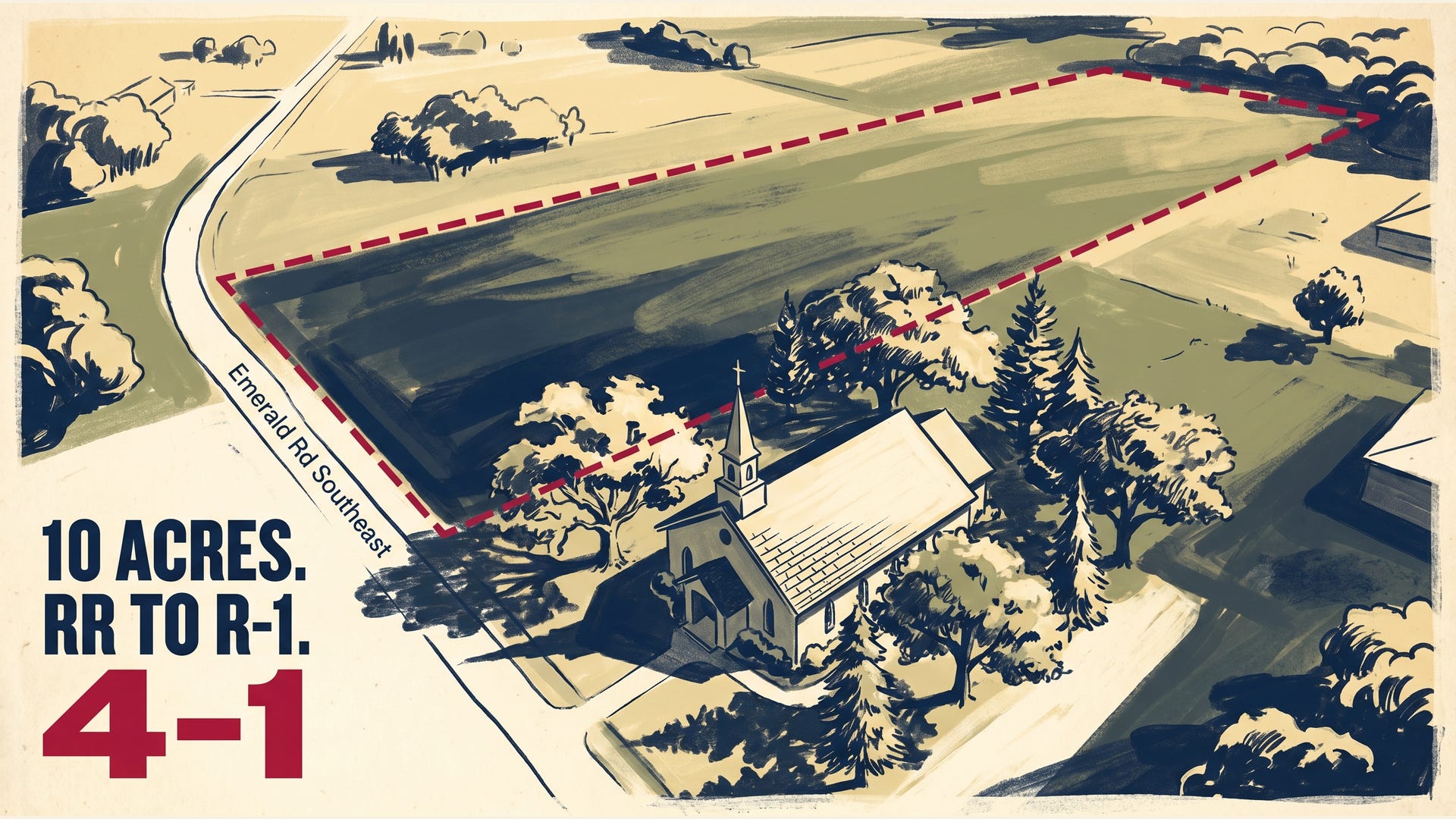
Council approved Ordinance 2025-44 by a 4-1 vote, rezoning a 10-acre parcel north of Emerald Road SE, south of Valor Drive SE, and west of Cavern Avenue SE from Rural Residential to RS-1 Single-Family Residential. The parcel is owned by Centerpointe Church (formerly Zion Christian Church). Pastor Tom Walker has led the congregation for 20 years and told council the church needs proceeds from the land sale to fund a new sanctuary, an expanded children’s ministry, and a youth ministry serving non-members.
The same parcel was denied 4-1 in September 2025 as RS-2, the denser zoning category. Tonight’s request was the result of a four-hour Bert Harris Act mediation, with Councilman Kenny Johnson representing the city. Under RS-1, minimum lot size rises to 8,000 square feet with an 80-foot lot width, larger than the 7,500-square-foot, 75-foot RS-2 standard. Up to 41 homes are planned on the site, below the maximum density the new zoning allows.
Attorney Kim Rozenko of Lacey Rozenko in Melbourne represented the church and made an explicit reference to the alternative path. The Live Local Act, codified at Florida Statute 166.04151 and amended in the 2025 legislative session, now requires cities to permit multifamily and mixed-use projects on religious-institution land at the highest density and height allowed within one mile. “It was a may, it’s now a shall,” Rozenko told council. Pastor Steve Petty made the same point in his testimony but identified the path differently. “My wife and I have had the opportunity to be introduced to a gentleman who has already helped two other churches in Brevard County build under the Yes In God’s Backyard plan. We know that plan provides honestly a much larger financial impact for us moving forward, but that’s not in harmony with our community.” The implicit message to council was clear. Approve the zoning, or the church can pursue a far more intense use without further council approval.
Lone Dissent on School Concurrency
Councilman Mike Hammer voted no, citing stale school concurrency data. “When I go and I look at a school concurrency from 18 months ago, I can’t make a good decision on that because I don’t know if we have room for those kids. So I’m going to be in denial because I do not have an updated school concurrency on that. And I would ask this council if they would wait to get an updated school concurrency before you make a decision.”
The school concurrency report in the agenda packet was dated June 29, 2025, drawing on data Hammer characterized as 18 months old. Rozenko acknowledged on the record that an updated concurrency report would be required at the subdivision and site-plan stage but defended use of the existing report at the rezoning stage. “It’s the report that your staff has relied upon and that we’ve relied upon.”
Mayor Medina and Councilman Chandler Langevin both supported approval. Langevin made the motion to pass and called the new RS-1 application “a great compromise” that better matched surrounding lot sizes. Medina noted that he held to a personal preference for one-acre lots as an economic-development tool but said requiring 41 one-acre estate lots on a parcel surrounded by single-family subdivisions was not realistic. “I am going away from my principles of one-acre lot in an effort to actually meet them at the place where they have brought back a proposal that would be more beneficial to our community.”
Public testimony broke along familiar lines. Centerpointe members Steve Petty, Paul Leece, and Barry Eschenberg spoke in support, as did visiting Pastor Ken Delgado. Two homeowners on Emerald Road, Shawnee Winnett and Briar Wynette, spoke against. Winnett opened her testimony with a direct framing of what she viewed as the appeal’s actual purpose. “It’s not about what Palm Bay needs. It’s about squeezing the highest possible return out of a piece of land they’d always planned to sell.” Wynette closed his testimony asking council to “please deny this request once again.” Bill Battin, a frequent council speaker, urged council to keep the rural-residential designation and recruit executive-tier homebuilders, citing prior city efforts to attract higher-income housing.
The first reading passed. Second reading is required for adoption. Hammer’s school concurrency request, that an updated report be obtained before second reading, is on the table.
SRO Agreements Tabled 3-2 to Force Negotiation
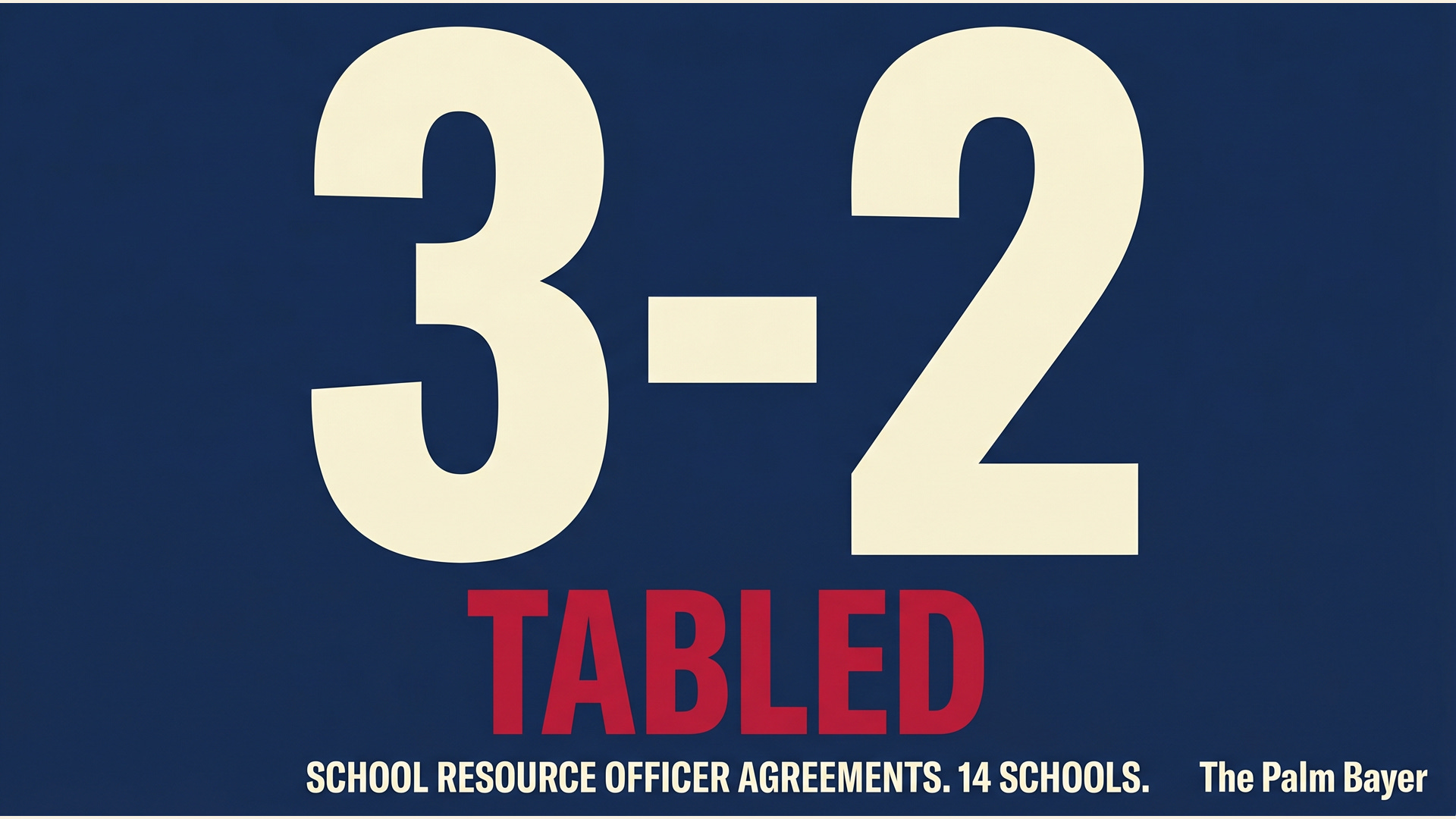
Council pulled items 2 and 3 from the consent agenda for separate debate and tabled both to the second meeting of May. The items would have authorized two memoranda of understanding with Brevard Public Schools and Odyssey Charter School for School Resource Officer staffing at 14 schools. Each tabling motion passed 3-2: Aye Medina, Aye Johnson, Aye Hammer; Nay Jaffe, Nay Langevin.
The dispute is about money. Morton confirmed on the record that the proposed reimbursement covers approximately 40 percent of the city’s actual cost per officer. “From the average hours calculated on assignment, the proposed reimbursement is probably only around 40 percent of what the actual cost would be for each officer.” Jaffe and Langevin pressed to deny the agreements outright as leverage; Hammer wanted to keep them and write a follow-up letter; Johnson moved to table to create negotiation room.
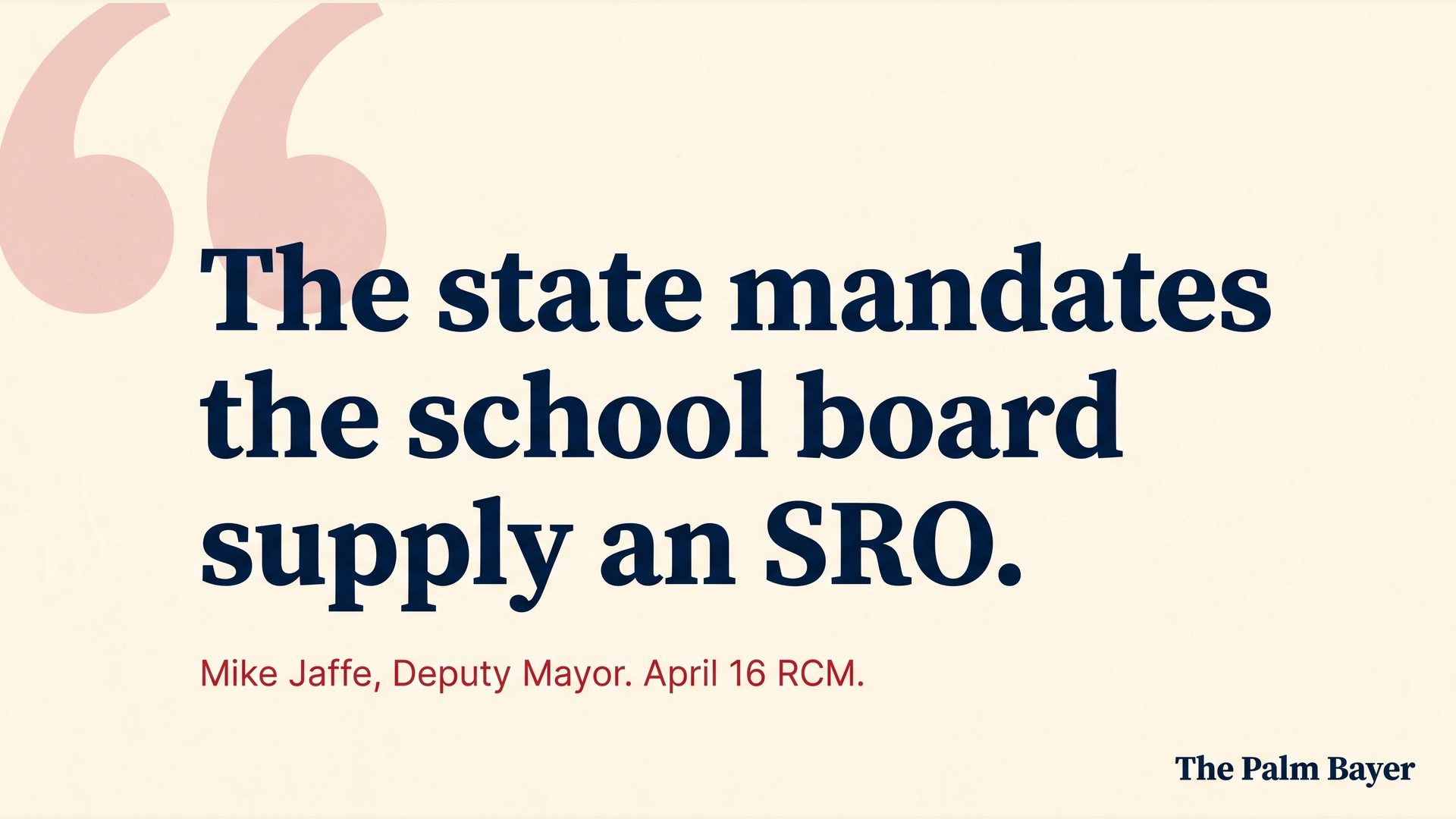
Jaffe was direct. “I’d be denying it if the money didn’t equate to what it actually cost the city to supply a full uniform officer. The state mandates the school board supply an SRO. They should fix their budget to accommodate a much higher reimbursement back to the cities and counties that are supplying these SRO officers.” Langevin framed it as a personnel issue inside a department that is per-capita one of the lowest-staffed in Florida. “They’re per capita one of the lowest staffed departments in the state of Florida. They do a phenomenal job for their staffing. But we have, I think it’s four resource officers that are in county schools that could be out on the streets.”
Hammer drew on his own school years. “I would like to say as a student that had an SRO in our school, that SRO isn’t just somebody that’s in there standing around protecting people. This SRO is somebody that is there for kids to go to if something is happening at home.” He supported keeping the program but agreed the conversation with the school board needs to happen.
Johnson expressed concern that a flat denial would push Brevard Public Schools to bypass Palm Bay PD entirely and contract with the Brevard County Sheriff’s Office. “My concern is say we do deny it, then they’re like, alright, call up Ivey and they just move forward with that, so there is no negotiation. But if we table, then we can at least say, hey, this is the option we’re weighing.” Johnson committed to call school board members John Thomas and Katye Campbell the day after the vote.
The MOU text states the agreement takes effect on July 1, 2026 regardless of when signed. That gives council roughly six weeks to negotiate. Morton noted that Sheriff Wayne Ivey’s office is the legal backstop if Palm Bay PD does not staff the schools. The pointed exchange came when Jaffe, asked who would do the negotiating outreach, told the city manager directly. “Well, you got told sir, I’m going to say no to the vote, so that’s not going to happen Mr. Morton.” Johnson took the lead.
Everlands West Continued to May 7
Council voted 3-2 to continue the public hearings on the Palm Vista Everlands West project to the May 7 regular council meeting. The applicant, Milrose Properties Florida, LLC (the land spinoff Lennar created in February 2025), requested the continuance through attorney Kim Rozenko of Lacey Rozenko, who also represented Centerpointe Church on the same agenda. Rozenko cited the need to complete traffic signal warrant studies and ongoing fire and police concurrency discussions with city staff.
Mayor Medina said his preference was a continuance to July, not May, citing the council’s June recess and the need for adequate review time. “I would suggest we go at least the first meeting in July.” Deputy Mayor Jaffe made the motion for May 7. Councilman Johnson seconded. The motion passed three to two.
The continuance preserves the current path: a first reading in May, transmittal to the state for a 30-day review window, the council recess in June, and a second reading in July. Deputy City Manager Jason DeLorenzo told council the traffic signal warrant study was being uploaded “as we speak” and the city’s outside consultant needs one to two weeks to review it. Rozenko also acknowledged that one of the project’s engineers, Ana Saunders, has a daughter graduating in late May and the team did not want a July hearing.
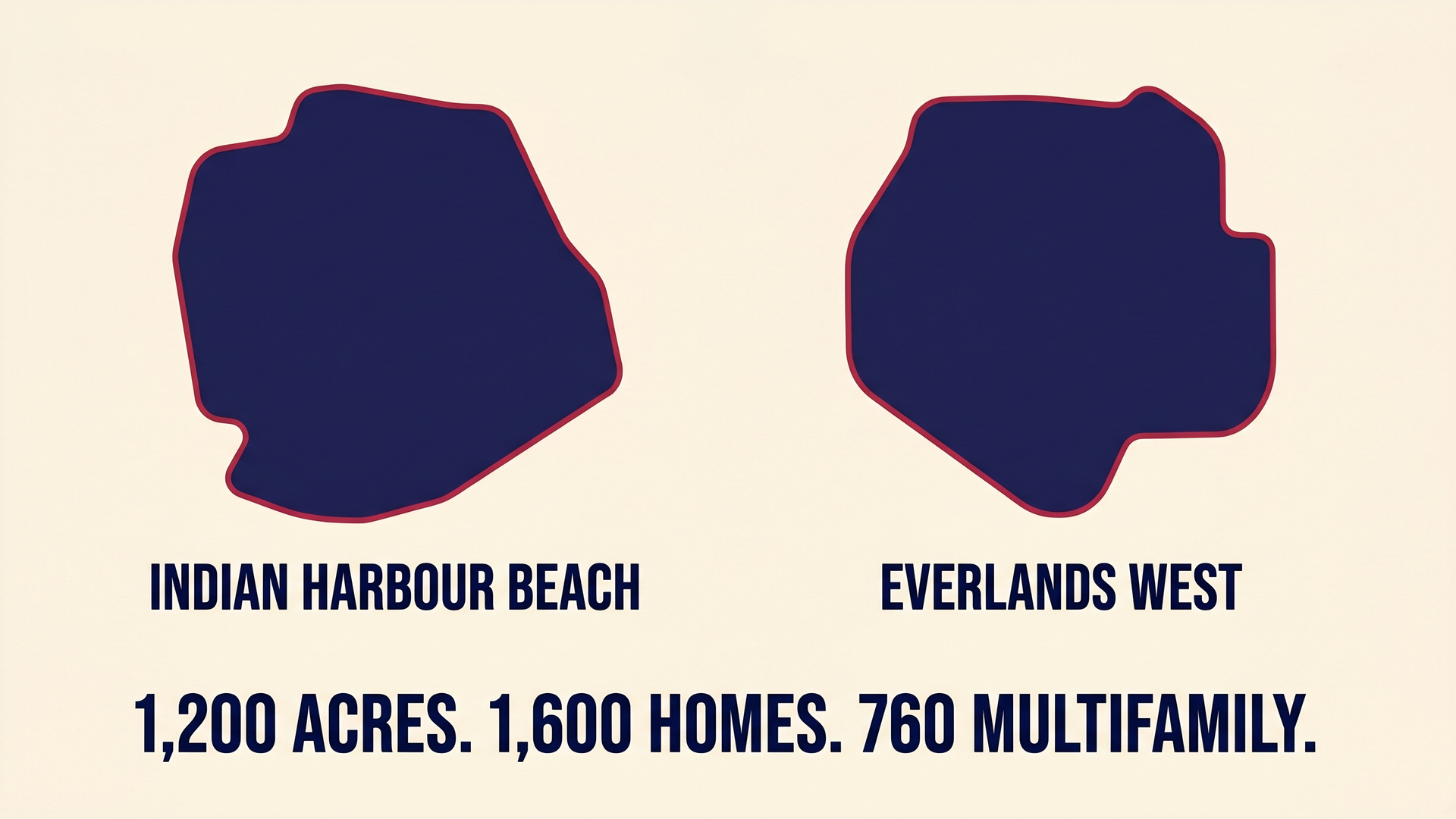
Everlands West, at 1,198 acres, is one of the largest single development applications in Palm Bay history. The project calls for 1,600 single-family homes, plus 760 multifamily units (493 townhomes and 267 apartments and condos), and 145,000 square feet of neighborhood-scale commercial space. For scale comparison, the project footprint is comparable to the entire city of Indian Harbour Beach (1,338 acres). At full buildout in 2037, Milrose and Lennar project $11.5 million in annual tax revenue, including $4 million to the city.
The Planning and Zoning Board approved the project 4-1 on April 1 with conditions on traffic, fire, and police concurrency that have not yet been fully resolved. Spectrum News 13 covered the project ahead of tonight’s meeting. The May 7 hearing will be the first time the full council weighs in.
Closing Items
A variance request from Valerie McFarland of Evergreen Street NE for a screen room replacement passed 5-0 with a refund of the $500 variance fee and a waiver of the building permit fee. McFarland inherited an unpermitted screen enclosure from a prior owner and worked through the permitting process for nearly a year before getting relief. The mayor apologized to her on the record. “Council’s apologies. And thank you for highlighting something that was broken. I really appreciate, unfortunately, you were the one, but you fixed it for so many others today.”
A second variance request from Allison Williams of Toy Street, for an oversized pole barn and shed combination built without a permit, generated extended discussion about retroactive enforcement and accessory structures larger than principal residences. The applicants stated they were unaware permits were required for an open-air pole barn.
The remainder of the consent agenda passed unanimously after items 2 and 3 were pulled. The Emerson Drive sidewalk and lighting safety project, funded by a $2.4 million federal USDOT FHWA grant with a $600,000 city match, was among the items approved without debate.
Council approved the Local Housing Assistance Plan (Resolution 2026-05) in a 4-1 vote, with Langevin the lone dissent. The plan governs SHIP-funded affordable housing programs through 2029. Council also approved Ordinance 2026-12 amending the Coastal Management element of the comprehensive plan to align with the Brevard County Comprehensive Emergency Management Plan, passing unanimously.
Two proclamations preceded the policy debates. Mary Grace West, Director of Community Connections for the Brevard County Foster and Adoptive Parent Association, accepted a proclamation declaring May 2026 National Foster Care Month. West noted Brevard County is at roughly 86 licensed foster homes serving approximately 600 children, the lowest count she has seen during her time as a foster parent. The mayor also recognized seven graduates of Master of Public Administration coursework: Yvonne Cleaver and Brittany Hecken from Finance, Grace Keller from Procurement, Mayte Nilsson from the City Manager’s office, Sean Spillers from Finance, Andrea Varela from Human Resources, and former economic development employee Robert McKenzie.
Doug Hook of the Sustainability Advisory Board addressed council during public comment about the board’s mission and direction. New SAB members were appointed during unfinished business; Kristen Lanzana was among the applicants who spoke directly to council about her interest in serving.
The acting building official addressed council briefly during the Williams variance discussion. The position remains in an acting capacity.
What to Watch
Three threads carry forward from this meeting.
First, the SRWRF emergency. The 45-day clock starts when the surety releases. Cathcart crews are mobilized. If Palm Bay accepts flows by early June, Morton’s gamble pays off and the meter-issuance moratorium does not have to be invoked. If the timeline slips, the question of regulatory consequence becomes immediate. FDEP has not closed the loop on the June 2025 Clearmont spill or the October 2025 capacity exceedance. Whether the agency moves to a successor consent order in light of tonight’s emergency declaration is the most consequential unanswered question on the city’s enforcement file.
Second, the SRO negotiation. Council has tabled the contracts to the second May meeting. Brevard Public Schools and Odyssey Charter now have to come to the table or lose Palm Bay PD coverage by the start of the school year. The legal backstop, BCSO deputies, is real but unappealing to all sides. Johnson is the city’s negotiator.
Third, Centerpointe second reading. Hammer asked for an updated school concurrency report before the second reading. Whether the rest of council backs that request, and whether Brevard Public Schools provides a current report on a timeline that fits, will determine whether the second reading goes forward as scheduled or slips.
The April 16 meeting ran more than four hours. Council demonstrated, again, that the underlying issue in Palm Bay is capacity. Capacity at the wastewater plant. Capacity in the police department. Capacity in the schools. The meeting did not solve any of those problems. It bought time on each one.
This story is also published at news.thepalmbayer.com/news/palm-bay-council-april-16-srwrf-emergency/ with additional inline visuals, related coverage links, and a video embed where available.
Sources
Palm Bay Regular Council Meeting 2026-12 transcript, April 16, 2026 (transcript-audio.com diarization with verified speaker mapping)
Ordinance 2025-44 (Centerpointe Church RS-1 rezoning)
Ordinances 2026-10 and 2026-11 (Everlands West FLUM amendment and PUD, continued to May 7, 2026)
Resolution 2026-05 (Local Housing Assistance Plan FY2026-2029)
Ordinance 2026-12 (Coastal Management element amendment)
FDEP March 2025 consent order coverage, via Florida Today / Yahoo
Original SRWRF construction contract, IFB 39-0-2020, awarded to RJ Sullivan Corporation November 5, 2020
Sunbiz corporate filings for R.J. Sullivan Corp. (Document No. 487712) and Cathcart Construction Company-Florida, LLC
Palm Bayer prior coverage: Palm Bay’s Water Reclamation Facility: Delays, Cost Overruns, and Leadership Challenges (May 19, 2024); Palm Bay City Council Faces Packed Agenda (May 10, 2025); Palm Bay Pivots from Facility Re... (January 23, 2026) -- includes Jaffe’s first published call for RJ Sullivan termination; Unity, Urgency, and a $750 Million Question (February 6, 2026) -- Cathcart Port Malabar piggyback approval
Spectrum News 13 pre-meeting coverage of Everlands West
Florida Statute 166.04151 (Live Local Act, 2025 legislative session amendment)
Florida Statute 403.086 (wastewater treatment compliance schedules)


