


Palm Bay, FL -- The City Council passed three ordinances Thursday night that restructure how Palm Bay’s government is organized, approved a $2,054,397.93 payment to the IRS for excess bond interest earnings, and heard from residents frustrated by unreliable bus service and a three-and-a-half-year property access dispute. The April 2 Regular Council Meeting also brought an update showing the city’s road network has dramatically improved since the GO Roads bond program launched, and a unanimous endorsement of a new business collaboration center coming to City Hall.
All five council members were present: Mayor Rob Medina, Deputy Mayor Mike Jaffe, Councilman Kenny Johnson, Councilman Mike Hammer, and Councilman Chandler Langevin.
City Government Reorganizes: Three Departments Become Three Different Departments
Council gave final approval to three ordinances that reshuffle how the city’s growth management and economic development functions are organized. The changes took effect immediately for administrative purposes, though the housing budget does not officially move until October 1, 2027.
Ordinance 2026-06 adds Parks and Facilities and Procurement as standalone departments and renames the former Community and Economic Development Department. Ordinance 2026-07 expands Growth Management to include a formal Long-Range Planning Section and absorbs the Housing and Community Improvement Division. Growth Management Director Althea Jefferson now oversees housing programs. Ordinance 2026-08 renames the department to Economic Development and strips out the housing functions, leaving it focused on business attraction and incentives.
City Manager Matthew Morton described the package simply: “This is the opportunity to reorganize growth management and community and economic development by creating essentially a stand-alone economic development department.” All three ordinances passed 5-0 with no public opposition and minimal council questions. Morton acknowledged multiple places in city code still need updating and said staff is working through them.
The 18-month lag before the housing budget transfers matters for residents who depend on federal CDBG housing programs. The reorganization on paper is done. The money follows later.
The $2 Million IRS Bill, Explained
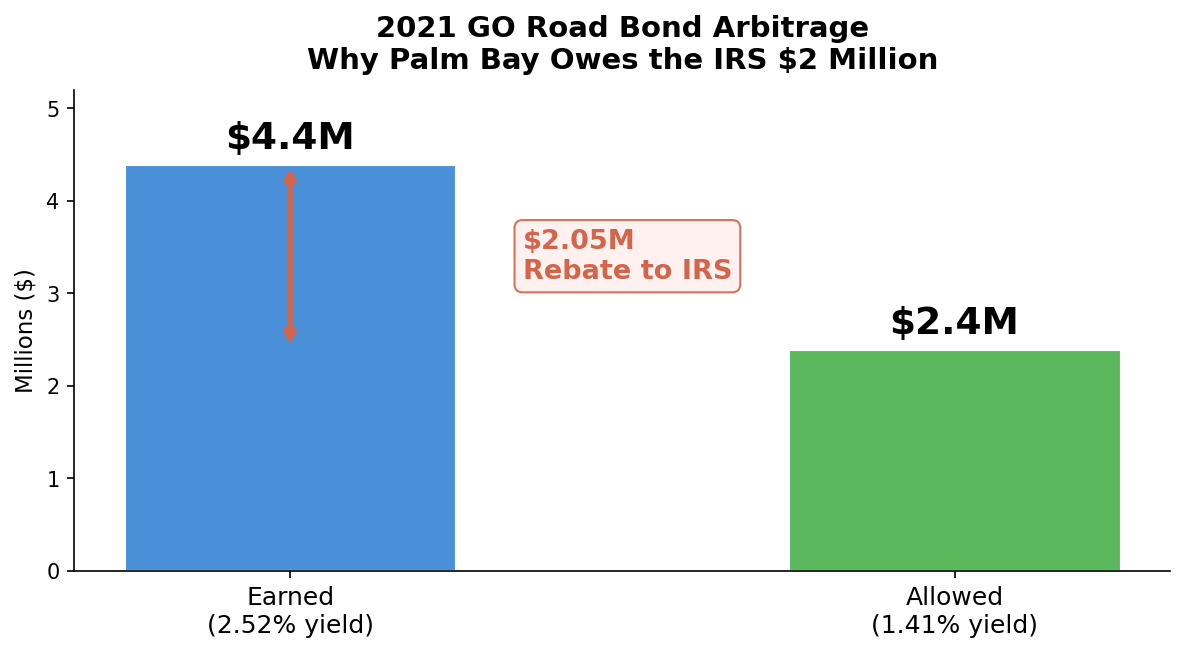
Finance Director Larry Wojciechowski presented what amounts to a bill Palm Bay knew was coming: a $2,054,397.93 arbitrage rebate payment to the Internal Revenue Service, due April 6.
Here is what happened. In 2021, the city sold $50 million in general obligation bonds to fund road paving. At the time, bond interest rates were very low, so the city was allowed to earn only a small yield on the invested proceeds. Federal law exists to prevent municipalities from borrowing cheap tax-exempt money and then parking it in higher-yield investments indefinitely, pocketing the spread. That is called arbitrage, and the IRS caps how much of it a city can keep.
Palm Bay hired the firm PFM to run the five-year analysis required by federal law. The result: the city earned $4.4 million in interest but was only permitted to earn $2.4 million based on the bond yield rate of 1.41 percent. The city exceeded the allowable rate, earning at 2.52 percent by investing aggressively. The difference, roughly $2 million, goes back to the IRS.
Wojciechowski was direct about the trade-off: “I would rather do that than stand up here and say we were negative arbitrage and I didn’t earn enough money.” Morton had already signed the check before the meeting. He told council: “I’m not going to federal prison, first of all.”
There was one way to have avoided the rebate. Under federal spending rules, if the city had spent all $50 million within three years, most of the interest could have been kept. Wojciechowski acknowledged that was not physically possible given the scale of a road paving program. Morton said the city should consider auditing its bond arbitrage annually or biannually rather than waiting for the five-year federal deadline, which would allow faster course corrections. The council did not vote on the payment separately; it was presented as a required expenditure.
Road Paving Report Card: Average PCI Jumped From 68 to 86
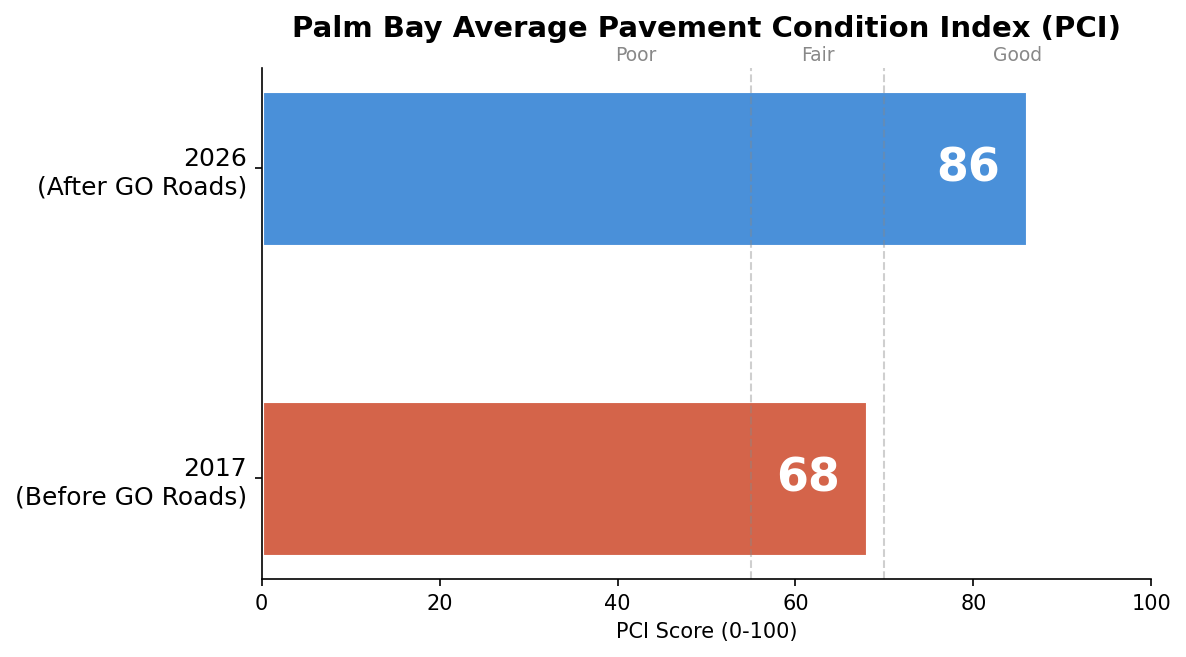
After the arbitrage item, Morton asked Public Works Director Kevin Brinkley to show council the freshest data on road conditions, making the connection explicit: if residents were going to hear the city sent $2 million to the IRS from road bond proceeds, they should also see what those bonds bought.
Brinkley presented results from a new pavement condition index survey completed in early 2026. The city’s new InForm dashboard uses AI-assisted forward and downward-facing cameras to rate every road segment on a scale from 0 to 100. In 2017, Palm Bay’s average PCI was 68. The new survey puts the citywide average at 86.
Only about 14 percent of Palm Bay’s road network now scores at or below 68, the old average. Before the GO Roads bond program, most of the network would have been in that range. The roads still scoring low are concentrated in phases four and five of the program, the phases that had not been completed before the paving pause.
Councilman Hammer pushed staff to verify that recently paved roads are not already failing, which would be a vendor warranty issue. He also proposed milling the roads at the Compound and reusing the asphalt millings for the broader road program. Deputy Mayor Jaffe suggested skipping an outside strategy consultant and going directly to paving contractors with a design-build request for proposals. City Manager Morton said a full road strategy report will go to the Infrastructure Advisory Board and come back to council in fall 2026.
Business Collaboration Center Gets Unanimous Green Light
Morton introduced a concept that drew unanimous support from the dais: a business collaboration hub on the first floor of City Hall, in office space recently vacated by Utilities Director Gabriel Bowden.
The model is not a lease arrangement. Partners including the Small Business Development Center, which Morton noted just won a national award, SCORE (Society of Retired Executives), and local chambers of commerce would maintain a rotating presence without paying rent. The city provides the space, utilities, and the connection point.
Morton framed it around what he called “business collisions,” the idea that putting bankers, investors, entrepreneurs, mentors, and regulatory professionals in the same building generates conversations that would not otherwise happen. “When you get the bankers, the investors, your chambers, your regulatory professionals, your entrepreneurs, your mentors and coaches in the same space, they talk and they start to learn things from each other.”
The goal, Morton said, is to reposition City Hall as more than a place to pay a bill or file a complaint, building on the approach the city took with its Eat to the Beats community events.
Councilman Langevin said he supports it fully and noted the city’s homeschooling community as an additional resource for business and education crossover. Councilman Hammer asked for data on commercial growth since the current council took their seats, so results can be measured against the investment. Councilman Johnson’s one note: get the chamber in there.
Consent Agenda: $55M Bond Transfer, 911 Console Deadline, CDBG Housing Funds
The consent agenda passed 5-0 as a block, but several items are worth noting.
Budget Amendment No. 2 (Ordinance 2026-09, first reading) includes 15 departmental requests. The largest individual item is a $55.22 million transfer of 2023 GO Bond proceeds and accumulated interest into the 2019 GO Road Program Fund. Also in the amendment: $1.69 million in CDBG federal funds for housing programs, $1.8 million for baffle boxes improving water quality on Meadowbrook Road (with an $800,000 city match), a $3.039 million FDOT agreement covering Malabar Road widening, and a $600,000 transfer to establish a new Fleet Replacement Fund.
The 911 console upgrade warrants separate attention. The city approved $115,000 to replace six L3Harris Symphony SDP-1 dispatch consoles with the newer SDP-3 model. The current hardware hits end-of-support on May 31, 2026. The vendor quote, at $104,575.50, expires May 12. Council moved quickly on this one.
Resident Calls Out SCAT Bus Failures; Council Commits to Follow Up
Palm Bay resident Debbie Broccoloni opened public comments with a pointed account of repeated SCAT bus failures. She told council she had spent six months trying to get someone to ride the bus with her to document the problem, received nothing but unanswered calls and emails, and emailed council members a conversation she had with the SCAT director where he admitted to telling buses to wait, which means riders are skipped.
“You are leaving Palm Bay citizens behind,” Broccoloni said. “It’s not about the rich. It’s about our poorest citizens, the people on dialysis, that people, the only way they can get to and from are buses.”
Councilman Johnson told her he had seen her standing on Babcock Road earlier that day waiting for a bus with no shelter. “Council hears you,” he said, and committed to meet with Georgiana Gillette. Johnson used the moment to push for a broader shift in how the city thinks about public transit, framing it as moving people rather than cars.
Councilman Hammer said he had already raised Broccoloni’s situation at the last Transportation Planning Organization meeting and has questions ready for the next one. He also has an MPO meeting in Orlando Friday where he expects to get additional information.
Elliott Street Property Owner Gets Council Direction After 3.5 Years
Palm Bay resident Shane Downing came to council with a paper trail. He purchased property on Elliott Street three and a half years ago with what he says was an explicit written letter from the city allowing him to access the property via an unimproved dirt road without having to build the road himself. Council minutes from December 21, 2021 confirm the city voted to allow property owners to build driveways connecting to existing dirt roads.
Now the city is telling Downing the dirt road is classified as a “trail,” not a road, and demanding he build a $175,000 road before he can get a building permit.
“The city is holding me hostage,” Downing told council.
ACM Jason DeLorenzo explained the city’s “paper road” policy, which distinguishes between platted rights-of-way and improved roads. Deputy Mayor Jaffe noted Downing’s building orientation may also require a variance. Council gave staff direction to find a resolution.
Jaffe Proposes Palm Bay Land Trust for Conservation Parcels
Deputy Mayor Jaffe proposed creating a municipal land trust to permanently preserve surplus city real estate that has no viable development use. Under his concept, parcels identified through the city’s ongoing surplus property broker process that lack highest-and-best-use value would be transferred to the trust and designated for conservation in perpetuity, with no future building allowed.
The trust would also cover Compound land for stormwater retention, parks, and trails. A second piece Jaffe called a potential incentive: developers could purchase credits in the trust to offset their open space requirements under the city’s Land Development Code. He described it as a DOGE-style efficiency effort, converting underutilized land into a managed conservation asset rather than letting it sit.
Council gave consensus to explore the concept. No formal ordinance or timeline was set.
Daytime Meetings Proposed, No Consensus Reached
Jaffe also proposed switching some council meetings to daytime hours, pointing to the County Commission and School Board as models. His stated rationale was reducing staff overtime from late-night sessions.
The idea did not generate enough support to move forward. Councilman Hammer said the feedback would be negative: “A lot of people want to attend after work.” Mayor Medina recalled the pushback Palm Bay received years ago when meetings moved from 7:00 p.m. to 6:00 p.m. Councilman Langevin said he could support one daytime meeting per month. No consensus was reached. Jaffe said he would bring it back for public input.
Other Council Business
Budget workshops scheduled. The FY27 budget workshop calendar: May 13, 2026 (Wednesday) for department budget requests, July 7 (Tuesday) for mid-year review, and August 4 (Tuesday) for an optional final review. All at 6:00 p.m. The original May 12 date was moved one day because Mayor Medina teaches a homiletics class on Tuesday evenings in May.
P-Card program renewed with JPMorgan Chase. Council approved renewing the city’s purchasing card program with JPMorgan, which already serves as the city’s bank. The current Bank of America contract expires July 4. Wojciechowski said the new program provides real-time transaction visibility, receipt uploads that auto-attach to reconciliation, and auditor read-only access. The rebate rate offered by JPMorgan (1.5 to 2.05 percent) is substantially better than Bank of America’s (1.1 to 1.71 percent). Passed 5-0.
Roundabouts and signal timing. Councilman Johnson asked for staff to explore both intelligent traffic signal timing and roundabout feasibility at key intersections, citing Viera as a successful model. Jaffe said public input would be needed before any roundabout decisions. Hammer said roundabouts are statistically safer, roughly 80 percent fewer severe crashes than signalized intersections, but acknowledged he personally dislikes them. Consensus reached on signal timing study. Roundabouts tabled pending public input.
IET travel and cybersecurity legislation. IT Director Rob Beach reported that a local government cybersecurity bill he had championed through the Florida Legislature passed both chambers unanimously. The legislation, run by Rep. Miller and Sen. Gail Harrell as companion bills, authorizes $30 million in the first year to protect 193 local governments statewide, with a retail value of $300 million in deployed capabilities. Council approved a travel request for a Tampa conference April 9-11 and discussed potentially sending Mayor Medina as a city representative.
Proclamations. The meeting opened with two proclamations. Mayor Medina, a Marine Corps veteran, delivered the Month of the Military Child proclamation for April 2026 with visible emotion. AVET Project Inc., an all-volunteer 501c3 serving military families in Brevard, was represented by Mr. Garrick, who noted the 920th Rescue Wing recently held a family day at Patrick Space Force Base ahead of a forward deployment. The Utilities Department’s Celia Killen then recognized Drop Savers poster contest winners for Water Conservation Month: Mia H. (Riviera Elementary), Miley G. (Odyssey Charter), Anthony D. (Riviera Elementary), and Camila O. (homeschooled).
E-bikes and dirt bikes. Robert Stice told council police cannot chase e-bikes and proposed the department consider Honda 190 or 195 dirt bikes, as used in Jersey City and Colorado. He also raised traffic concerns about a new 450-home development near Bayside Lakes, estimating it adds 900-plus new residents to an area with documented road hazards. Regular commenter Bill Battin recalled that Bombardier once donated ATVs to the city for a similar off-road enforcement need, adding with characteristic dry humor that it was “pretty hard to catch them on the ATVs when you’re leading the pack.”
Powell community concerns. Mr. McClary raised three issues from the Powell neighborhood: illegal dumping at the Florida Avenue roundabout (requesting no-dumping signs), the status of an abandoned house slated for demolition at Florida Avenue and Northview Street, and an apparently unpermitted restaurant operating at 2295 Washington Street. Morton said staff would follow up on all three.
Police Chief Change of Command. Multiple speakers and council members referenced the Change of Command ceremony held earlier that day, in which Jeff Spears was sworn in as Police Chief, succeeding the retiring Mario Augello. The Palm Bayer covered Augello’s retirement separately. Councilman Hammer noted Spears is a Palm Bay native who started as a Police Explorer at age 15. Mayor Medina added that ten of Spears’ elementary school teachers attended the ceremony.
Sources
City of Palm Bay Regular Council Meeting 2026-11, April 2, 2026 (meeting transcript)
City of Palm Bay Budget Amendment No. 2, FY26 (Ordinance 2026-09, Exhibit A)
Ordinances 2026-06, 2026-07, 2026-08 (City Departments reorganization, final readings)
PFM arbitrage analysis, 2021 GO Road Bond series


