


PALM BAY, FL (The Palm Bayer) — North Brevard is building the factories. South Brevard is building the bedrooms. This geographic reality defines the current economic state of Brevard County and dictates the trajectory of the Palm Bay housing market 2026. While headlines celebrate a historic industrial renaissance at the Kennedy Space Center and surrounding aerospace parks, the fiscal burden of housing the workforce powering that renaissance falls disproportionately on municipalities located 50 miles away.
Palm Bay stands at the center of this structural imbalance. The city continues to approve sprawling residential subdivisions to accommodate the influx of new aerospace and defense workers. However, the commercial and industrial facilities generating the high-wage jobs and substantial commercial tax revenues are largely located in Titusville, Cape Canaveral, and Melbourne. This creates a challenging long-term equation for Palm Bay property owners.
The Core Thesis and Regional Economic Mismatch
The contrast between North Brevard’s commercial aerospace capital boom and Palm Bay’s residential bedroom community expansion reveals a fundamental economic misalignment. Municipalities rely on a balanced tax base to fund infrastructure, schools, police, and fire services. Commercial and industrial properties generate significant tax revenue while demanding relatively few city services. Residential properties, conversely, demand high levels of continuous city services while generating comparatively modest property tax revenues.
Building tens of thousands of bedrooms without an equivalent expansion in the commercial tax base creates a pathway toward long-term municipal insolvency. Palm Bay is absorbing the infrastructural wear and tear of a massive population expansion without reaping the high-margin corporate tax benefits of the Space Coast aerospace expansion housing the workers. The city functions as an extraction zone. Workers sleep in Palm Bay, consume local municipal resources, and export their labor and their employers’ commercial property taxes to neighboring jurisdictions.
Understanding this dynamic is essential for interpreting the current data in the Palm Bay real estate sector. The housing market is not simply reacting to supply and demand. It is reacting to a regional economic structure that forces South Brevard to subsidize North Brevard’s industrial growth through residential property taxes and extreme commute times.
The North Brevard Industrial Expansion
The sheer scale of industrial development in North Brevard clarifies why the local workforce is expanding so rapidly. Relativity Space recently announced “Project Forge,” a $350 million capital investment at the Space Coast Regional Airport (TIX) in Titusville. Supported by up to $134 million in Florida Department of Transportation Spaceport Improvement Program grants, this facility will manufacture the Terran R reusable medium-to-heavy lift rocket. The project cements a NASA 2028 Aeolus Mars partnership and secures a massive development timeline through 2034.
This is not an isolated project. SpaceX is constructing a 380-foot Starship Gigabay at its Roberts Road campus inside the Kennedy Space Center, scheduled for full operation in late 2026. Blue Origin continues its aggressive New Glenn expansion at Exploration Park and Launch Complex 36. Lockheed Martin has established a 225,000-square-foot Trident II D5LE2 plant at the Titusville Enterprise Park. Further south, Extant Aerospace in Melbourne is executing a $75 million, 376,000-square-foot expansion.
These facilities bring specific, high-paying North Brevard rocket jobs. The wage tiers dictate what these workers can afford and where they choose to live. Aerospace engineers command salaries ranging from $95,000 to over $125,000. Non-Destructive Evaluation Specialists earn between $85,700 and $128,500. Instrumentation and Control Technicians make $64,900 to $97,300. Certified TIG Welders and CNC Machinists pull in $59,300 to $91,500. Launch and Pad Operations Technicians earn hourly rates of $30 to $45.
These income levels support home purchases in the $300,000 to $500,000 range. The immediate question for the region is where these thousands of specialized technicians and engineers will buy their homes.
Space Coast and Palm Bay Real Estate Diagnostics Q3 2026
The Q3 2026 data reveals a market in transition. Brevard County as a whole presents a single-family home median sales price of $380,000. This figure remains flat year-over-year. Active resale inventory stands at 2,937 single-family homes, representing a sharp 23.7 percent decline year-over-year. The county operates with a 3.5-month supply of inventory. Closed sales average 943 per month, up 4.1 percent. Cash sales account for over 32 percent of all transactions, a 19.6 percent year-over-year increase indicating strong investor and high-equity buyer presence. Countywide days on market hover between 50 and 57 days.
Palm Bay specifics tell a slightly different story. The median single-family home price in Palm Bay ranges from $315,000 to $335,000 depending on the quadrant. Homes here sit longer, with days on market stretching to 68 to 72 days. The months supply of inventory is higher at 4.2 months. The sale-to-list ratio remains respectable at 97.5 percent, but sellers are feeling the pressure. Between 28 and 34 percent of all active listings in Palm Bay have undergone price reductions. For further historical context on these pricing trends, review our previous analysis on the Palm Bay housing market 2026.
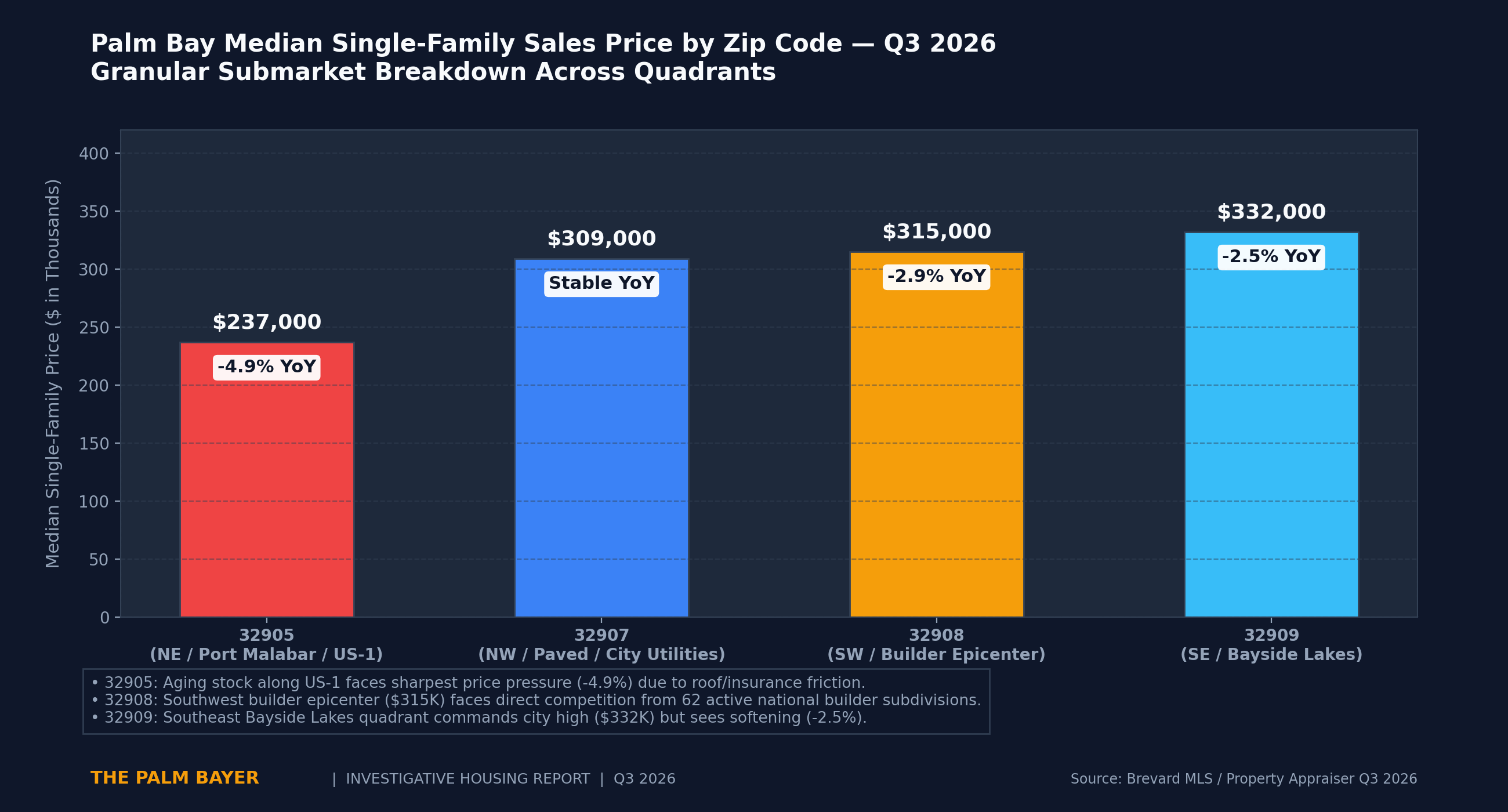
A granular zip code analysis illustrates the deep internal divisions within the Palm Bay city limits:
In 32905, covering Northeast Palm Bay, Port Malabar, and the older housing stock along the US-1 corridor, median prices have dropped to approximately $237,000. This represents a 4.9 percent year-over-year decline. The housing stock here is aging, often requiring significant roof and plumbing updates that deter first-time buyers constrained by tight insurance requirements.
In 32907, encompassing the Northwest quadrant with established paved roads and reliable city utilities, prices stabilize between $303,000 and $315,000. This area attracts buyers seeking predictable infrastructure without the premium of new construction.
In 32908, the Southwest builder epicenter, the median price sits at $315,000, down 2.9 percent year-over-year. This quadrant is defined by heavy new construction volume, which actively suppresses resale values as builders offer aggressive incentives.
In 32909, the Southeast sector anchored by Bayside Lakes and larger lot sizes, median prices reach $332,000. This represents a 2.5 percent decline year-over-year, reflecting broader affordability caps despite the localized desirability of the neighborhoods.
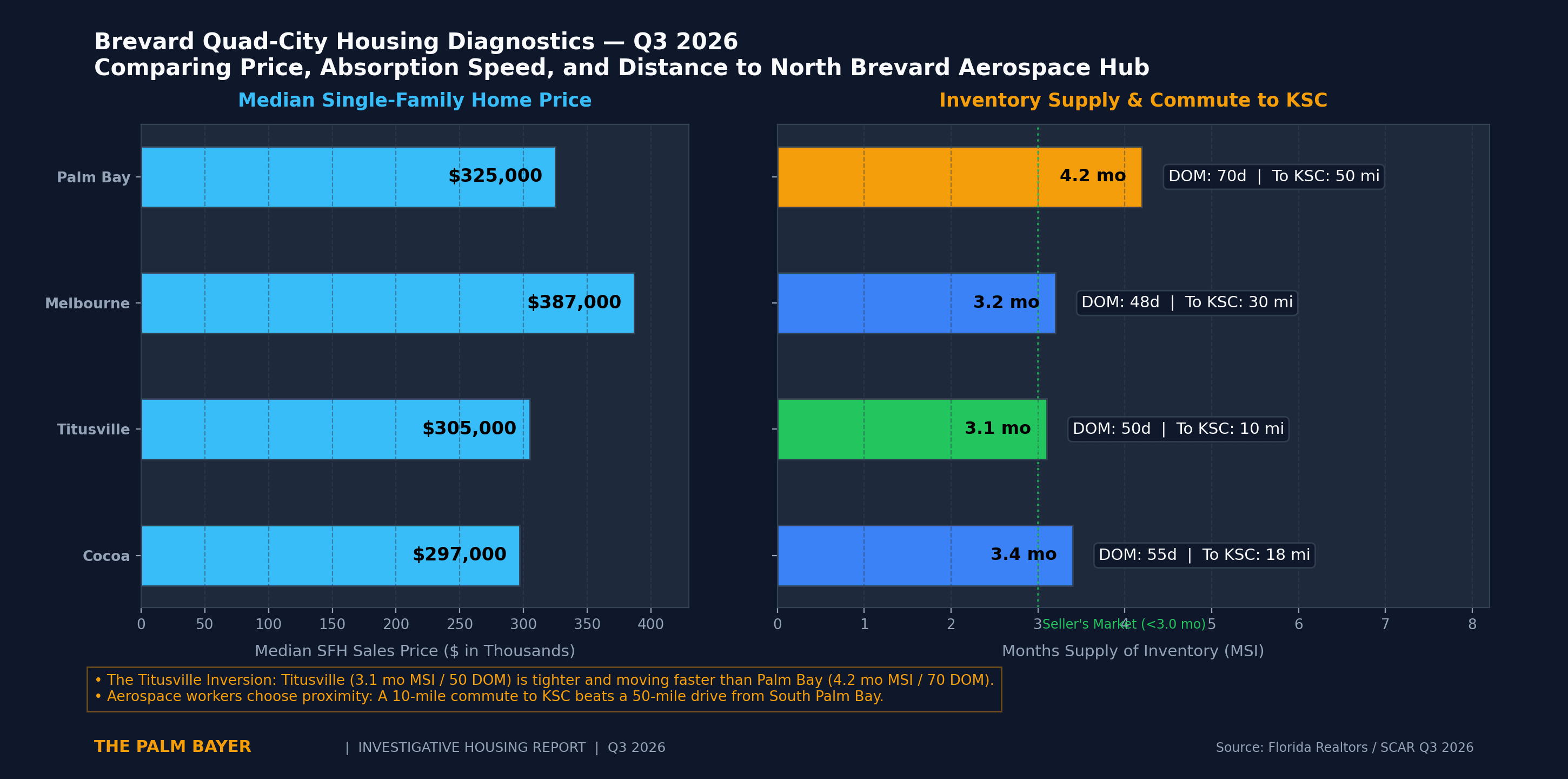
Comparing the regional quad-city breakdown highlights Palm Bay’s distinct market position. Palm Bay sits at a $325,000 median with 4.2 months of inventory, 70 days on market, and a grueling 50-mile commute to the Kennedy Space Center. Melbourne commands a $387,000 median with a tighter 3.2 months of inventory, 48 days on market, and a 30-mile commute. Titusville offers a $305,000 median with 3.1 months of inventory, 50 days on market, and a brief 10-mile commute. Cocoa presents a $297,000 median with 3.4 months of inventory, 55 days on market, and an 18-mile commute.
The Titusville Inversion: North Brevard Tightens Faster Than South Brevard
The historical real estate dynamic in Brevard County has completely flipped. For the decade following the retirement of the Space Shuttle program, Palm Bay absorbed virtually all residential growth. North Brevard languished in an economic depression marked by high vacancy rates and stagnant property values. That era is over. The Titusville inversion is now the defining characteristic of the Space Coast housing market.
Aerospace workers are doing the math and choosing North Brevard. Titusville boasts a 3.1-month supply of inventory compared to Palm Bay’s 4.2 months. Homes in Titusville sell in 50 days, while Palm Bay homes sit for 70 days. Titusville sellers achieve a 98.8 percent sale-to-list ratio. The influx of capital to the Space Coast Regional Airport and Exploration Park has transformed Titusville from a forgotten shuttle-era relic into the most fiercely competitive housing submarket in the county. Workers earning $90,000 a year are no longer willing to trade two hours of their day in traffic for a slightly newer house in South Brevard. They are buying the older inventory in Titusville and Cocoa, driving up prices and tightening supply at a rate Palm Bay cannot match.
The Commuter Math and the 100-Mile Daily Grind
The physical geometry of the Brevard County commute enforces strict limits on worker behavior. Traveling from Palm Bay (accessed via Interstate 95 Exits 166 through 176) to the Kennedy Space Center and Titusville industrial zones (accessed via Exit 215 and State Road 407) requires a 44 to 54-mile one-way trip.
During shift-change congestion, which peaks heavily between 6:00 a.m. and 7:30 a.m. in the morning and 3:30 p.m. to 5:30 p.m. in the afternoon, this drive takes 55 to 80 minutes each way. A worker living in Palm Bay and working in North Brevard commits to 1.8 to 2.5 hours of daily driving.
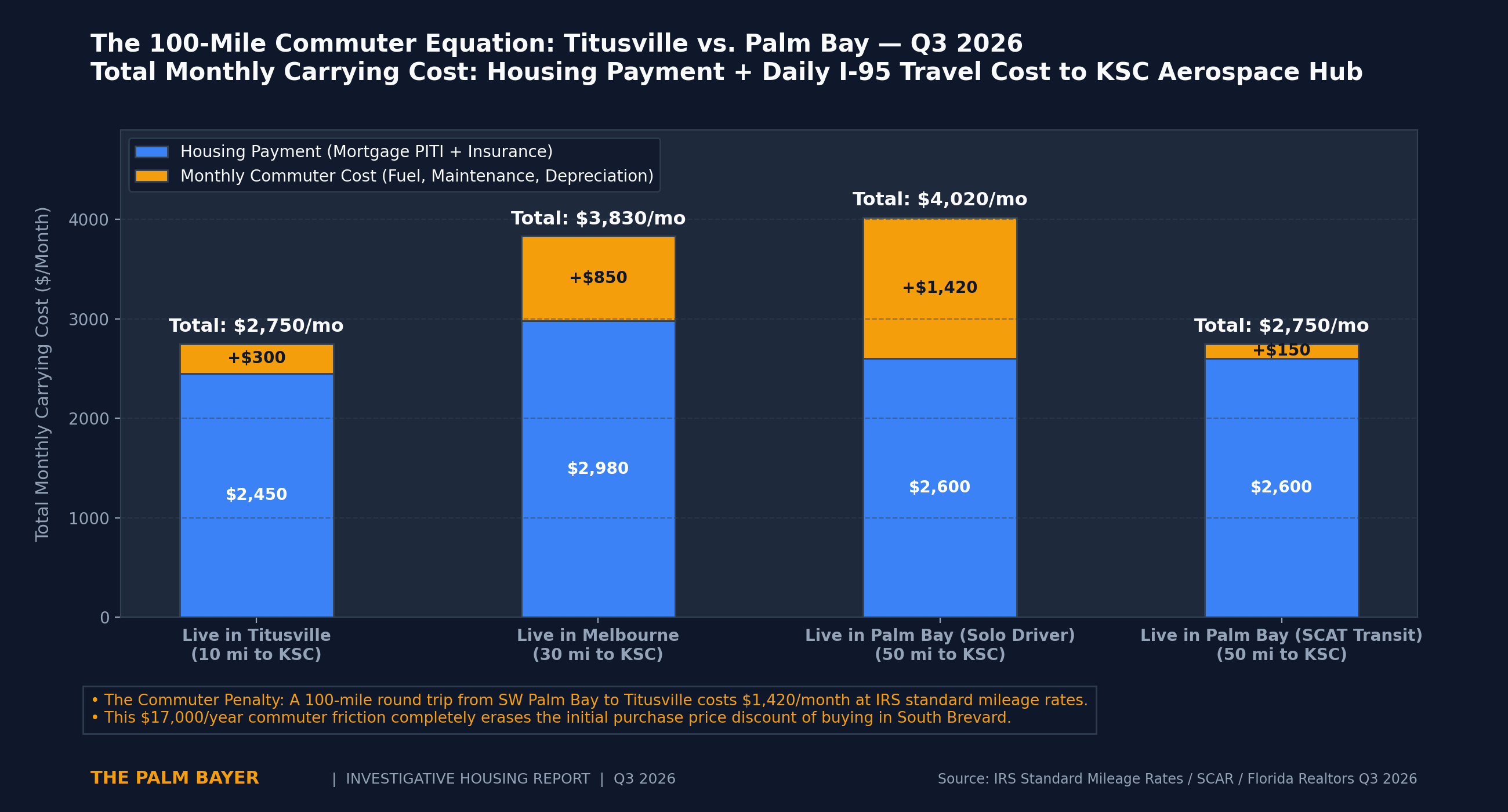
The economic calculation of this commute is brutal. Using the IRS standard mileage rate of 67 cents per mile, a 100-mile daily round trip costs $67 per day. Over a standard work month, this equates to $1,340 to $1,500 in direct and indirect vehicle costs, encompassing depreciation, fuel, tires, and routine maintenance. Annually, this constitutes a $16,000 to $18,000 commute penalty.
When buyers run these numbers, the financial logic of buying in South Brevard collapses. The commute penalty completely erases the purchase price difference between a $325,000 home in Palm Bay and a $305,000 home in Titusville. Buyers who secure lower purchase prices in Palm Bay end up paying the difference to the highway in the form of automotive depreciation and lost time.
To understand how these geographic realities impacted earlier market cycles, see our coverage of the palm-bay-housing-market-2024-key metrics.
For those attempting to mitigate these costs, the Space Coast Area Transit park-and-ride service provides route connectivity from South Brevard to North Brevard. This transit option remains a heavily underutilized alternative, though rising vehicle operating costs may force wider adoption among entry-level technicians. Meanwhile, the Florida Department of Transportation is executing multiple road projects to handle the volume. This includes a $29.8 million northern resurfacing project from State Road 50 to State Road 46, a $63.3 million central and southern corridor project from Malabar Road to Fiske Boulevard, and the ongoing widening of the St. Johns Heritage Parkway. These projects will maintain traffic flow but cannot shrink the physical distance.
The Builder Invasion and Resale Homeowner Competition
Dozens of active new construction subdivisions span across Palm Bay. This staggering volume of new inventory places immense downward pressure on the resale market. National homebuilders like Lennar (developing Everlands and Tillman Lakes), D.R. Horton (developing Cypress Bay West), and KB Home operate with economies of scale that individual homeowners cannot match.
These builders compete directly with existing homeowners by deploying sophisticated financial incentives. The primary weapon is the mortgage rate buydown. While the standard market rate hovers around 6.75 percent, national builders leverage their in-house financing arms to offer rates as low as 5.5 percent. They pair these below-market rates with comprehensive warranties and massive closing cost incentives.
This dynamic explains why a 15-year-old resale home needing a new roof sits on the market for 72 days while new construction units move steadily. A buyer analyzing the monthly payment on a $315,000 resale home at 6.75 percent interest quickly realizes that a newly built $335,000 home at 5.5 percent interest yields a lower monthly payment, zero immediate maintenance anxiety, and brand-new appliances. Existing homeowners in Palm Bay must accept that they are competing against multi-billion dollar corporations willing to buy down interest rates to clear inventory.
The Development Pipeline: A 10-to-1 Fiscal Imbalance
The structural problem for Palm Bay lies in the extreme imbalance of its development pipeline. The city is currently tracking over 13,500 planned residential units across 4,900 acres. The projects are massive in scale. Ashton Park is slated for 4,500 to 5,000 units. SunTerra Lakes plans 3,200 units. Everlands West proposes 2,300 units, with 1,200 already active in the original Everlands footprint. Cypress Bay West has 600 active units. Specialized developments like The Havens offer 218 build-to-rent casitas, while The Tides brings 318 luxury units. Total active construction sits near 1,800 units, with over 10,300 in the permitting phase.
The commercial pipeline fails to match this residential explosion. The city has less than 250,000 square feet of commercial space in active vertical construction. The primary projects include a 50,000-square-foot Publix at the Shops at Cypress Bay and a 120,000-square-foot industrial facility on Robert J. Conlan Boulevard. While the Ashton Park and SunTerra mega-developments promise roughly 2.5 million square feet of future commercial phases, those plans are speculative and years away from moving dirt.
This creates a 10-to-1 ratio of residential to commercial development.
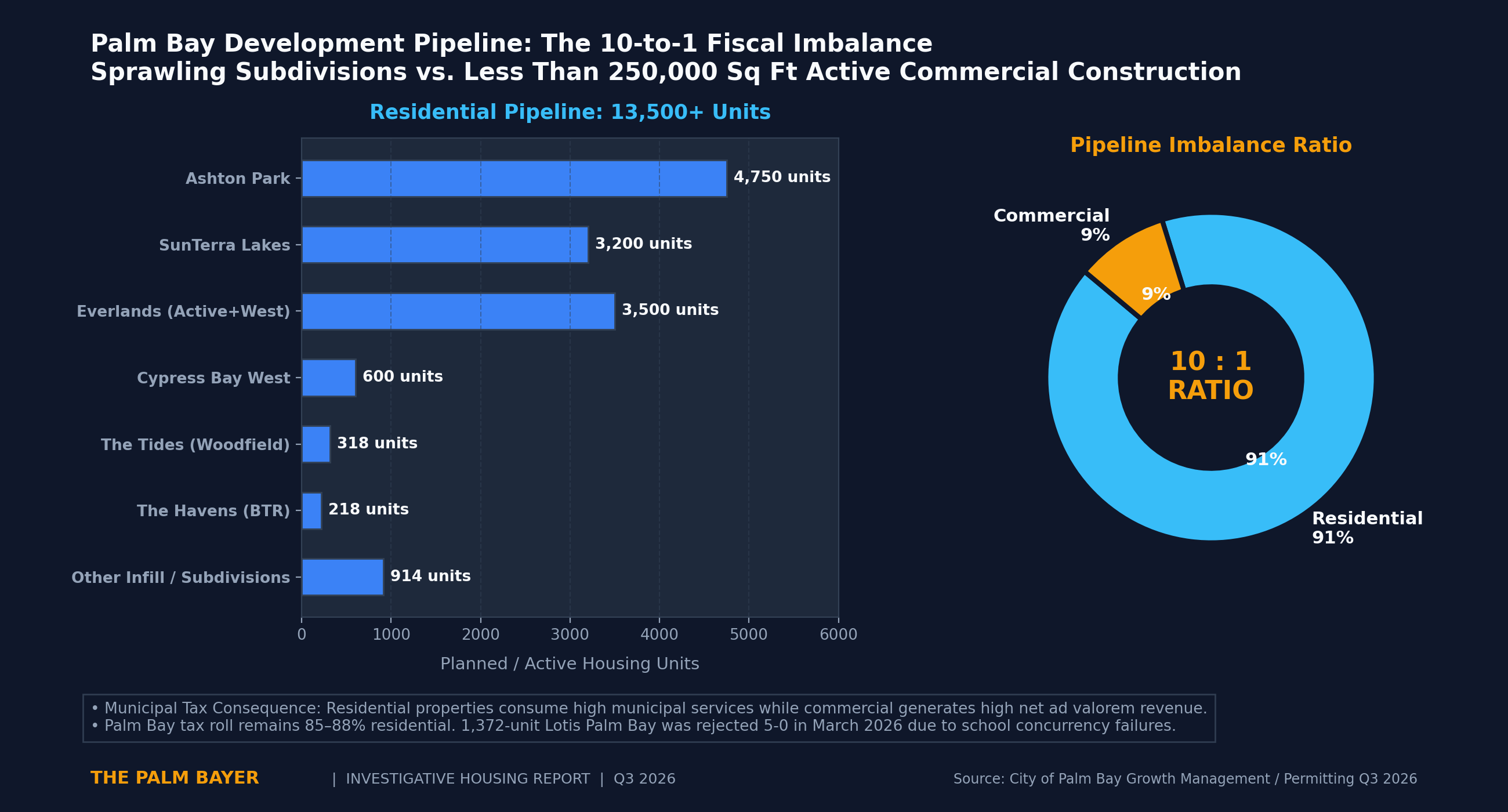
This imbalance ensures that Palm Bay’s residential tax burden will remain trapped between 85 and 88 percent of the city’s total revenue. The city council is beginning to recognize the danger of this trajectory. In March 2026, the council voted 5-0 to reject the Lotis Palm Bay project, which would have added 1,372 units. The rejection centered on school concurrency failures and inadequate infrastructure. The city cannot afford to build roads and utilities for thousands of new homes without the commercial tax base to fund long-term maintenance.
The Bedroom Community Tax Trap and Municipal Policy
Ad valorem tax mechanics are unforgiving. Residential property demands expensive, continuous municipal services. Every new subdivision requires fire protection, police patrols, road repaving, stormwater management, and parks. Yet, an acre of residential housing generates a relatively low tax yield. Commercial property, by contrast, generates high tax revenue per acre while demanding minimal municipal services.
Palm Bay recently lowered its millage rate from 6.7 to 6.6 mills. However, keeping the city budget balanced while lowering the rate depends entirely on expanding the tax base. Without commercial land development, the city must continuously approve new residential subdivisions to generate the impact fees and new property taxes required to pay for the services demanded by the previous wave of residents. It is a municipal treadmill.
To protect its existing revenue streams, the Palm Bay City Council passed Resolution 2024-46 on September 5, 2024, in a unanimous 5-0 vote. This resolution officially opted the city out of the Live Local Act (Senate Bill 102) missing middle tax exemptions. The council took this action to protect local zoning control and preserve vital ad valorem revenue that would have been lost to developers claiming affordable housing tax breaks.
The city is actively attempting to attract commercial players through Economic Development Ad Valorem Tax Exemptions (EDATE). Recent successes include Rogue Valley Microdevices, which leveraged a $25 million CHIPS Act grant to build a 50,000-square-foot MEMS foundry, and continued expansions by L3Harris. These are steps in the right direction, but the scale of commercial growth required to offset the residential pipeline is immense.
The Rental Market and the Affordability Wall
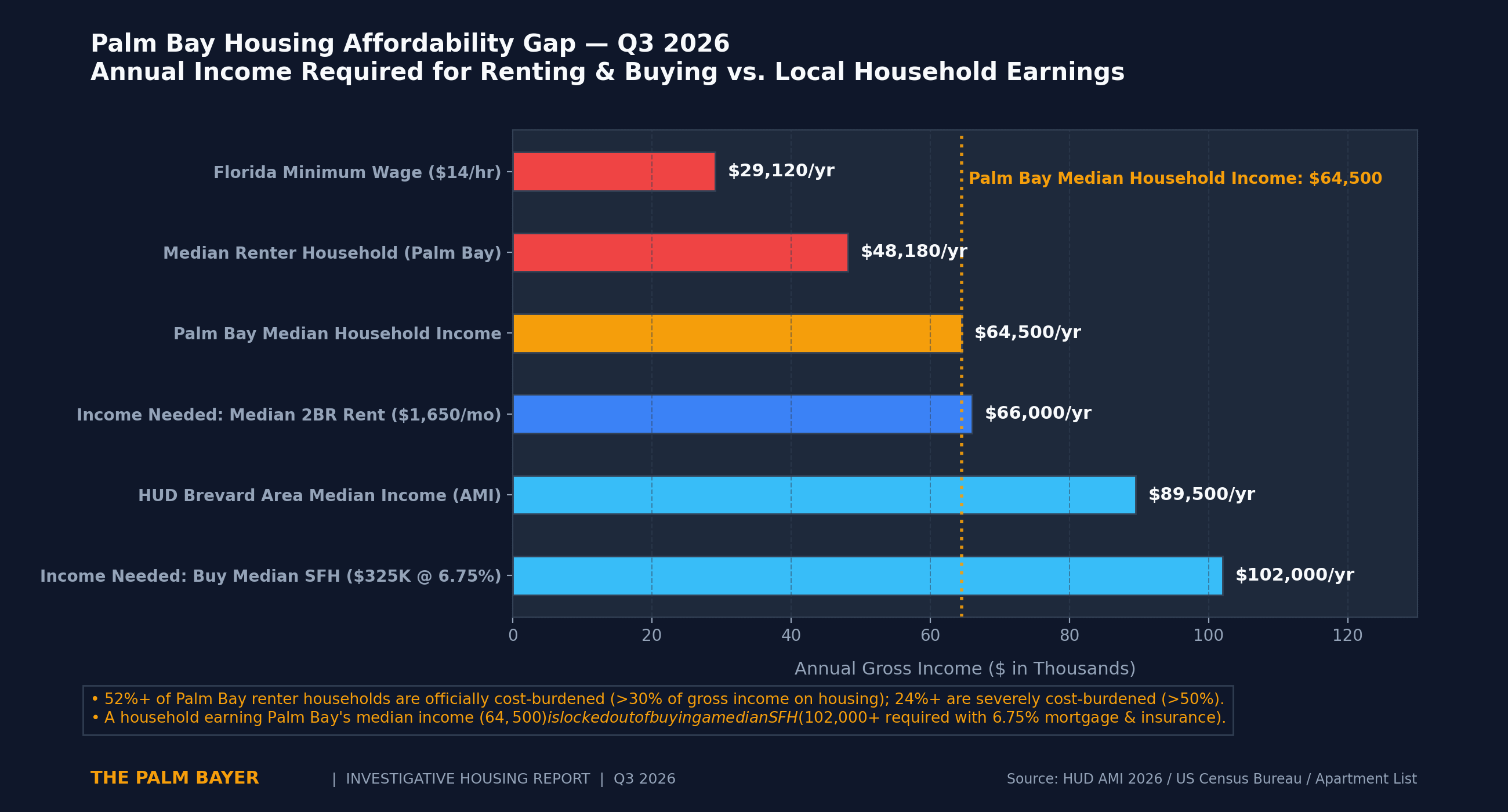
The Palm Bay rental market has hit a hard affordability wall. Average rents sit at $1,586 according to RentCafe, with Apartment List calculating a median of $1,439. Breaking down the inventory reveals studio apartments commanding $1,100 to $1,250. One-bedroom units cost $1,420. Two-bedroom units average $1,650. Three-bedroom units require $1,975. Single-family home rentals, which comprise a staggering 84.5 percent of the local rental stock, range from $1,995 to $2,250 per month.
The income math does not support these prices. The HUD 2026 Area Median Income for a four-person family in Brevard County is $89,500. However, the median household income specific to Palm Bay is only $64,500. Applying the standard 30 percent housing cost rule to a median two-bedroom apartment at $1,650 per month requires a household income of $66,000 annually, or $31.73 per hour.
The result is severe economic distress for tenants. Over 52 percent of renter households in Palm Bay are cost-burdened. More than 24 percent are severely cost-burdened, spending more than 50 percent of their gross income on rent and utilities. The local safety net provides no relief. The Section 8 voucher waitlist has been closed since 2020 and carries a multi-year backlog. Recent affordable projects like Space Coast Commons added a meager 31 units to the market. A worker earning the Florida minimum wage of $14 per hour grosses $29,120 annually. That income cannot afford any market-rate unit in Palm Bay without severe cohabitation density.
For deep metrics on the low-income housing shortfall, refer to our detailed report on palm-bays-affordable-housing-crunch.
Hidden Friction Points: Insurance, SB 4-D, Utilities, and School Concurrency
Beyond the headline prices, buyers in Palm Bay face four hidden friction points that execute quiet destruction on household budgets.
Property insurance remains volatile. Post-2010 constructed homes average $3,400 to $4,900 annually in premiums. Pre-2002 homes, built before the adoption of modern Florida building codes, average $5,500 to $7,000 annually. Hurricane deductibles, typically set at 2 percent to 5 percent of the dwelling coverage, mandate that a homeowner with a $380,000 house must absorb $7,600 to $19,000 in out-of-pocket costs before the policy activates after a storm.
The condo market is undergoing a localized crisis driven by Senate Bill 4-D and the Structural Integrity Reserve Study (SIRS) mandates. Effective January 1, 2026, condo associations must fully fund their reserves for structural components. This mandate is driving HOA dues up by 40 to 120 percent across the region. Special assessments ranging from $15,000 to $65,000 per unit are freezing condo resales. Buyers who traditionally targeted entry-level condos are being forced into the single-family home market, increasing competition at the lowest price tiers.
School concurrency is acting as a hard brake on development. Schools in Southwest Palm Bay, including Southwest Middle, Sunrise Elementary, and Westside Elementary, are operating at 95 to 108 percent of capacity. School Concurrency Application for Development Approval (SCADL) requirements are blocking new subdivisions from moving forward. Meanwhile, North Brevard schools remain comfortably under capacity, further incentivizing developers to shift their focus northward.
Utility expansion in the Compound and deep Southwest Palm Bay faces massive capital hurdles. Under City of Palm Bay Utilities Department regulations, developers must fund 100 percent of water loops, gravity sewer extensions, and lift stations, alongside capital charges of $8,000 to $12,500 per Residential Equivalent Unit (REU). The physical distance from the city’s South Regional Water Reclamation Facility and the Troutman Wastewater Treatment Plant creates severe cost barriers for extending transmission mains into unimproved sectors.
Strategic Action Directives for Market Participants
The Q3 2026 housing environment in Palm Bay requires calculated, disciplined decision-making.
Homebuyers: Do not purchase a resale home built before 2004 without verifying the age of the roof, HVAC, and plumbing. The insurance premiums will destroy your monthly debt-to-income ratio. If you work north of State Road 520, carefully calculate the IRS standard mileage rate against your commute distance. The $1,500 monthly automotive cost of driving from South Palm Bay to Titusville eliminates any savings achieved by purchasing in the 32908 zip code. Evaluate builder rate buydowns meticulously. A 5.5 percent builder rate on a new build often provides better long-term financial stability than a slightly cheaper resale home at 6.75 percent.
Existing Homeowners and Sellers: Understand that you are competing against national homebuilders with deep financial reserves. You cannot beat them on interest rates or closing cost incentives. You must beat them on condition and price. If your home requires a new roof within the next three years, replace it before listing or discount the property aggressively. Buyers are strictly constrained by insurance underwriting rules and cannot secure mortgages on homes with aging critical systems. Expect your property to sit on the market for at least 70 days. Price correctly on day one to avoid falling into the 30 percent of sellers forced into panicked price reductions.
Renters: The math for single-family rentals is currently capped by local wage limits. Property managers cannot aggressively raise rents because the tenant pool simply does not have the income to support it. If you are facing a lease renewal with an increase exceeding 5 percent, negotiate firmly. Landlords are aware that replacing a tenant costs between one and two months of lost rent, plus turnover repairs. Use the high volume of new build-to-rent inventory entering the market as leverage in your renewal discussions.
Real Estate Investors: Avoid the condo market completely until the SB 4-D special assessments are fully capitalized and reflected in the stabilized HOA fees. Direct capital toward the 32907 zip code, where infrastructure is established, or target properties in North Brevard where the inventory remains tight and aerospace wage growth provides a floor for future appreciation. In Palm Bay, focus exclusively on properties that do not compete directly with the massive influx of new construction in the Southwest quadrant.
See published article cross-reference note below for source materials and external data verification.
Sources
Space Coast Association of Realtors — Monthly Market Reports
Florida Department of Transportation — Spaceport Improvement Program
Florida Department of Transportation — Central Florida Road Projects
City of Palm Bay Growth Management Department — Permitting & Development Pipeline
City of Palm Bay City Council — Meeting Agendas & Minutes (Resolution 2024-46)
U.S. Department of Housing and Urban Development (HUD) — 2026 Area Median Income Guidelines
The Florida Senate — Senate Bill 4-D (Building Safety & Structural Integrity Reserve Studies)
Space Coast Area Transit (SCAT) — Routes & Park-and-Ride Services
Florida Office of Insurance Regulation — Property Insurance Market Metrics


