


Palm Bay, FL -- A Vero Beach ranch company has filed an environmental permit application to build roughly one mile of the St. Johns Heritage Parkway through its 1,346-acre property in southwest Brevard County. The move is the first concrete public step toward a 2,000-plus-home development on land that sits outside Palm Bay’s city limits but remains legally entitled to Palm Bay water and sewer service.
The permit application was filed with the St. Johns River Water Management District around December 28, 2025. The Palm Bayer has reconstructed the full public record: who owns the land, how it left Palm Bay, who made that happen, and what those people were doing at the time they made it happen.
The Land and the Owner
Rolling Meadow Ranch, Inc. is a Florida corporation incorporated in May 1973, with its registered office at 3060 Airport West Drive, Vero Beach. The company has been continuously active for more than 50 years.
Andrew R. Machata, 88, of Vero Beach serves as president, treasurer, and registered agent. His wife, Adele Bucci Machata, is secretary. Matthew J. Machata is vice president. All three officers share the Vero Beach address.
Machata is a substantial landowner with a record in large-scale real estate transactions. Around 2002, he sold a ranch near Lake Kissimmee to a state conservation program for approximately $38 million, then used the proceeds in a tax-deferred 1031 exchange to acquire a 7,110-acre ranch in Humboldt County, California, also named Rolling Meadow Ranch. His remaining Florida landholdings are the Willowbrook Street parcels in southwest Brevard County.
The Property: Nine Parcels, All Unincorporated County
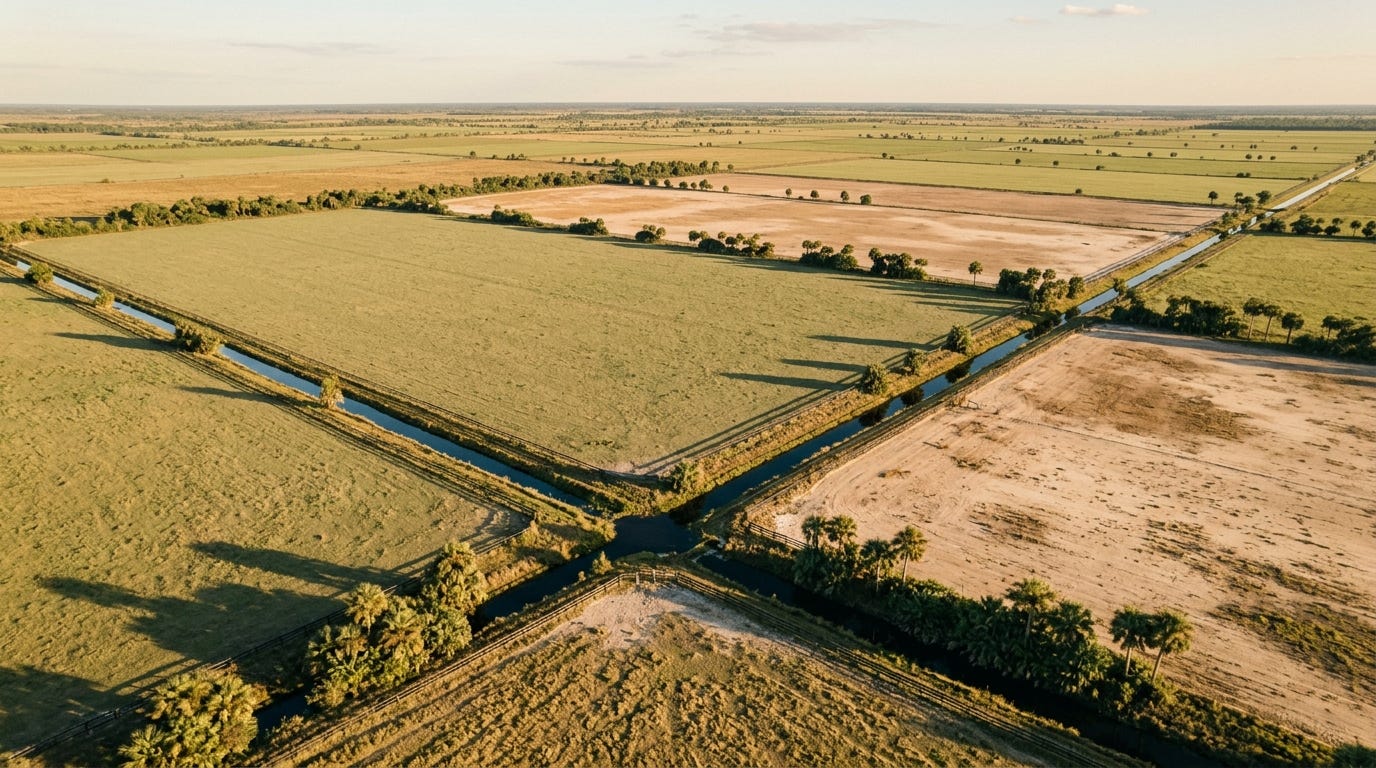
The Brevard County Property Appraiser lists nine parcels owned by Rolling Meadow Ranch, Inc., totaling approximately 1,346 acres. Every parcel carries the code “5300 - UNINCORP DISTRICT 5.” The parcels carry Palm Bay mailing addresses, but those are postal designations, not municipal jurisdiction.
The two main parcels sit at 1200 and 1400 Willowbrook Street. The 1400 Willowbrook parcel is the largest at 620.61 acres, designated Cropland (Class I). It has existing structures: a 6,000-square-foot warehouse built in 1985, horse stables from 1996, and several thousand square feet of concrete and asphalt paving. The 1200 Willowbrook parcel is 288.87 acres of vacant grazing land.
The remaining seven parcels include grazing land tracts in the San Sebastian Farms subdivision, three small lots in Sunshine Grove Unit 7, and two vacated road rights-of-way the company absorbed in 2014. As of 2025, combined market value per the property appraiser is approximately $5.28 million. All parcels carry agricultural classification, meaning the actual tax burden is a fraction of market value.
Immediately to the north and west, at 3400 Willowbrook Street, sits a 590-acre property now owned by Jaric Holdings LLC, the entity that acquired what was previously associated with rancher Chris Sartori’s Willowbrook Farms operation. Jaric Holdings took title via warranty deed in December 2023. Machata and Sartori had previously collaborated on legal actions involving Palm Bay. Combined, the two adjacent ownerships represent approximately 1,936 acres of contiguous undeveloped land in this corridor.
The SJRWMD Permit and the Heritage Parkway
The current trigger for public attention is SJRWMD Permit Application #248179, filed around December 28, 2025, under the project name “Rolling Meadow Lakes - St Johns Heritage Parkway Offsite Extension.” The permit is in Initial Sequence, with reviewers assigned. The public comment period had not opened as of this writing.
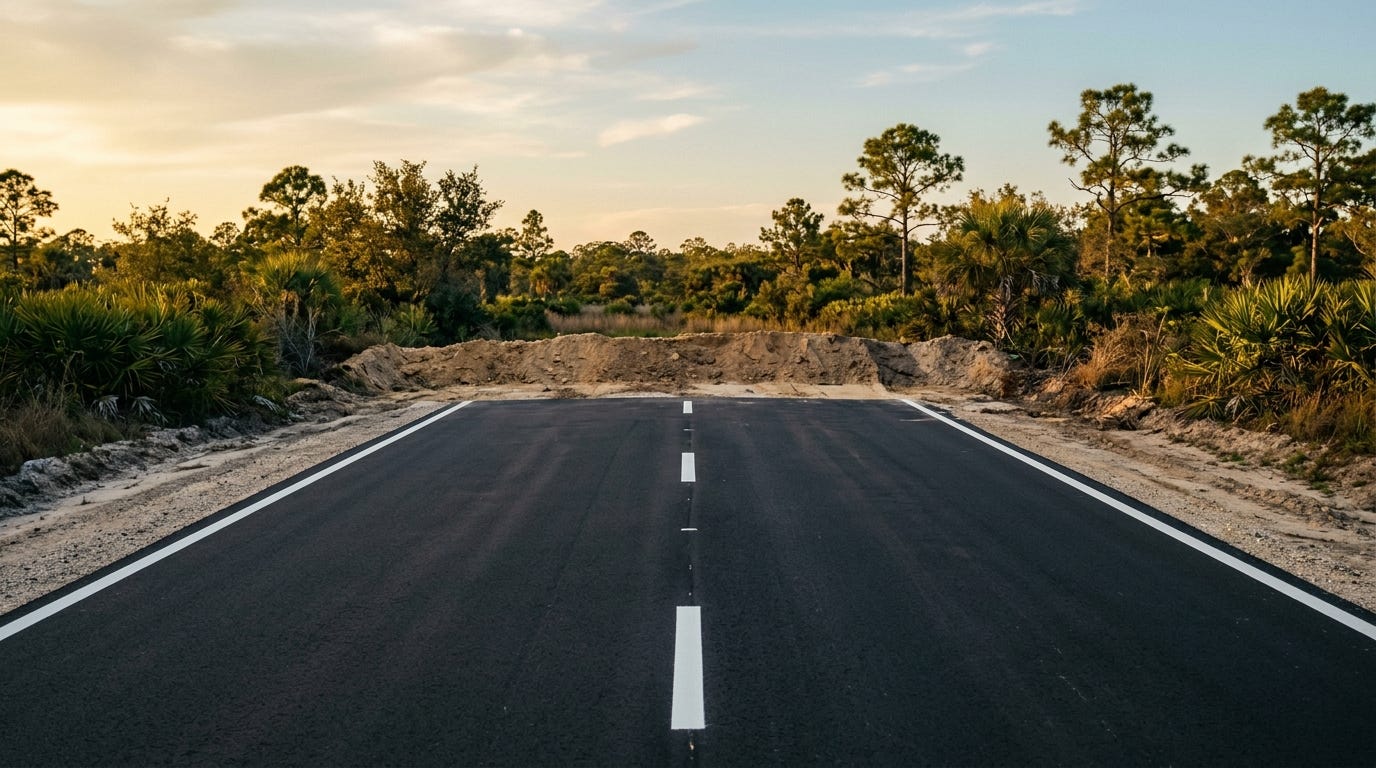
The application covers approximately one mile of road construction classified as an “offsite improvement” for the Rolling Meadow Lakes development. The SJRWMD lists the City of Palm Bay as the road right-of-way owner in its permit database, which reflects that the St. Johns Heritage Parkway is a city-designated roadway even where Rolling Meadow Ranch is the applicant funding and building this segment. The road corridor is 150 feet wide. Construction will require muck removal and replacement with clean fill. The road surface must sit at least two feet above the seasonal high groundwater level. The property has wet soils, wetlands, and mucky seasonally flooded ground. The permit’s receiving waterbody is the Sottile Canal.
Two Ends of the Same Road That Don’t Connect
The St. Johns Heritage Parkway is Palm Bay’s north-south relief route, conceived in the 1990s to reduce congestion on Minton Road and provide an alternative to I-95 through the city’s western corridor. Despite decades of planning and construction, it exists today as two physically separate segments with approximately 14 miles of unbuilt corridor between them.
The northern segment runs from Malabar Road through West Melbourne to the I-95 interchange at Ellis Road, approximately 7.8 miles built in phases between 2015 and 2020. The southern segment is 1.67 miles long, running east-west from the I-95 diverging diamond interchange at Micco Road to Babcock Street near Davis Lane, opened August 2020. Entering “St. Johns Heritage Parkway” as a navigation destination routes a driver to whichever stub is closer. There is no route connecting them.
Brevard County completed an Alternative Corridor Evaluation study in 2023 that identified five viable routes and recommended two corridors for a future Project Development and Environment study. That PDE study is unfunded as of early 2026. Palm Bayer coverage of the SJHP widening plans has full background on the northern segment’s current design phase.
Rolling Meadow Lakes is proposing to build approximately one mile of road within that 14-mile gap, through its property west of Babcock Street. If built, roughly 13 miles of the gap remain unconnected. The segment would represent the first physical piece of SJHP built within the gap, providing primary road access for the development and potentially satisfying transportation concurrency requirements with Brevard County.
Other large developments are committing to other pieces of the corridor. The Lotis Palm Bay development near the Micco Road interchange has committed to building a segment south of the existing southern stub as a condition of its Final Development Plan. The Ashton Park project near Micco Road includes a four-lane SJHP extension bisecting the property. Neither of those segments connects to the Rolling Meadow location.
The city’s own history with the parkway financing is worth noting. Prior to 2015, the official expectation was that private developers would entirely fund SJHP design, right-of-way, and construction. A staff-level decision changed course. Palm Bay issued revenue notes to build the southern segment and I-95 interchange, leaving taxpayers servicing a $9 million road bond. A Florida Auditor General operational audit found the city had assumed an estimated $16.4 million deficit without securing actual developer contributions. Rolling Meadow Lakes is structured the opposite way: the developer funds the road as a private offsite improvement.
The Utility Lock-In
CS/HB 1063 did more than move a boundary line. It embedded specific protections for Machata into Florida law that will outlast any future election or administration.
The act requires Palm Bay to provide the deannexed area with access to public water and sewer utility services on the same terms and at the same rates applied to other eligible land within the city’s service area. It explicitly prohibits Palm Bay from requiring annexation as a condition of receiving utility service. The developer can build 2,000-plus homes on county land and receive city water and sewer without ever rejoining Palm Bay.
Palm Bay Utilities operates under Florida Statutes § 180.191, which permits a 10% surcharge on water rates and a 25% surcharge on wastewater rates for customers outside municipal boundaries. Rolling Meadow Lakes will pay those surcharges if built. But the utility lines are the developer’s responsibility to fund and extend. Palm Bay city council records confirm the city must include the Rolling Meadow property in its utility master planning for the southeast service area, just as it did for Emerald Lakes and Ashton Park.
No formal utility service agreement between Palm Bay and Rolling Meadow Ranch is in the public record as of late March 2026. That agreement would typically be executed later in the development approval process.
The practical result: Palm Bay has no authority to stop this development. The land is unincorporated Brevard County. Zoning, permitting, and density decisions belong to the county. Palm Bay cannot condition utility service on annexation or use it as leverage over the project. The city is legally obligated to serve the development but has no seat at the table where the development gets approved.
Schools Already Over Capacity
The school capacity picture for this service area is already under pressure, and no application has even been filed yet.
Westside Elementary (2175 DeGroodt Rd SW, Palm Bay) is operating at 105% of capacity and is projected to reach 118% by 2026. Bayside High (1901 DeGroodt Rd SW, Palm Bay) is at 90% capacity and projected to reach 103% by 2027. Southwest Middle feeds into Bayside High and serves the same zone. Remediation efforts already underway include 12 additional classrooms at Westside Elementary and a two-story addition at Bayside High totaling approximately $47 million.
The Lotis Palm Bay development, a 353-acre project in the same southwest Palm Bay school service area with 1,372 proposed units, already received a School Capacity Availability Determination Letter finding that Sunrise Elementary, Southwest Middle, and Bayside High lack sufficient projected capacity. Lotis was required to negotiate a proportionate share mitigation agreement with Brevard Public Schools before preliminary plat approval could be issued. Rolling Meadow Lakes, at more than 2,000 homes in the same school attendance area, faces the same legal process when it reaches that stage. No SCADL has been issued for Rolling Meadow yet, consistent with the project not having reached the preliminary plat stage.
Palm Bay’s population has grown 21% since 2020, now above 146,000. More than 6,000 people move to the area annually. The schools are not catching up to current growth, let alone future approvals.
Police and Fire: County, Not City
Because the property is unincorporated Brevard County, law enforcement is the responsibility of the Brevard County Sheriff’s Office, not Palm Bay Police. The BCSO South Precinct covers the relevant unincorporated area. Fire service falls to Brevard County Fire Rescue. The nearest BCFR station is Station 89 at 2051 De Groodt Rd SW, the same road as Westside Elementary and Bayside High.
Palm Bay Police and Palm Bay Fire Rescue have no jurisdiction over the Rolling Meadow Lakes parcels. That is a direct consequence of the 2019 deannexation. No interlocal service agreement between Palm Bay and Brevard County specifically covering public safety response for the Rolling Meadow area was found in accessible public records. HB 1063 locked in Palm Bay’s utility obligation but was silent on police and fire.
No County Development Application Yet
Despite the permit filing, Rolling Meadow Ranch has not submitted a formal Preliminary Development Plan application to Brevard County Planning and Development as of March 2026.
A comprehensive review of all Brevard County Planning and Zoning Board meeting minutes from August 2024 through January 2026 and BCC Zoning meeting agendas through December 2024 shows no Rolling Meadow Ranch application before the board during that period. The August 12, 2024 P&Z meeting is the only one that mentions the development at all. At that hearing, the Rolling Meadow property appeared only as a density comparison cited by attorney Kim Rezanka, representing the neighboring SunTerra Lakes project. Rezanka told the board that Rolling Meadow “went into Palm Bay and then came back out of Palm Bay in 2014” and is “vested here at Brevard County at two units to the acre.” Rolling Meadow Ranch was not an applicant.
The SJRWMD environmental permit is infrastructure-level work that typically precedes a formal county application. The sequence suggests the developer is securing environmental approvals for the road segment before pursuing the full development entitlement from the county. No timeline for a county PDP filing has been publicly announced.
How Did County Land End Up With a Guaranteed City Utility Hookup?
That question has an answer, and it runs through Tallahassee. The Rolling Meadow property was not always outside Palm Bay. It was inside the city for more than a decade. Getting it out required a special act of the Florida Legislature, and the person who carried that act was a sitting Palm Bay council member working as the developer’s paid lobbyist. The full sequence is in public records.
How the Land Came to Palm Bay, and Left Again
The Rolling Meadow property has been in Machata’s hands since at least the 1970s. City of Palm Bay records confirm it was annexed into the city circa 2005, during a period when Palm Bay was expanding its municipal footprint along the southwest corridor.
For nearly a decade after annexation, the land sat in Palm Bay’s orbit without advancing. In August and September 2014, while still inside the city, Rolling Meadow Ranch filed two planning applications: a preliminary PUD (Case No. PUD-15-2014) and a final PUD (Case No. PUD-16-2014) for approximately 1,373 acres, south of Melbourne Tillman Water Control District Canal No. 38, west of Babcock Street. The project did not proceed under Palm Bay’s approval process.
By 2018, Machata and Sartori were participating in Palm Bay matters as adjacent non-city landowners, a status shift that places their separation from the city sometime between 2014 and that year. They sued Palm Bay in 2018 over the approval of the Waterstone planned development, alleging due process and notice violations. The case settled.
In 2019, the Florida Legislature passed CS/HB 1063, a special act that formally removed the Rolling Meadow property from Palm Bay’s municipal limits and returned it to unincorporated Brevard County. Gov. Ron DeSantis signed it on May 10, 2019 (ch. 2019-176, L.O.F.), with immediate effect. State Rep. Randy Fine, who represented Brevard County’s HD-53 district that session, sponsored the bill.
Why did Machata need the legislature at all? The bill analysis explains. The area does not meet the criteria for standard deannexation under s. 171.052, F.S. The reason: “60 percent of the area proposed for deannexation is adjacent to either municipal boundaries or land developed for urban purposes.” Under that standard, the land qualifies for annexation, making standard city-initiated removal legally problematic. A special act bypassed those criteria entirely. No referendum was required. Palm Bay was receiving approximately $43,538 in annual ad valorem taxes from the area at the time of deannexation.
The bill covered more land than just Rolling Meadow. The legal description encompasses more than 5,800 acres across five blocks, capturing the full combined Machata-Sartori landholding.

The Lobbyist in the Middle
The deannexation did not happen on its own. Someone had to carry it to Tallahassee. That person was Calvin Lewis Holton III, who goes by “Tres,” and whose presence at the center of this transaction is where the story gets complicated.
Holton is the CEO of The Holton Group LLC, a Palm Bay-based government relations and economic development firm. He has a long history in local politics, having served on the Palm Bay City Council beginning in 2001. He ran for mayor in 1999, won a council seat, served as Deputy Mayor in 2002, and returned to the council in November 2014 for a second stint.
On November 16, 2017, Holton’s council colleagues appointed him Deputy Mayor of Palm Bay again.
Six days earlier, on November 10, 2017, Holton had become a Confidential Human Source for the FBI (Binder, p. 95).
According to FDLE investigative reports, Holton was terminated as an FBI Confidential Human Source on July 11, 2018. The reason: “withholding information and providing statements in contradiction to evidence” (Binder, p. 97).
On January 2, 2019, Holton registered with the State of Florida as a lobbyist for Rolling Meadow Ranch, Inc. He also registered for Holiday Builders, Inc. on January 9. Both registrations show a branch of “FL House and Senate.” The public hearing on HB 1063 at Palm Bay City Hall was held January 15, 2019. The bill was filed February 25, 2019. Holton prepared and signed the economic impact statement attached to the bill analysis. Gov. DeSantis signed HB 1063 on May 10, 2019. Holton withdrew his lobbyist registrations for both clients on December 4, 2019.
The timeline is worth reading slowly. Holton became a Palm Bay Deputy Mayor on November 16, 2017. He had become an FBI informant six days before taking that office. He was terminated as an FBI source in July 2018 for lying. He registered as a state lobbyist for Andrew Machata’s company on January 2, 2019, while still a sitting Palm Bay council member. He prepared the economic impact statement for a bill removing land from the city where he held elected office. The bill passed.
What Florida Law Says About All of This
Florida’s Code of Ethics for Public Officers and Employees, Part III of Chapter 112, is specific about what an elected official cannot do.
Section 112.313(7)(a) prohibits a public officer from having any employment or contractual relationship that creates “a continuing or frequently recurring conflict between his or her private interests and the performance of his or her public duties.” Holton had a paid lobbyist contract with Rolling Meadow Ranch, Inc. while simultaneously serving as a Palm Bay city council member. The council retained jurisdiction over city utilities, land use, and infrastructure decisions directly affecting Machata’s property. The contract did not create a one-time conflict. It was a paid, registered, ongoing contractual relationship during his term of office.
Section 112.313(6) prohibits a public officer from corruptly using or attempting to use “his or her official position or office to secure a special privilege, benefit, or exemption for himself, herself, or others.” Holton did not simply vote on a matter while carrying a conflict. He was the active agent. He prepared and signed the economic impact statement attached to the bill analysis for CS/HB 1063. That document was submitted to the Florida Legislature in his capacity as the registered lobbyist for the entity seeking the benefit. The bill removed 5,800-plus acres from Palm Bay’s jurisdiction. The city lost $43,538 in annual ad valorem tax revenue. Palm Bay was the city Holton was sworn to serve.
The statute does not require a quid pro quo. It does not require a bribe. It requires a “continuing or frequently recurring conflict” and the use of position to secure a benefit. The public record documents both. Holton was being paid by the developer to lobby the state legislature to remove the developer’s land from the jurisdiction of the city Holton was sworn to represent. He signed the document that accompanied the bill. The bill passed.
In December 2017, a month after Holton became Deputy Mayor, retired Circuit Court Judge John Moxley Jr. found “probable cause” of a conflict of interest violation against Holton. The issue was separate: Holton had done paid government affairs work for the Space Coast Paratroopers Association before taking office in 2014, then received payment after. The SCPA partnered with Palm Bay on a veteran housing program. Moxley found Holton’s financial interest created “a temptation to favor” the organization. Moxley twice denied Holton’s requests for rehearing. Holton called the complaint baseless and pledged to remain “truthful, transparent and ethical.”
What the FBI Was Watching at the Same Time
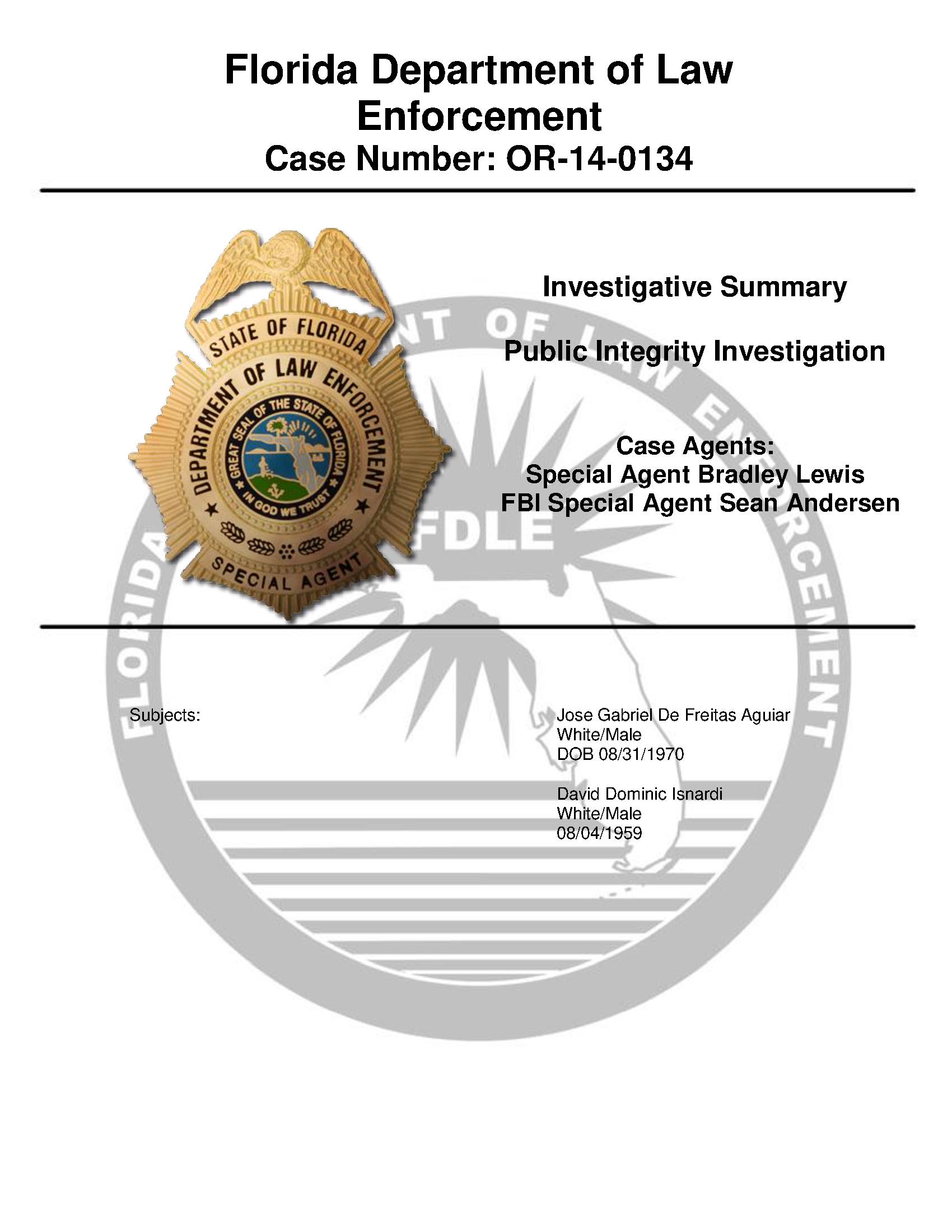
The Holton-Machata lobbying connection does not exist in isolation. FDLE investigative records from Case OR-14-0134 document that in 2018, the same period Holton was serving as Deputy Mayor, being terminated as an FBI source, and preparing to register as Machata’s lobbyist, federal and state agents were recording meetings between Machata and a cooperating Palm Bay council member about the routing of the St. Johns Heritage Parkway through Machata’s property.
According to FDLE investigative reports, the first recorded meeting occurred on April 25, 2018 (Binder, pp. 88-89). David Isnardi, then a senior Palm Bay city official, contacted a cooperating council member source and told them developer Andrew Robert Machata wanted to meet to discuss “a pending roadway project that potentially could pass by the Rolling Oaks Subdivision, which is one of Machata’s pending developments.” The source agreed to be equipped with a recording device. SA Lewis and FBI SA Andersen handled the setup.
Machata arrived in a black Cadillac Escalade. He told the cooperating source he “wants the roadway to pass by his development and needs the CS’ support.” Machata did not offer a bribe. Then City Manager Gregg J. Lynk arrived at the restaurant, unexpected by the cooperating source, and sat with Machata and the source. Agents observed Lynk arrive in a vehicle with government plates.
The recording device malfunctioned. The conversation was not captured.
A separate FDLE confidential source had informed the investigation that Lynk and Machata were friends who began their relationship after Lynk was hired at Palm Bay. According to FDLE investigative reports, that source told investigators Machata pays for Lynk to fly to Colorado and that Lynk stays at a residence owned by Machata (Binder, p. 89).
The second recorded meeting occurred on June 4, 2018 (Binder, pp. 90-91). On May 21 of that year, the cooperating source had reported that Machata obtained the PUD and wanted to meet before the next city council meeting on June 7, 2018. SA Lewis and FBI SA Dave Hacker met with the source before the June 4 meeting, which was recorded. According to FDLE investigative reports, Machata “repeatedly offered the CS reasons why he thought the projected path of the roadway should be altered.” Machata did not offer any enticement. Before leaving, Machata mentioned he was meeting with Deputy Mayor Harry Santiago Jr. the following day.
A council vote on the roadway was scheduled for June 7, 2018.
The “pending roadway” in those investigative records is the St. Johns Heritage Parkway. Machata was working the council. The same council that included Holton. The city manager showed up at a recorded meeting between the developer and a federal cooperating witness. And within six months, Holton would register as Machata’s state lobbyist to shepherd the deannexation bill through the legislature.
The FDLE investigative records also document a separate finding about the SCPA no-show job arrangement (Binder, p. 79). Dale Davis, who worked on Brevard County Commissioner Kristine M. Isnardi’s 2016 campaign, reported that David Isnardi arranged a “no show” job for Ashley Holton, wife of Calvin Holton III, on that campaign. According to Davis, Ashley Holton received between $500 and $800 per month for eight months, and Davis “never observed Mrs. Holton at the office or at any of the campaign events.” Davis believed the arrangement was used to funnel money to Councilman Holton, who was reportedly experiencing financial difficulties at the time.
The same investigative file describes Isnardi and a separate figure discussing purchasing surveillance equipment to record Bailey and Holton in compromising positions at a Palm Bay residence, as part of what investigators documented as an attempt to gain leverage over council members (Binder, pp. 115-116).
What Was Not Charged
These recorded meetings produced no criminal charges directly related to the SJHP routing. The investigations focused on other conduct. David Isnardi was arrested on May 10, 2019, the same day Governor DeSantis signed HB 1063, on charges of racketeering and extortion unrelated to the parkway. He pleaded guilty to a single felony charge.
Holton was not charged with any offense in connection with these events. The FDLE records are from an ongoing investigation that produced charges against some participants and not others. The records were released in February 2020 under Florida’s public records law.
The documented facts are: FBI and FDLE agents recorded a Palm Bay developer lobbying a cooperating council member about routing a publicly funded road past the developer’s land. The city manager attended one of those meetings without being invited by the cooperating source. A separate government source said the same city manager received paid travel from the developer. The developer’s designated lobbyist for the subsequent deannexation of that same land was, at the time of the lobbying, simultaneously serving as Palm Bay Deputy Mayor and recently terminated from the FBI as a source for lying.
The pattern, documented in public records, describes the same development asset generating contact with multiple points of government influence at the same time. The documents speak for themselves. Readers can draw their own conclusions.
What Comes Next
As of late March 2026, Rolling Meadow Lakes is in environmental permitting phase. The SJRWMD permit review is active. A formal Brevard County development application has not been filed. A utility service agreement with Palm Bay has not been executed. No construction timeline has been publicly announced.
Three items to watch: the SJRWMD permit portal at permitting.sjrwmd.com (Permit #248179) for a public comment period opening; any Palm Bay City Council agenda item involving a utility service agreement with Rolling Meadow Ranch; and any Brevard County Planning and Zoning Board agenda listing Rolling Meadow Ranch as an applicant.
What The Palm Bayer has documented here is the public record as it stands: a permit filing, a development history, and a political backstory that is fully documented in FDLE investigative reports, state lobbying records, Florida Legislature bill analyses, and Brevard County property records. None of those documents are secret. All are public record. They have not been assembled in one place before.
The Palm Bayer will continue reporting as this development moves through the approval process.


