


Palm Bay, FL -- Two elementary schools serving southwest Palm Bay are already above 100% capacity. The middle school serving that same area lacks sufficient capacity to absorb projected students. Bayside High is at 90% and projected to cross 100% by 2027. And development proposals for thousands of additional homes in those attendance zones keep arriving at City Hall.
School concurrency is Florida’s legal tool for slowing that process down. It requires developers to show that schools can handle the students before they get approval to build. In Brevard County, it does impose real conditions on developers. It also has structural gaps that residents living near those schools should understand before Workshop 3 on April 8.
The gaps are not a reason to write off the system. They are a reason to ask better questions at the LDC process.
The Lotis Case Study
The most useful recent example is the Lotis development proposal, which came to a vote at the March 19, 2026 Regular City Meeting. Lotis was a 1,372-unit project on 353 acres in southwest Palm Bay. Before Palm Bay could approve a preliminary plat, Brevard Public Schools was required to issue a School Capacity Availability Determination Letter, known as a SCADL.
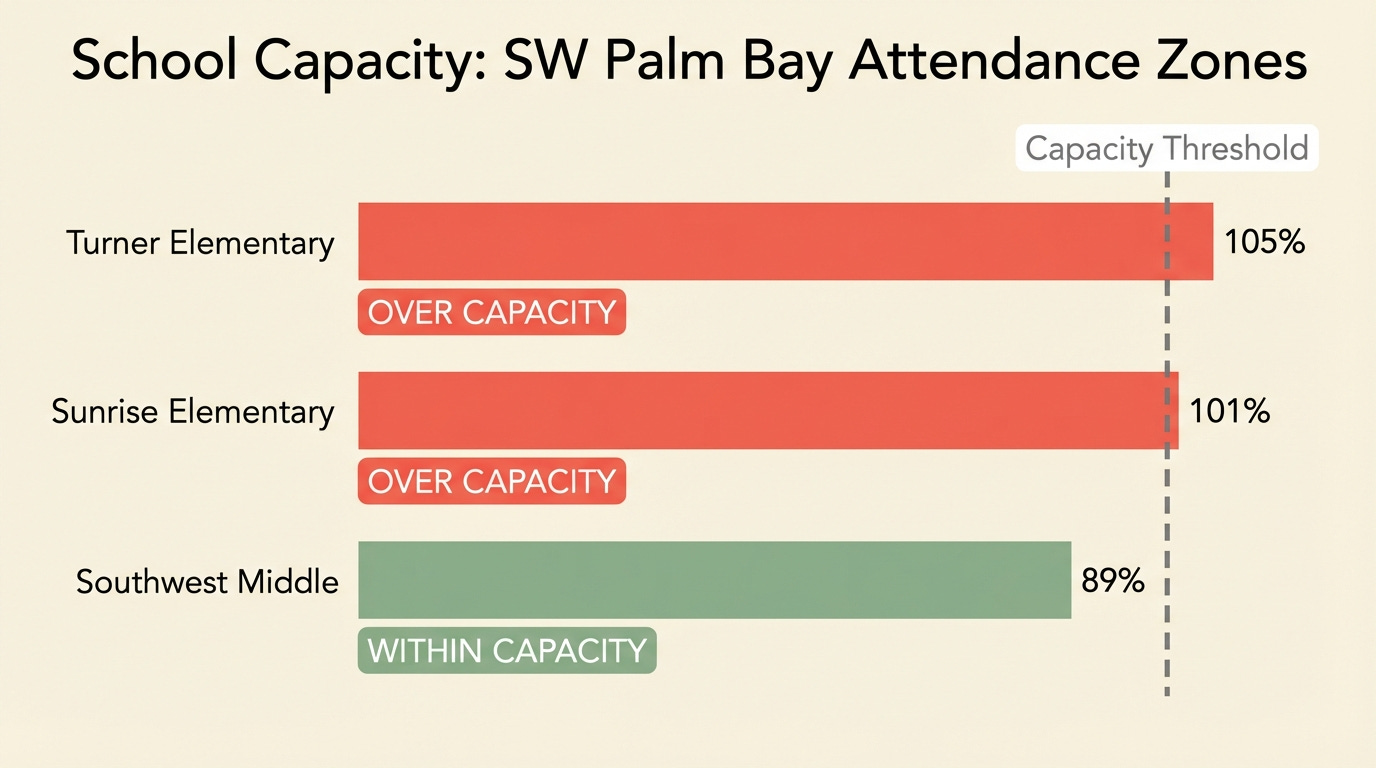
The SCADL projected 459 new students from the development and evaluated the schools serving that area. Its findings: Sunrise Elementary at 101% capacity with a projection of 117% by 2027. Westside Elementary at 105%, projected to reach 118% this year. Southwest Middle School lacking sufficient capacity for the projected students. Bayside High at 90%, projected to reach 103% by 2027.
The SCADL imposed a condition: before any preliminary plat approval, the developer and Brevard Public Schools must execute a binding proportionate share mitigation agreement committing the developer to fund the capacity needed to accommodate the students Lotis would generate.
Council voted 5-0 to reject the project. The stated reason was inadequacy of police and fire services, not schools.
The school capacity data was in the file. The SCADL had already established that two elementary schools were over 100%, the middle school lacked capacity, and Bayside High was on a trajectory to breach capacity within a year. That documentation was part of the record Council reviewed. The vote record says the denial was about something else entirely. That gap between what the data showed and what the vote said is the tension residents should understand. When the next project comes forward citing a clean SCADL, the Lotis precedent tells you very little about whether schools were actually weighed. The concurrency system produced the right outcome here. The paper trail doesn’t show it.
How the System Actually Works
Florida law makes school concurrency a local option. The Legislature made it mandatory statewide in 2005, then reversed course with HB 7207 in 2011, making it optional again. Brevard County chose to keep it. Any county that does must comply with the framework in F.S. 163.3180(6).
Brevard uses 85 school attendance zones as its Concurrency Service Areas, one per school. This is the most granular approach available under state law. The 2014 Interlocal Agreement that governs today’s process states the framework directly:
“The School District and local governments shall apply school concurrency on a less than district-wide basis, using the school attendance zones, in which the school is located, as the CSA. Use of this method will create a separate concurrency service area boundary map for each elementary, middle and high school. Each school attendance zone will become its own CSA.”
Each development must clear all three tiers: elementary, middle, and high school. If any zone is at or over capacity and adjacent zones cannot absorb the shortfall, the developer must negotiate a binding mitigation agreement before plat approval.
One provision in the statute is worth clarifying for context. F.S. 163.3180(6) includes a contiguous service area provision:
“Where school capacity is available on a districtwide basis but school concurrency is applied on a less than districtwide basis in the form of concurrency service areas, if the adopted level-of-service standard cannot be met in a particular service area as applied to an application for a development permit and if the needed capacity for the particular service area is available in one or more contiguous service areas, as adopted by the local government, then the local government may not deny an application for site plan or final subdivision approval.”
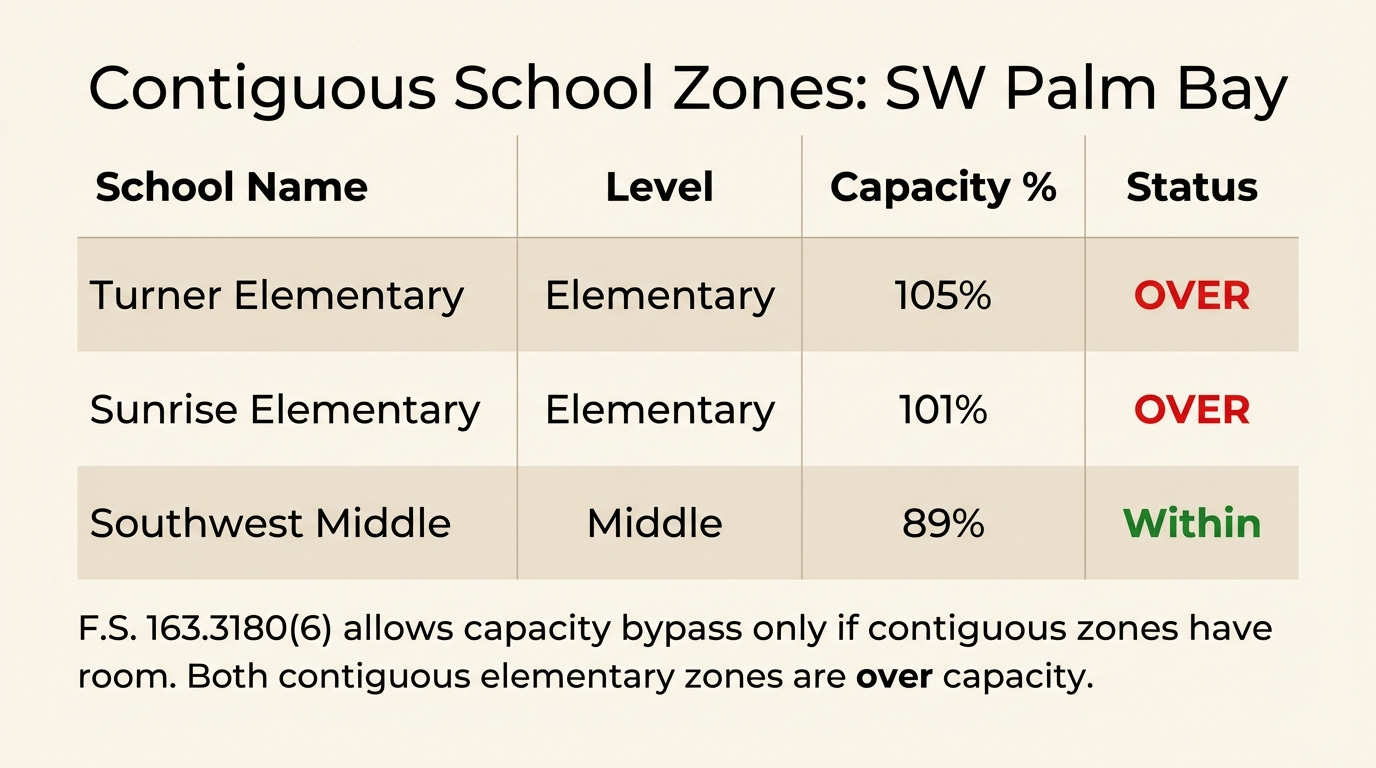
The operative word is “contiguous.” The statute allows a bypass if capacity exists in adjacent attendance zones. It does not allow a bypass pointing to open seats anywhere in the county.
For southwest Palm Bay, the contiguous zones are not abstract. They are Sunrise Elementary (101% capacity, projected 117% by 2027), Westside Elementary (105%, projected 118% this year), Southwest Middle School (insufficient capacity), and Bayside High (90%, projected to cross 100% by 2027). These schools are both the primary service zones and the contiguous zones. The statutory bypass requires available capacity in a neighboring attendance area. There is none. The schools that are supposed to absorb the overflow are the ones that are already full. The bypass is on the books; it just doesn’t apply to southwest Palm Bay right now.
The Gaps That Exist
The Brevard system does what it’s designed to do. It evaluates school capacity at the attendance-zone level and requires mitigation agreements before plat approval when capacity is insufficient. That is more rigorous than a district-wide count, and the Lotis SCADL proved it works in practice.
The gaps are structural, not procedural failures. They are features of how the system is built, and they are worth naming.
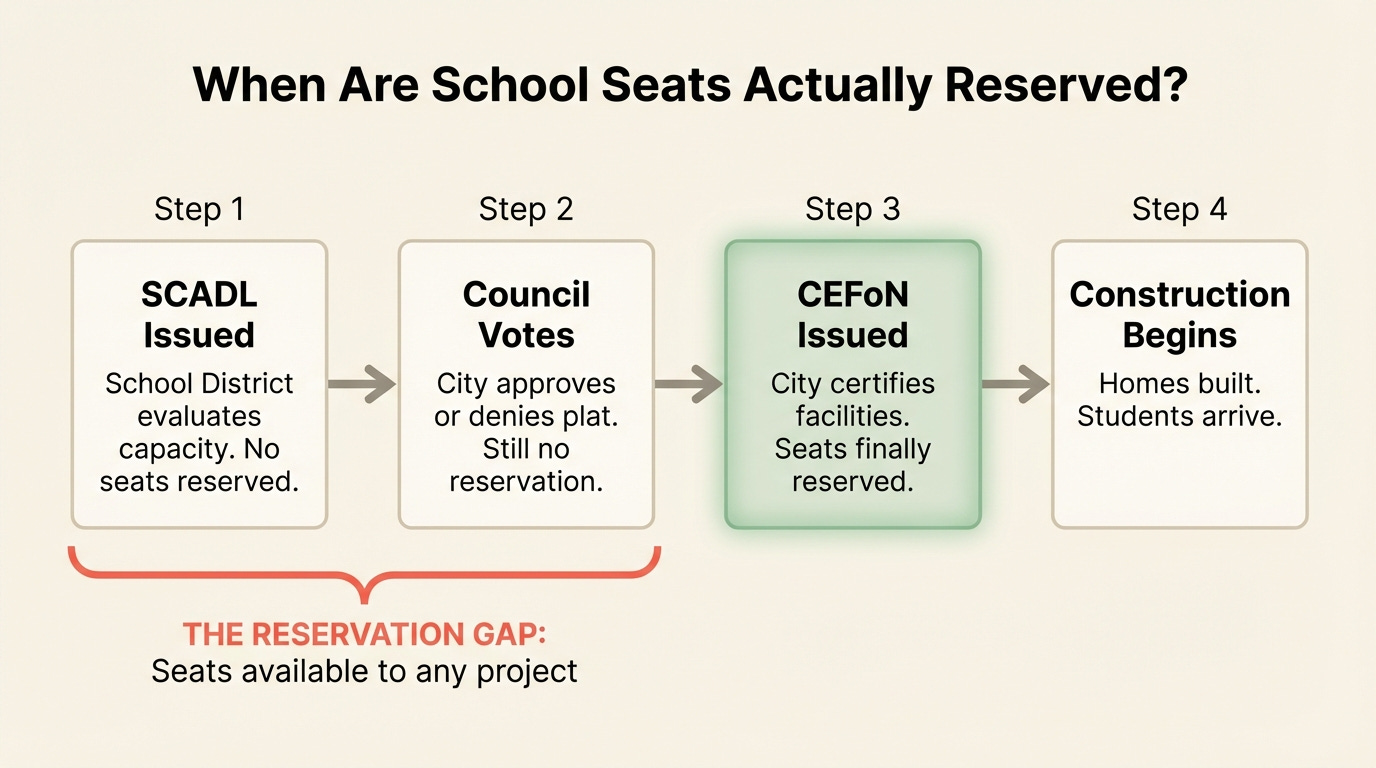
The reservation gap. ILA Section 13.3 states that school capacity is not formally reserved for a specific project until the local government issues a Certificate of Adequate Public Facilities, known as a CEFoN. A SCADL finding of adequacy does not hold those seats. Multiple SCADLs can be issued against the same school zone simultaneously. A zone could receive favorable findings for several projects before any of them reach the CEFoN stage, at which point the available seats are already spoken for.
The order of operations matters here. A project moves through the pipeline like this:
SCADL issued -- School District evaluates capacity and issues a finding. No seats are reserved at this step.
Council votes -- City approves or denies the plat. Still no reservation.
CEFoN issued -- Only at this stage does the city formally certify adequate public facilities. Seats are reserved here.
Construction begins -- Homes go up. Students arrive.
Between steps 1 and 3, the available seats in that attendance zone are still on the table for every other project in the pipeline. A school that shows 10% headroom in a SCADL can have that headroom claimed twice or three times before any project reaches the CEFoN stage.
Hillsborough County uses live GIS tracking and reserves seats at the preliminary plat stage. Orange County issues paid Capacity Reservation Certificates. St. Johns County uses a two-year reservation with an expiration date. Brevard’s process is slower, and the reservation gap is the most direct consequence.
The annual reporting lag. ILA Section 9.1(d) requires local governments to report approved development data to the School District by October 15 each year. ILA Section 13.4(b) states the Development Review Table is updated using Fall FTE enrollment counts. That structure builds a 12-month lag into the data. By the time a SCADL reflects the full picture of recently approved projects, the numbers are already a year old.
The Student Generation Multiplier. Brevard updates the multipliers used to estimate how many students a development will generate on a five-year cycle. The last update was in 2022, using enrollment data from 2016 to 2021. That is pre-pandemic data being used to project students from developments that will open in 2027 and beyond. Flagler County recommends biannual updates. St. Johns updates annually. If the multiplier understates how many children move into new southwest Palm Bay subdivisions, every SCADL that relies on it starts with an optimistic baseline.
What that means in practice: a SCADL might project 400 students from a development when 600 will actually arrive. The school clears the concurrency threshold on paper. Then the first kids enroll and the portables show up on day one. The mitigation agreement was written to fund capacity for 400. The shortfall for the other 200 falls on the School District’s capital budget.
Proportionate share mitigation timing. F.S. 163.3180(6)(h)2.c. states that proportionate share mitigation funds “must be set aside and not spent until” a specific capital improvement is identified. A developer executes the mitigation agreement, pays into the fund, and construction does not begin until the School District identifies and schedules the actual capacity project. A developer can have hundreds of homes under construction while the mitigation money waits for a capital improvement that may be years from the planning stage.
These four gaps interact. A stale multiplier produces a lower student count projection. The annual lag means recent approvals don’t show up in the next SCADL. The reservation gap means favorable findings issued in sequence against the same zone don’t reduce the available count until the CEFoN stage. And the mitigation timing means money is committed before capacity exists.
None of this is illegal. All of it is the system working as designed. The question is whether the design is adequate for a city adding housing at Palm Bay’s pace.
What Palm Bay Can and Cannot Do
Palm Bay is a party to the 2014 ILA alongside Brevard County and 13 other municipalities. F.S. 163.3180(6)(a) requires that “all local government provisions included in comprehensive plans regarding school concurrency within a county must be consistent with each other.” That uniformity requirement means Palm Bay cannot unilaterally adopt a stricter or more lenient concurrency standard without unanimous agreement from all ILA parties.
What Palm Bay can do is ask pointed questions.
Growth Management Director Althea Jefferson oversees the city’s LDC process. The LDC Workshop series is the venue for raising process questions about how Palm Bay’s own comp plan and LDC interact with the ILA framework.
Specifically: Palm Bay’s Public School Facilities Element in its comp plan should explicitly reference the ILA’s attendance-zone CSA standard. If it doesn’t, there is ambiguity between state law and local policy that the LDC revision could close. The city could also formally request that Brevard Public Schools clarify how the reservation gap in ILA Section 13.3 is managed when multiple SCADLs are issued against the same zone before any CEFoN is issued.
Neither of those actions requires an ILA amendment. They require attention.
Workshop 3: April 8, 4 PM, City Hall
LDC Workshop 3 is scheduled for April 8 at 4:00 PM at City Hall. The topic is Community Development. Growth management tools, including school concurrency, sit at the center of that conversation.
The LDC Phase 2 process is where residents can put structural questions on the record. The Lotis case demonstrated that the concurrency system can flag school capacity issues and impose mitigation requirements. It also raised the question of what role those findings play when a vote comes down to other factors.
The schools serving southwest Palm Bay are full. The mechanism for managing that is real. The gaps in that mechanism are also real. Knowing where they are is the first step to asking whether the LDC can help close them.


