


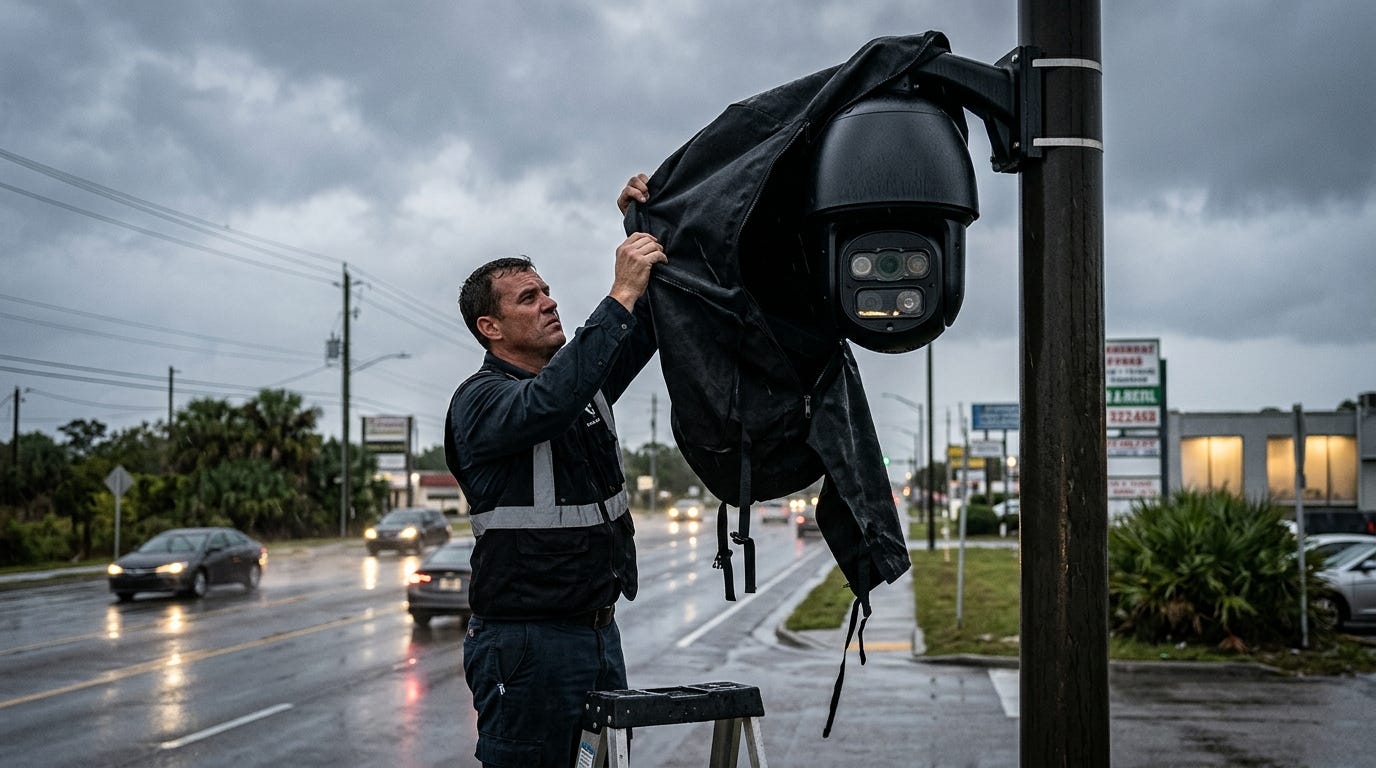
PALM BAY, FL (The Palm Bayer) — The City of Palm Bay resumed operations of its Flock Safety automated license plate reader network on Monday morning, seventeen days after placing the 36-camera system on administrative suspension for an internal review of right-of-way pole permits.
Municipal crews unhooded the roadside solar-powered units across major corridors following the completion of an engineering check conducted by the Public Works Department. The administrative review focused strictly on physical pole installations and right-of-way engineering standards within municipal corridors.
While the administrative review resolved municipal permitting requirements, the broader public discussion across Brevard County centers on operational utility, third-party data custody, and Fourth Amendment privacy protections for about 142,000 residents.
Police Casework During the Administrative Suspension
The seventeen-day operational pause provided a practical test of municipal police operations without an active automated license plate reader network. During this window, sworn detectives and patrol officers with the Palm Bay Police Department investigated and resolved major criminal incidents using traditional investigative methods, forensic science, and community cooperation.
On August 15, a violent hit-and-run spree occurred along Consumer Street Southeast. A suspect driving a stolen vehicle crashed through multiple residential front yards, striking parked vehicles in driveways with sufficient force to propel one car across a lawn and shove another through a resident’s garage door before fleeing the scene on foot.
PBPD officers recovered the abandoned stolen vehicle, dispatched Crime Scene Investigators to pull DNA swabs and latent fingerprints, and canvassed the neighborhood. Detectives gathered voluntary video footage from residential doorbell cameras and processed community tips submitted through CrimeLine to advance the investigation.
In a separate high-priority case, PBPD detectives collaborated with the FBI Joint Terrorism Task Force to investigate a mass-casualty school threat posted to TikTok that targeted local students. Investigators identified, located, and arrested a 13-year-old suspect within 24 hours of the initial report.
The rapid resolution relied on digital forensic subpoenas, telecommunications search warrants, and direct field intervention at the suspect’s residence. The casework demonstrated municipal law enforcement capability to address urgent public safety threats through targeted legal process, forensic evidence, and multi-agency coordination.
The Administration and Mayor’s Perspective
City administration and law enforcement leadership maintain that automated license plate readers serve as an essential tool for modern municipal policing.
In an official municipal release issued August 24, City Manager Matthew Morton clarified the administrative basis for the restart. Morton stated that with the permitting review complete, “there is no longer a permitting basis to keep the system offline.”
Mayor Rob Medina has consistently articulated the administration’s position on the dais, describing the network as modern, essential law enforcement technology. Medina noted that the roadside devices capture license plates in public view rather than personal identities, providing officers with rapid lead generation when investigating stolen vehicles, missing persons, and serious felonies.
“You call them cameras. They’re license plate readers,” Medina stated during council debate, emphasizing officer safety and situational awareness. Medina reiterated that the pause was purely an administrative check to ensure municipal permitting standards were met, rather than an operational retreat from automated policing tools.
Technical and Security Disclosures: The Leaked Codebase
While the city addressed physical right-of-way permits, external technical disclosures raised new questions regarding the software architecture supporting automated camera networks.
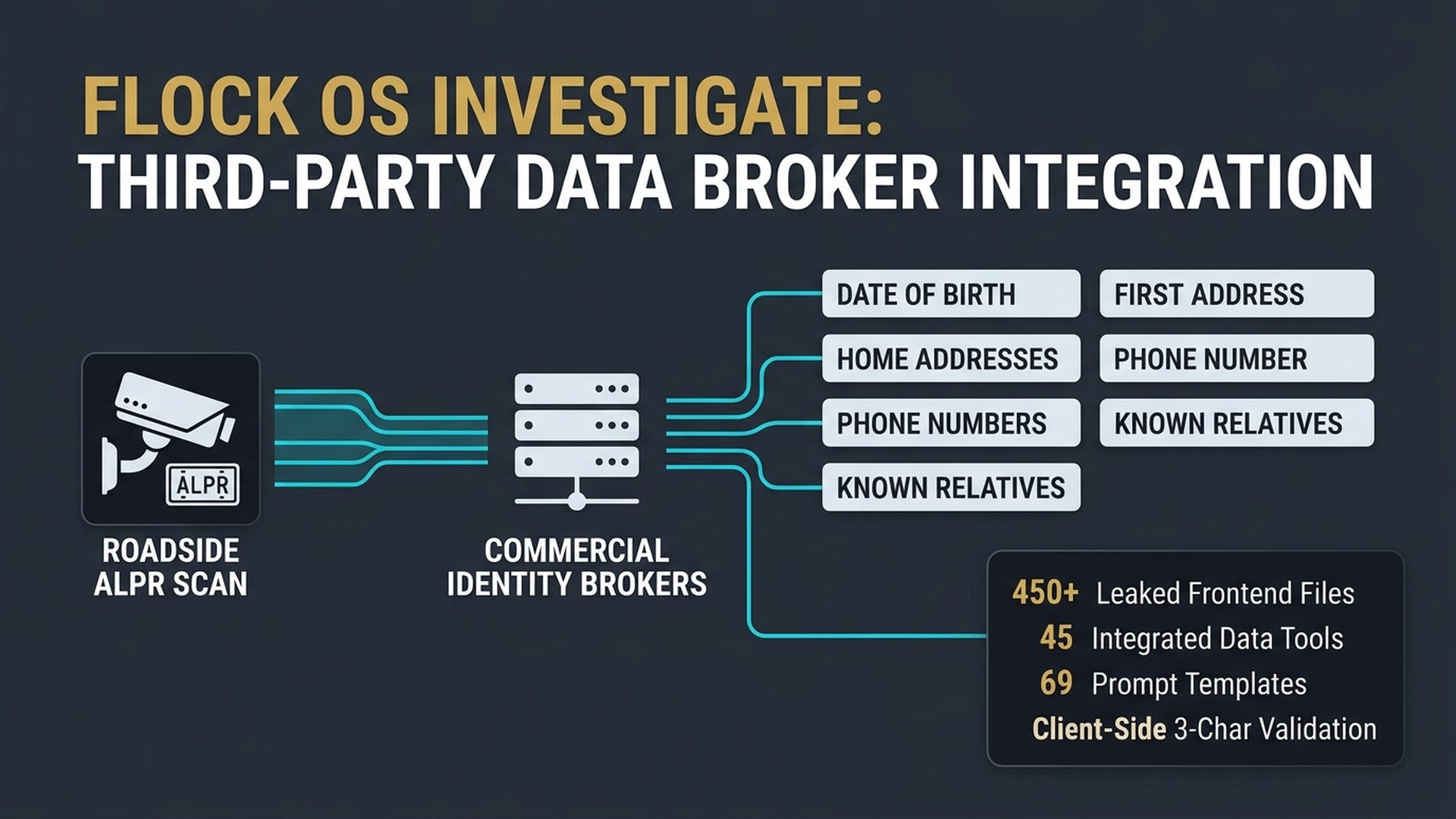
On August 19, an investigative report published by WIRED journalists Dhruv Mehrotra and Dell Cameron, independently verified by surveillance researcher “Buchodi,” revealed significant security and capability disclosures in Flock Safety’s software ecosystem. More than 450 frontend source code files for Flock OS Investigate, an artificial intelligence platform codenamed “Nightshift,” were actively served to unauthenticated web browsers across the public internet.
The leaked codebase documented advanced features and integrated tools that extend beyond standard optical character recognition of license plates:
Commercial Data Fusion: The platform incorporates 45 integrated tools connecting camera captures to external commercial identity broker databases. The integration allows queries to return Dates of Birth, personal telephone numbers, residential addresses, and lists of known relatives associated with registered vehicle owners.
Natural Language Query Templates: The codebase includes 69 pre-loaded prompt templates. Among these, 14 templates require zero license plate numbers, zero suspect names, and zero verified crime reports, facilitating pattern-of-life queries, routine movement analysis, and associational convoy tracking based on temporal proximity.
Client-Side Audit Controls: The internal auditing code revealed that agency search justification validation checks operate entirely client-side. The system accepts arbitrary entries as short as three characters, allowing an input such as “123” to satisfy the validation filter and unlock network search capabilities.
Data Privacy and Fourth Amendment Considerations
The intersection of automated tracking technology and constitutional law continues to generate debate among legal scholars, privacy advocates, and municipal officials.
Constitutional questions center on retrospective, prolonged vehicular tracking under the Fourth Amendment. In landmark rulings such as Carpenter v. United States (2018) and United States v. Jones (2012), the United States Supreme Court recognized that individuals maintain a reasonable expectation of privacy in the aggregate of their physical movements over time.
Legal analysts distinguish between an officer observing a single license plate in plain view during a routine traffic stop and the government maintaining an automated, searchable repository of historical travel patterns. When automated camera networks log vehicle sightings across municipal boundaries, the resulting data construct enables comprehensive historical tracking without prior judicial authorization.
The custody of municipal movement records by private cloud vendors introduces additional regulatory and security considerations. When municipal travel data resides on third-party cloud infrastructure, local governments face ongoing questions regarding vendor security protocols, secondary data custody, and compliance with Florida public records standards under Chapter 119.
The Dais Record and Public Testimony
The Palm Bay City Council has engaged in extensive debate over automated license plate readers, with council members recording distinct policy positions across recent legislative sessions.
Councilman Kenny Johnson has focused on national municipal trends and legislative oversight. On the dais, Johnson pointed out that “there have been countless amount of cities who have removed flock cameras from their cities,” arguing that elected officials must exercise rigorous administrative and legislative oversight before expanding automated surveillance grids.
Deputy Mayor Mike Jaffe has focused on municipal risk management, data handling protocols, and administrative governance. Pointing out that initial surveillance contracts were approved through routine consent agendas before undergoing comprehensive public vetting, Jaffe called for dedicated public discussion on the dais, requested proactive auditing from vendor representatives, and opposed integrating private Homeowners Association camera feeds without strict safeguards.
Councilman Mike Hammer has approached the system through fiscal accountability and vendor performance. Hammer has repeatedly advocated for mandatory “Vendor Quality Reports” and detailed cost-benefit reviews of recurring software subscriptions, arguing that municipal procurement must demand verifiable performance benchmarks and measurable returns on taxpayer investments.
Councilman Chandler Langevin has articulated foundational constitutional objections, arguing that continuous automated location tracking in public spaces infringes upon Fourth Amendment protections. On the dais, Langevin cautioned against municipal environments where automated systems monitor routine civilian travel.
Elected officials have also heard extensive public testimony during regular council meetings:
Pastor Ken Delgado addressed foundational liberties from the podium: “Those who would give up essential liberties to purchase a temporary safety deserve neither liberty nor safety… sooner or later that safety will be used against us.”
Deborah, a resident, challenged the transparency of automated surveillance disclosures, citing Supreme Court precedent in United States v. Throckmorton: “The overall lack of disclosure on how the system works and stating that it’s just a license plate is a manipulation of the public and a fraud… U.S. v. Throckmorton goes on to say fraud vitiates everything.”
Kristen Yonce, a civic participant, summarized community privacy concerns: “No mass surveillance without consent.”
Legislative Authority and Upcoming Decisions
The resolution of right-of-way engineering permits addresses the physical placement of hardware in city corridors. However, physical permit compliance remains distinct from broader municipal technology policy, data custody standards, and long-term appropriations.
Under Florida municipal law, administrative departments execute operational tasks, while elected city councils retain sole authority to set municipal policy, approve vendor contracts, and allocate taxpayer funds. As upcoming fiscal budget hearings and municipal purchasing discussions approach the dais, the future role of automated surveillance networks in Palm Bay remains a central legislative question.
The Palm Bayer investigative reporting is supported by public records, municipal transcripts, and verified agency disclosures. Read our related coverage on special council meetings, traffic and right-of-way corridor work, and city growth and capital infrastructure.
Sources
City of Palm Bay Official Press Release: “City of Palm Bay to Resume FLOCK Camera Operations Following Completion of Permitting Review” (August 24, 2026).
City of Palm Bay PrimeGov Meeting Portal & Official Council Records (Minutes and Transcripts: February 6, 2025; February 20, 2025; March 6, 2025; March 20, 2025; January 22, 2026; April 16, 2026; May 7, 2026; May 21, 2026; July 2, 2026; August 6, 2026; August 20, 2026).
WIRED Investigation: “Flock Has a Powerful New AI Tool for Police. We Got Its Code” by Dhruv Mehrotra and Dell Cameron (Published August 19, 2026).
U.S. Supreme Court: Carpenter v. United States, 138 S. Ct. 2206 (2018)
U.S. Supreme Court: United States v. Jones, 565 U.S. 400 (2012)
U.S. Supreme Court: United States v. Throckmorton, 98 U.S. 61 (1878)
Florida Statutes: Chapter 316 (State Uniform Traffic Control)
Fox 35 Orlando: “String of hit-and-run crashes target cars parked in driveways in Palm Bay neighborhood” (Broadcast August 17, 2026).
U.S. Census Bureau QuickFacts: Palm Bay City, Florida (July 1, 2025 Population Estimate: ~142,000).


