


Palm Bay, FL -- Approximately 1,500 golf courses have closed across the United States since 2014. Each one sits on an average of 150 acres of land zoned for recreation or open space. In state after state, a pattern has emerged: an investor buys a struggling course at a discount, lets it deteriorate, then files for rezoning to residential. Academic papers from MIT, Touro Law, and Villanova Law have examined the cycle. 1000 Friends of Florida documented it in a 2021 special report. Companies have built entire business models around it.
In Palm Bay, the former Majors Golf Course, an Arnold Palmer-designed championship course and the centerpiece of the Bayside Lakes community, has been closed since 2022. Its owner, Joy LLC, has spent the past two years seeking approval to build a master-planned residential development called Eden at Bayside Lakes on the roughly 200-acre property. Nearly 3,000 residents have signed a petition opposing it. The HOAs are organized. The yard signs are up.
But six meetings and two years into the process, no attorney has spoken on behalf of Bayside Lakes homeowners at a single public hearing.
The National Playbook
The sequence is consistent enough to diagram.
Step one: acquire a distressed or unprofitable golf course at a steep discount. Step two: allow operations to decline or cease entirely. Step three: cite the deteriorated condition in rezoning applications as evidence the recreational use is “no longer economically viable.” Step four: apply for rezoning from recreation or open space to residential. Step five: if denied, sue, reapply, or invoke state preemption to bypass local zoning entirely.
GL Homes, one of Florida’s largest homebuilders, has run this play simultaneously at multiple properties across South Florida and the Tampa Bay region. ClubLink, a Canadian company, bought eight golf courses out of WCI Communities’ bankruptcy for $8.7 million in 2010, then announced plans to convert three of them to housing developments in 2022. D.R. Horton, the largest homebuilder in the country, has pursued golf course conversions and explicitly threatened to use state law to override local decisions when cities said no.
These are not fringe operators. These are publicly traded companies and institutional investors executing a documented land strategy.
What’s Happening Across Florida
The pattern is not theoretical. It is playing out in real time, in real communities, with real outcomes. Here are the cases that matter.
Sherwood Golf Club, Brevard County. Same county as Palm Bay. The Ballarena Group proposed development on the roughly 100-acre abandoned Sherwood course west of Titusville. The original proposal called for 900 units. After pushback, it was revised to 597 (187 single-family, 408 multi-family). The Brevard County Planning and Zoning Board approved the rezoning in August 2024. The County Commission followed with a 4-1 vote in September 2024 despite significant community opposition. Residents organized as “Save Sherwood” through savesherwood.com. They did not have legal representation.
Calusa Golf Course, Miami-Dade County. GL Homes purchased the course for $32 million, partnering with prior owner Facundo Bacardi on the venture, and proposed 550 homes. Miami-Dade commissioners approved the rezoning. But Save Calusa, the residents’ group, retained an attorney and sued. The courts sided with residents because the hearing was improperly noticed. GL Homes appealed. The Florida Supreme Court refused to hear the appeal in May 2024. The project is effectively dead. The residents won because they had a lawyer who found a procedural defect.
Pebble Creek Golf Course, Hillsborough County. G.L. Acquisitions Corp. sought to rezone the 149-acre course for 250-plus single-family homes. Hillsborough County commissioners denied the rezoning in 2023. The developer sued. The circuit court sided with the developer. The county appealed. In July 2025, the appellate court reversed the lower court and upheld the denial, establishing that county commissions have broad discretion to deny rezoning to preserve community character. The county won because it had lawyers who took the case through two levels of appeals.
Sun City Center, Hillsborough County. ClubLink bought eight courses from WCI bankruptcy for $8.7 million in 2010. In March 2022, ClubLink announced plans to convert three of those courses to housing. In February 2024, ClubLink submitted Notices of Intent to use the Live Local Act to develop Sandpiper, the North Course, and Caloosa Greens, bypassing public hearings and zoning oversight entirely. Litigation was ongoing as of September 2025.
Lone Pine Golf Course, Riviera Beach. The course closed in April 2023. D.R. Horton proposed 286 single-family homes. The city council rejected the proposal 4-1 in July 2023 and denied it again in 2024. D.R. Horton then explicitly threatened to invoke the Live Local Act, telling the council, “your hands are tied.” The council said no twice. The developer responded by pointing to state law that could override the decision entirely.
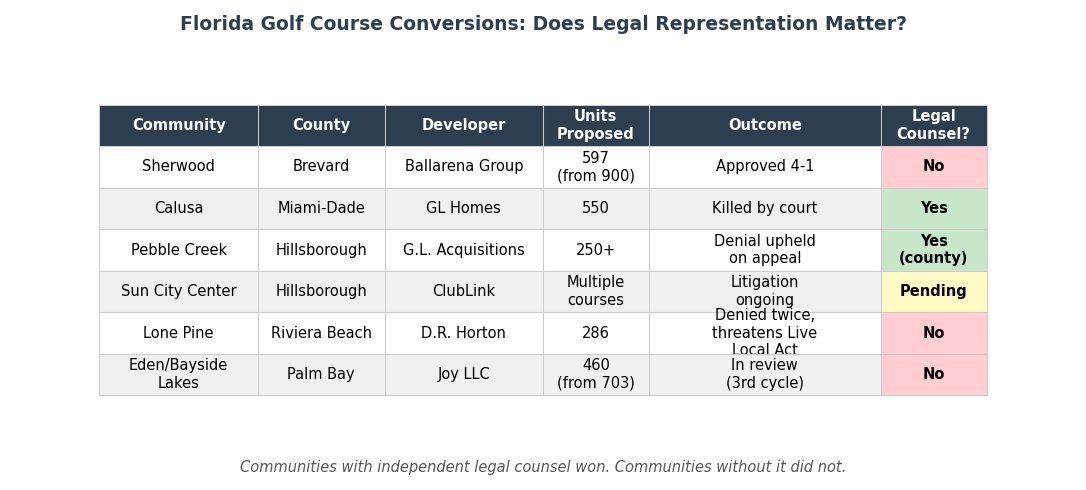
The pattern across every case: communities that retained independent legal counsel and challenged procedure had a fighting chance. Communities that relied on petitions, public comment, and political pressure alone did not.
Six Parties, Six Interests
The Eden at Bayside Lakes project involves six distinct parties, each with different interests and different levels of power in the process.
Joy LLC. The developer. Owned by Heather Joyner, with attorney Jack Spira and planning firm Cotleur and Hearing out of Jupiter. Joy LLC purchased the Majors Golf Course property at auction in December 2019. The course permanently closed in June 2022. Joy LLC claims the course is “no longer economically viable” and proposes a master-planned community called Eden at Bayside Lakes. The original CPP proposal described 703 units (403 single-family homes, 150 townhomes, 150 apartments). The city’s project page now describes it as a 460-unit community. Joy LLC has filed three applications and is currently in its third review cycle.
The Residents. Nearly 3,000 homeowners in Bayside Lakes. Over 3,000 petition signatures to keep the golf course zoned recreational. An organized coalition of HOA presidents, led by figures like Robert Stise of Summerfield HOA and civic activist John Magee. A contact email (protectbaysidelakes@yahoo.com). Red shirts. Public comment. Mass attendance at the March 28, 2024 CPP meeting. Two years of sustained opposition. No independent legal counsel retained to represent homeowner interests in the land use proceedings.
The City (Staff). The Growth Management Department, currently under the Deputy City Manager following the departure of Director Lisa Frazier, is conducting the review. Senior Planner Debbie Flynn is the point of contact. The staff review has been thorough and substantive. The city is not rubber-stamping this application.
City Council. The elected body that will ultimately vote on the Comprehensive Plan amendment, the rezoning, and the Preliminary Development Plan. Council has not voted on anything related to this application. No hearing date has been set. Council passed Ordinance 2022-119 in January 2023, strengthening nuisance provisions for unimproved property, a direct response to the condition of the abandoned course. Mayor Medina explored purchasing the property in 2023. The property was appraised at approximately $7 million. Joy LLC was unwilling to sell for less.
The State (DEO). The Florida Department of Economic Opportunity reviews Comprehensive Plan amendments under Section 163.3184 of the Florida Statutes. When Joy LLC’s Comprehensive Plan amendment reaches the state review stage, DEO and other commenting agencies can flag inconsistencies with the state comprehensive planning framework. This review has not occurred yet because the application has not advanced past staff review.
St. Johns River Water Management District. SJRWMD holds conservation easements on 10.78 acres of wetlands within the property. Basin Management Action Plan (BMAP) obligations travel with the land. They do not disappear because ownership changes or because the property gets rezoned. The developer’s own environmental narrative acknowledges that impacting those wetlands would cost $150,000 to $175,000 per acre in mitigation, “possibly more if it is determined that these wetlands were utilized as past mitigation.”
What the City Found
The city’s September 2025 review comments, issued during the third review cycle for both the Comprehensive Plan amendment and the Preliminary Development Plan, identified substantial problems with the application. These are the city’s own findings, documented in official review correspondence dated September 18, 2025.
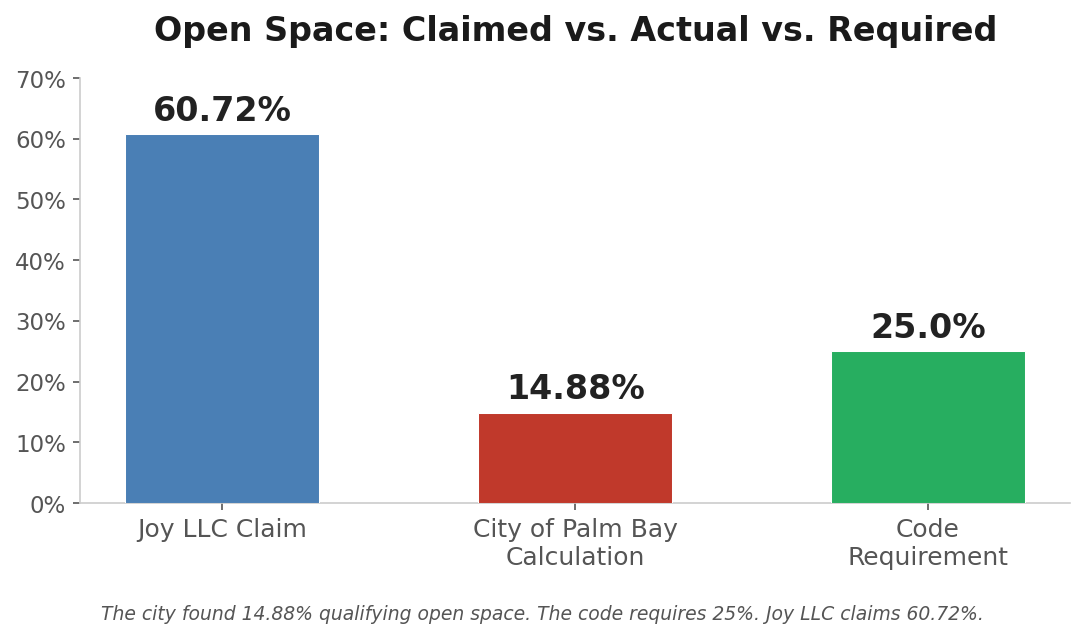
Open space: claimed versus actual. Joy LLC claims 60.72% open space in the development. The city calculated 14.88%. The code requires 25%. The discrepancy is not a rounding error. The city’s position is that stormwater ponds count toward open space only if they are designed as visual and usable amenities with landscaping, access, and recreational value. Stormwater infrastructure that simply holds water does not qualify as open space under the code.
No approved Traffic Impact Study. The city had not accepted the traffic study methodology as of September 2025. The city engineer added three intersections and two road segments to the study scope that Joy LLC had not included. Bayside Lakes has limited ingress and egress points. School traffic is already a daily problem. A traffic study that does not account for the right intersections is not a traffic study.
No utility concurrency review. Joy LLC stated in its application that there is “sufficient capacity” for water and sewer. The city’s Utility Department had not conducted or confirmed this review. The claim was unsupported.
No school concurrency review. Not conducted.
No transportation concurrency review. Not conducted.
Lot sizes reduced. The prior Preliminary Development Plan included 80-foot lot frontages. The current application drops to 40, 50, and 60-foot lots. Smaller lots. Denser feel. Closer to the neighboring Bayside Lakes homes.
Commercial acreage shortfall. Section 185.065(F) of the city code requires a minimum of 15% commercial acreage in the development. Based on the total acreage of 210.99 acres, that means 31.6 acres of commercial. The application does not meet this threshold.
Open space calculation methodology. The city’s math: 31.4 acres of qualifying open space divided by 210.99 total acres equals 14.88%. Not 60.72%.
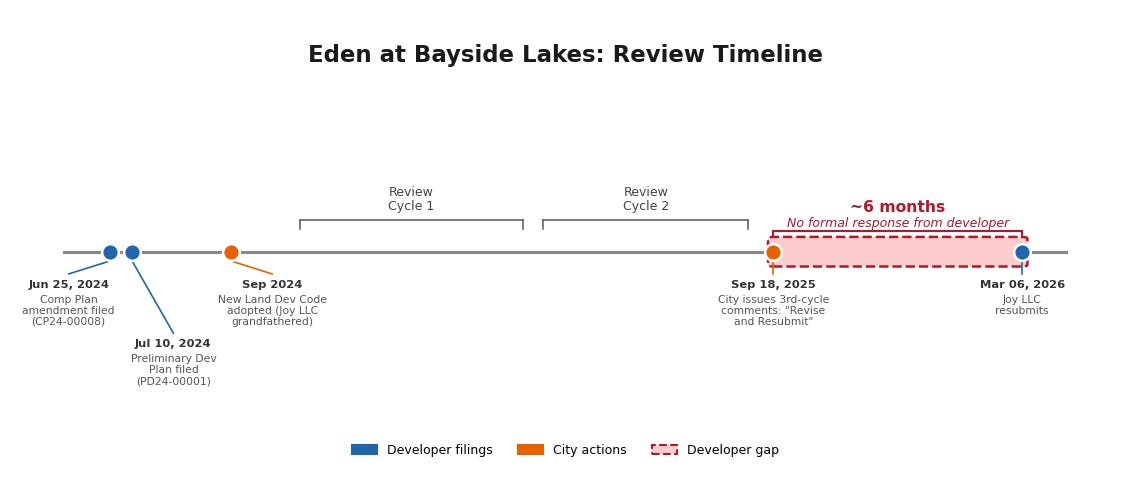
Joy LLC has not responded to these comments. The review comments were issued September 18, 2025. As of March 2026, approximately six months have passed with no formal response from the developer. Joy LLC resubmitted documents in early March 2026, but the revised plans have not yet been posted to the city’s project website.
The Old Code Advantage
Joy LLC filed its applications before the City of Palm Bay adopted its updated Land Development Code in September 2024. Under Florida law, the application is reviewed under the regulations in effect at the time of filing. This means Joy LLC’s proposal is being evaluated under the old, less restrictive code.
The Palm Bayer previously reported on this regulatory gap in September 2025. The old LDC has different standards for open space calculations, lot dimensions, setbacks, and PUD requirements. Every application filed after September 2024 must meet the updated standards. Joy LLC’s does not, because it does not have to.
This is not illegal. It is how Florida’s development review process works. But it means that a project proposed in 2024 is being judged by standards that Palm Bay’s own elected officials decided were insufficient and replaced.
The Environmental Question
The 200-acre property is not just land. It is part of a water management system.
SJRWMD holds conservation easements on 10.78 acres of wetlands on the property. BMAP obligations, the state’s framework for managing nutrient pollution in impaired waterways, apply to the land regardless of who owns it or what they want to build on it.
The developer’s own narrative acknowledges the cost of impacting those wetlands: $150,000 to $175,000 per acre in mitigation. The narrative adds a caveat that should give everyone pause: the cost could be higher “if it is determined that these wetlands were utilized as past mitigation.” In other words, if prior development in Bayside Lakes already counted these wetlands as environmental offsets, disturbing them now creates a double liability.
The environmental assessment also flags the current condition of the property. Two hundred acres of dead brush and weeds reaching five to six feet. Unmaintained canals with lily pads and dead animals causing blockages. Palm Bay’s Deputy Fire Chief walked the property and confirmed that a single lightning strike could consume neighboring homes within eight minutes.
The property is simultaneously a fire hazard and a development proposal. Both conditions are the result of the same decision: to close the golf course.
What the Residents Have Done
The Bayside Lakes community has been organized, vocal, and persistent. The record shows:
Over 3,000 signatures on a Change.org petition to keep the golf course zoned recreational. Hundreds of residents attending the March 28, 2024 Citizen Participation Plan meeting. Organized red-shirt campaigns at public meetings. An HOA coalition coordinating opposition across multiple homeowners’ associations in Bayside Lakes. A dedicated contact email (protectbaysidelakes@yahoo.com). Mass email campaigns. Public comment at every relevant meeting. Media coverage through Fox 35, Spectrum News 13, and The Palm Bayer. Two years of sustained civic engagement.
The opposition is real, organized, and broad-based. No one questions the community’s commitment.
What the Residents Have Not Done
A review of the Swagit-recorded proceedings for all six meetings where Eden at Bayside Lakes or Joy LLC appeared on the agenda, spanning from January 2024 through September 2025, confirms one fact: no attorney has spoken on behalf of Bayside Lakes homeowners at any City Council or Planning and Zoning Board meeting.
Two years. Six meetings. Zero legal representation at any proceeding where a vote is taken.
Attorney Kim Rezanka of Lacey Lyons Rezanka did speak on behalf of residents at the March 28, 2024 Citizen Participation Plan meeting. But a CPP meeting is a developer-led requirement, not a City Council or Planning and Zoning Board hearing. No attorney has appeared for residents at any official hearing where the applications are actually decided.
HOA attorneys represent the corporate entity of the homeowners’ association. They protect the association’s governance documents, enforce CC&Rs, manage contracts with vendors, and handle board-level disputes. They do not represent individual homeowners claiming diminished property values. They do not challenge traffic study methodology. They do not file formal objections under Section 163.3184 of the Florida Statutes. They do not retain experts to conduct independent concurrency analyses.
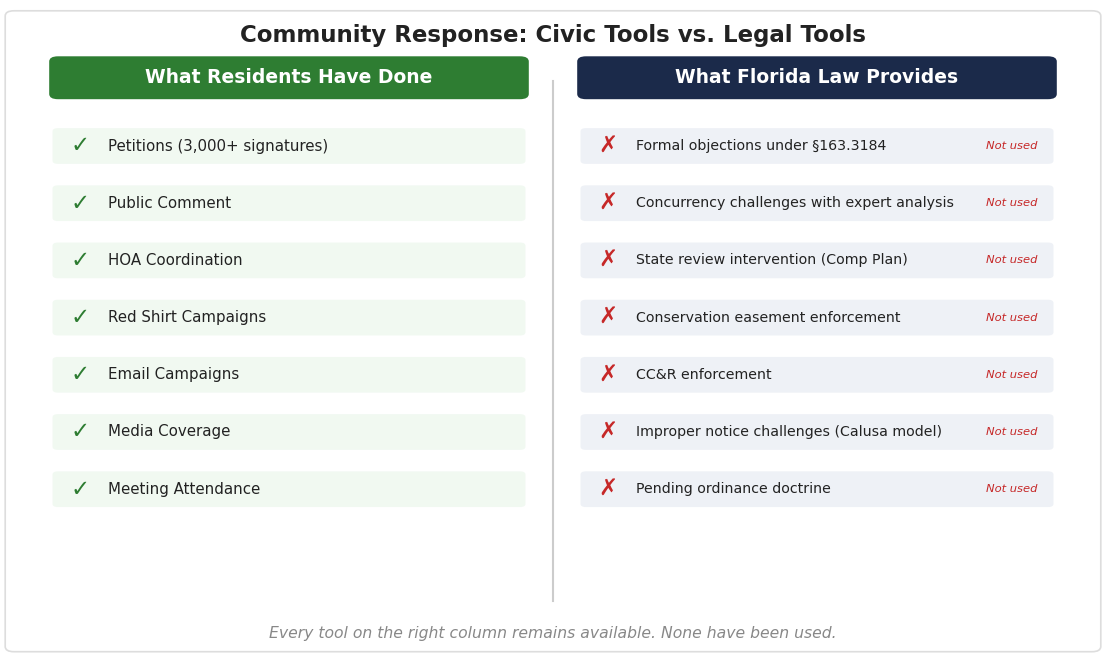
Look at the cases where communities won.
In Calusa, Save Calusa retained a lawyer who found that the rezoning hearing was improperly noticed. The courts killed the project. In Pebble Creek, the county’s attorneys took the denial through circuit court and the appellate court, and the appellate court upheld the county’s authority. In Park Hill, Denver, a conservation easement put the question to voters, and voters said no by a 60-40 margin. In Reston, Virginia, the Board of Supervisors refused to even begin the Comprehensive Plan amendment process.
In every case where the community prevailed, the tools were legal and procedural. Petitions demonstrated public sentiment. Lawyers won the fights.
To date, the Bayside Lakes opposition has relied on petitions, public comment, and HOA coordination. No independent legal counsel has been retained to represent homeowners’ interests in the land use proceedings.
Three Applications, One Long Review
Joy LLC has three applications pending before the City of Palm Bay.
Large-Scale Comprehensive Plan Future Land Use Map Amendment (CP24-00008). Filed June 25, 2024. Currently in its third review cycle. Status: Revise and Resubmit. This is the foundational application. The current land use designation does not support the proposed density. Without a FLUM amendment, the project cannot proceed.
Preliminary Development Plan (PD24-00001). Filed July 10, 2024. Third review cycle. Status: Revise and Resubmit. This is the detailed site plan showing lot layout, roads, open space, commercial areas, and infrastructure. The September 2025 review comments identified the open space discrepancy, the missing concurrency reviews, and the lot size reductions.
Final Development Plan (FD24-00002). On hold. Cannot move forward until the PDP is approved by City Council.
The approval sequence, if the applications advance, would proceed through staff review, Planning and Zoning Board recommendation, City Council first reading of the Comprehensive Plan amendment, state review by DEO and commenting agencies, Council second reading and adoption, Council approval of the PDP, and then FDP review. No P&Z hearing date has been set. No Council hearing date has been set.
A Compressed History
December 2019. Joy LLC purchases the Majors Golf Course property at auction.
2020. Golf course operations decline. Joy LLC attorney Jack Spira cites “significant financial loss.”
June 2022. The golf course permanently closes.
January 2023. Palm Bay City Council passes Ordinance 2022-119, modifying nuisance provisions for unimproved property. The ordinance is a direct response to the condition of the abandoned course. Joy LLC’s attorney objects, citing financial hardship.
May through October 2023. Mayor Medina explores city purchase of the property. Staff reveals Joy LLC appraised the property at approximately $7 million and will not sell for less.
November 2023. Medina asks Council to direct staff to negotiate a public-private partnership to restore and operate the course.
March 28, 2024. Citizen Participation Plan meeting at the property. Hundreds of residents attend. Joy LLC presents 703 units (403 single-family, 150 townhomes, 150 apartments), with 38% green space and a linear park using existing golf cart paths. Residents voice concerns about traffic, infrastructure, and loss of green space. Residents criticize the meeting format: limited seating, no opportunity to question the developer directly.
June 25, 2024. Comprehensive Plan amendment application (CP24-00008) filed.
July 10, 2024. Preliminary Development Plan application (PD24-00001) filed.
September 2024. Palm Bay adopts updated Land Development Code. Joy LLC’s applications, filed before adoption, are grandfathered under the old code.
September 18, 2025. City issues third-cycle review comments. Revise and Resubmit. Major findings on open space, traffic, concurrency, and lot sizes.
March 6, 2026. Debbie Flynn notifies HOA contacts that Joy LLC has resubmitted the Eden at Bayside Lakes project. Revised PDP documents expected on the city project website the week of March 9.
March 7-8, 2026. HOA presidents mobilize. Civic activists demand a public hearing within 30 days.
What Happens Next
No Planning and Zoning Board hearing date has been set. No City Council hearing date has been set. The Final Development Plan is on hold. The application is in staff review.
The revised documents from the March 2026 resubmission are expected on the city’s project website the week of March 9. Whether Joy LLC has addressed the open space discrepancy, the missing concurrency reviews, and the lot size changes will be visible in those documents.
The next public touchpoint is unknown.
The city’s dedicated project page for Eden at Bayside Lakes is at palmbayfl.gov. The Comprehensive Plan amendment application, the Preliminary Development Plan, the environmental narrative, and the review correspondence are all public records. Anyone who wants to read the documents themselves can do so.
Sources
Government Records and Applications - City of Palm Bay, Eden at Bayside Lakes Project Page (palmbayfl.gov) - City of Palm Bay, Growth Management Department Review Comments, CP24-00008 and PD24-00001, September 18, 2025 - Palm Bay Ordinance 2022-119 (nuisance provisions for unimproved property) - Palm Bay Ordinance 2022-09 (land use change, 23.86 acres, Sachs Capital Group) - Florida Statute 163.3184 (Comprehensive Plan amendment process) - St. Johns River Water Management District conservation easement records
Research and Advocacy Reports - 1000 Friends of Florida, “Special Report: Golf Course Redevelopment or Repurposing in Florida,” August 2021 - MIT Thesis, “Land Use Disputes over Golf Course Redevelopment” - Touro Law Review, “Ensuring Continuing Community Amenities Through Golf...” - Villanova Law Review, “The Legal Land Use Controls Involved with Golf Course...”
Court Records - Save Calusa v. Miami-Dade County (Florida Supreme Court, May 2024, appeal refused) - G.L. Acquisitions Corp. v. Hillsborough County (appellate court, July 2025, denial upheld)
News Coverage - FOX 35 Orlando, “Palm Bay residents push back over development of vacant golf course,” March 2024 - Spectrum News 13, “Developer looks to transform an old Palm Bay golf course,” March 20, 2024 - The Palm Bayer, “Eden at Bayside Lakes: A Pivotal Juncture for Palm Bay’s Growth,” March 27, 2024 - The Palm Bayer, “Eden at Bayside Lakes CPP Meeting,” March 29, 2024 - The Palm Bayer, “Joy LLC’s Regulatory Advantage: Palm Bay’s Development Loophole,” September 5, 2025 - The Palm Bayer, “Environmental Obligations of Palm Bay’s Majors Golf Course,” June 27, 2025 - The Palm Bayer, “Palm Bay City Council Voting Record 2021-2024,” May 6, 2024
Community Records - Change.org petition, “Keep the Majors Golf Course Zoned Recreational” (3,000+ signatures) - Save Sherwood (savesherwood.com) - Save Sun City Center (savescc.org)
Correspondence - Email chain: Debbie Flynn (City of Palm Bay) to Robert Stise (Summerfield HOA), March 6, 2026


