


City Manager Mathew Morton launches FY27 planning with a mandate for internal austerity and a “government center” relocation proposal.
Palm Bay, FL – The City of Palm Bay has officially opened its Fiscal Year 2027 budget cycle months ahead of schedule, debuting a “fiscal fitness” strategy that demands every department prove it can do more with 20% less. The workshop, held on January 20, signaled a move away from the haphazard late starts of the past toward a model that City Manager Mathew Morton calls “priority-driven zero-based budgeting.” This early start raises a significant question: Can the city bridge a multi-billion dollar infrastructure gap while simultaneously lowering the tax burden on residents?
The workshop served as a pivot point from previous correction course efforts, moving from reactive crisis management to proactive modeling. Morton emphasized that the city is not just pumps, pipes, and police cars, but a community that must align its limited resources with its actual priorities. The “fiscal fitness” theme is intended to ensure the city is lean enough to survive the 3% revenue cap mandated by state and local regulations.
The Response Time Deficit
A noteworthy moment in the workshop occurred when performance metrics for public safety were laid bare. Fire Chief Richard Stover. reported an average response time of 7.4 minutes, which is significantly higher than the national standard of roughly five and a half minutes. Chief Diehl attributed this delay to the city’s massive 100-plus square mile footprint and the lack of hydrants in newer developments, which forces the use of slower water tenders.
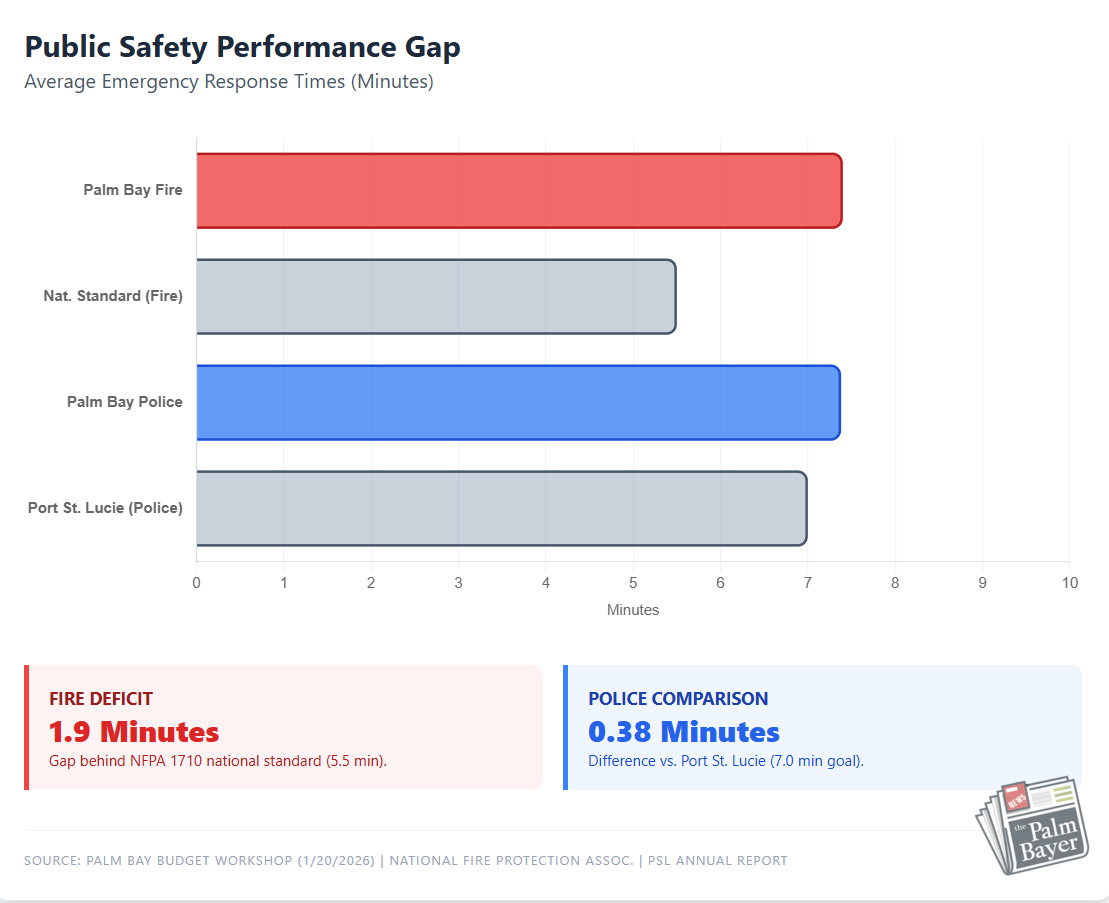
Police response times were similarly high, hovering around 7 minutes and 38 seconds. Councilman Mike Hammer questioned how these numbers compare to Port St. Lucie, a city of similar scale, to determine if Palm Bay’s performance is an outlier. Mayor Rob Medina reminded the council that while the city has made strides with new fire trucks and police equipment, it is still operating within a deficit that has existed since the 1980s.
Selling the Malabar Corridor
There was a proposed bold realignment of city assets to generate revenue without raising taxes. He suggested that the city should sell its high-value surplus property, specifically the Public Works land on Malabar Road, which occupies a prime commercial corridor. Jaffe argued that the proceeds could fund a new “government center” located on city-owned land in the Compound, potentially satisfying workforce grant requirements while centralizing operations.
City Manager Morton confirmed that the city currently holds approximately $17 million in surplus property based on book assessed value. However, the market value of these parcels could be significantly higher if sold for commercial development. This shift would represent a fundamental change in how the city manages its real estate portfolio to address its infrastructure needs.
The 20% “Thought Exercise”
In an attempt to identify internal waste, Morton revealed that he recently tasked every city department with modeling a 20% budget cut. This exercise required directors to show how they would maintain current service levels with a fifth of their operations budget removed. The goal is to identify “overhead expense” at City Hall before the council is asked to consider cutting services that residents rely on, such as summer camps or road paving.
The city is also looking at alternative delivery models to reduce costs. A pilot program that shifted some summer camp operations to the YMCA saved the city between $25,000 and $50,000 per session. Morton noted that the city must be willing to look inward first, asking what tasks could be better handled by professional organizations or outsourced to save taxpayer dollars.
Accountability and Next Steps
The discussion also touched on the need for increased oversight, with Councilman Johnson advocating for a “CPA position” or an Internal Auditor to track every dollar. While some public comment warned against the cost of adding more employees, the consensus among the council was that accountability is essential for building public trust. Morton welcomed the oversight, stating that he wants to “get to the truth as quick as possible” regarding city numbers.
The budget process will continue with a formal vote on FY27 goals scheduled for early February. Residents will have multiple opportunities for input, including a potential “listening” workshop in May before the official proposed budget is published in July. The city’s current strategy suggests that if everything is a priority, nothing is, forcing a hard look at which projects will actually make the cut.
Data Visualization Opportunity: A chart comparing Palm Bay’s current fire/police response times against the national average and neighboring municipalities like Port St. Lucie.


