


Palm Bay, FL -- Palm Bay’s real estate market has flipped. Home prices are falling for the first time since the pandemic run-up. Inventory has nearly doubled. National builders are dropping subdivisions across the city like paratroopers, and renters are watching luxury apartments go up while Section 8 waitlists stay closed. The city is adding residents at 3.7% annually, over 152,000 people now, but the housing being built isn’t solving the affordability problem that existed before the boom started.
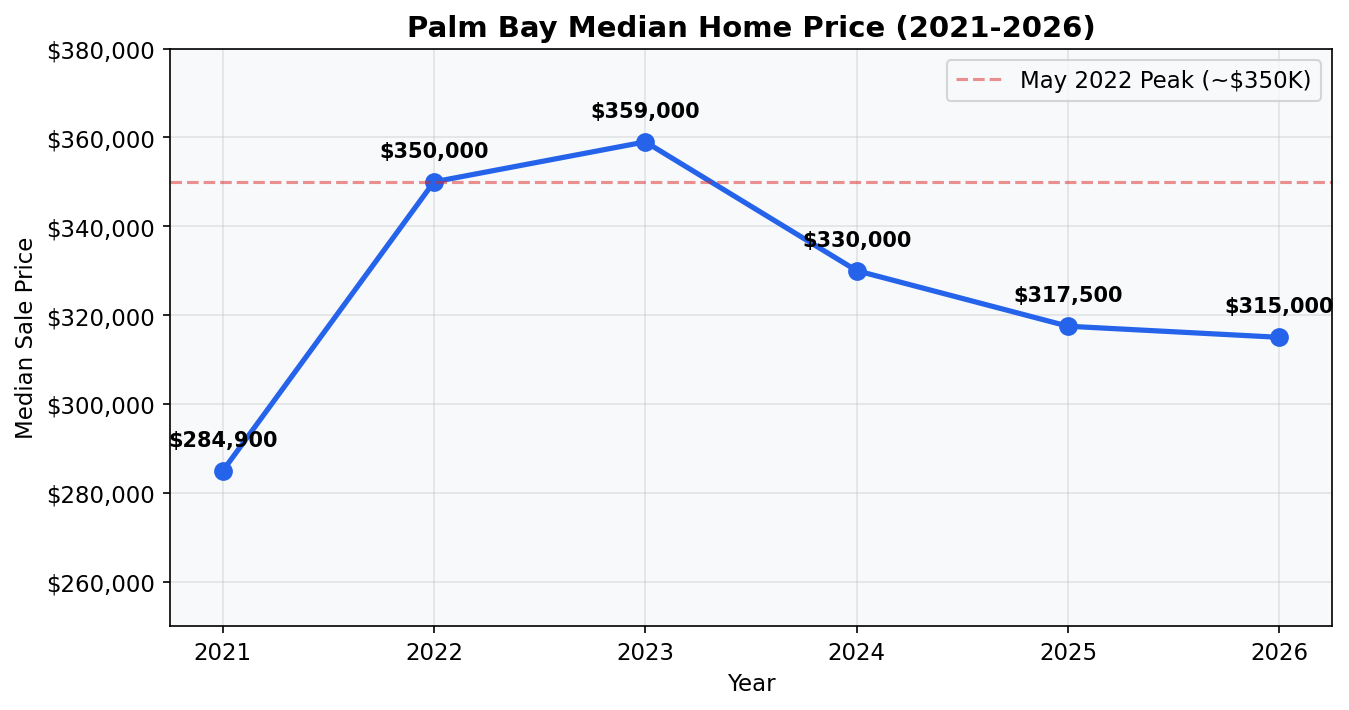
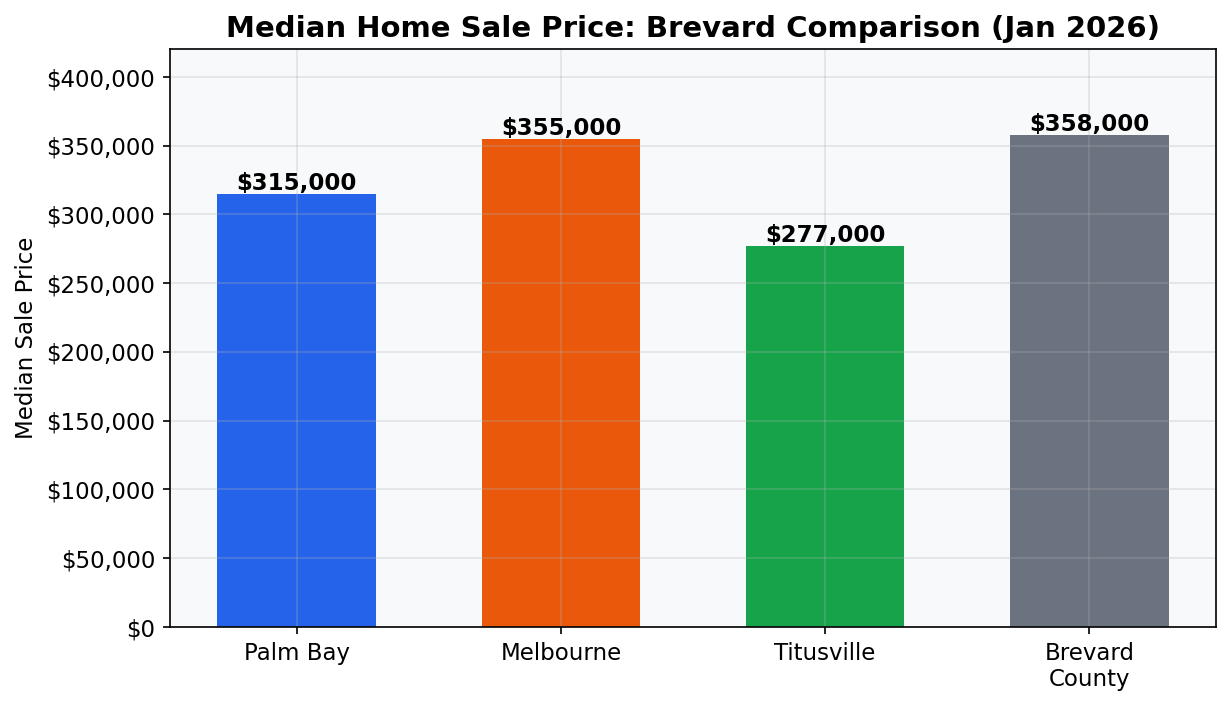
The median home sale price hit $315,000 in January 2026. That’s down 3.1% from a year ago and roughly 10-12% below the May 2022 peak. Active resale listings jumped 73% year-over-year to 471 homes. Homes are sitting on the market for 78 to 90 days, averaging one offer each. A third of all listings have had price cuts. This is a buyer’s market for the first time in five years.
But cheaper relative to last year is not the same thing as affordable. A city employee earning $64,780 cannot qualify for a median-priced home under standard lending rules. A minimum wage worker at $14 an hour can’t rent a studio. And the thousands of new units in the development pipeline are mostly market-rate or above. Palm Bay is building a lot of housing. The question is whether any of it helps the people who need it most.
Single-Family Homes: The Core Market Cools
The numbers tell a clear story. Prices peaked in mid-2022 and have been grinding lower since. The Zillow Home Value Index puts Palm Bay at $313,692 as of February 2026. Price per square foot is $183, down 3.7% from last year. Over five years, prices are still up 10.5% from 2021’s $284,900 median. But anyone who bought at the peak is underwater in real terms, and the trend line is pointed down.
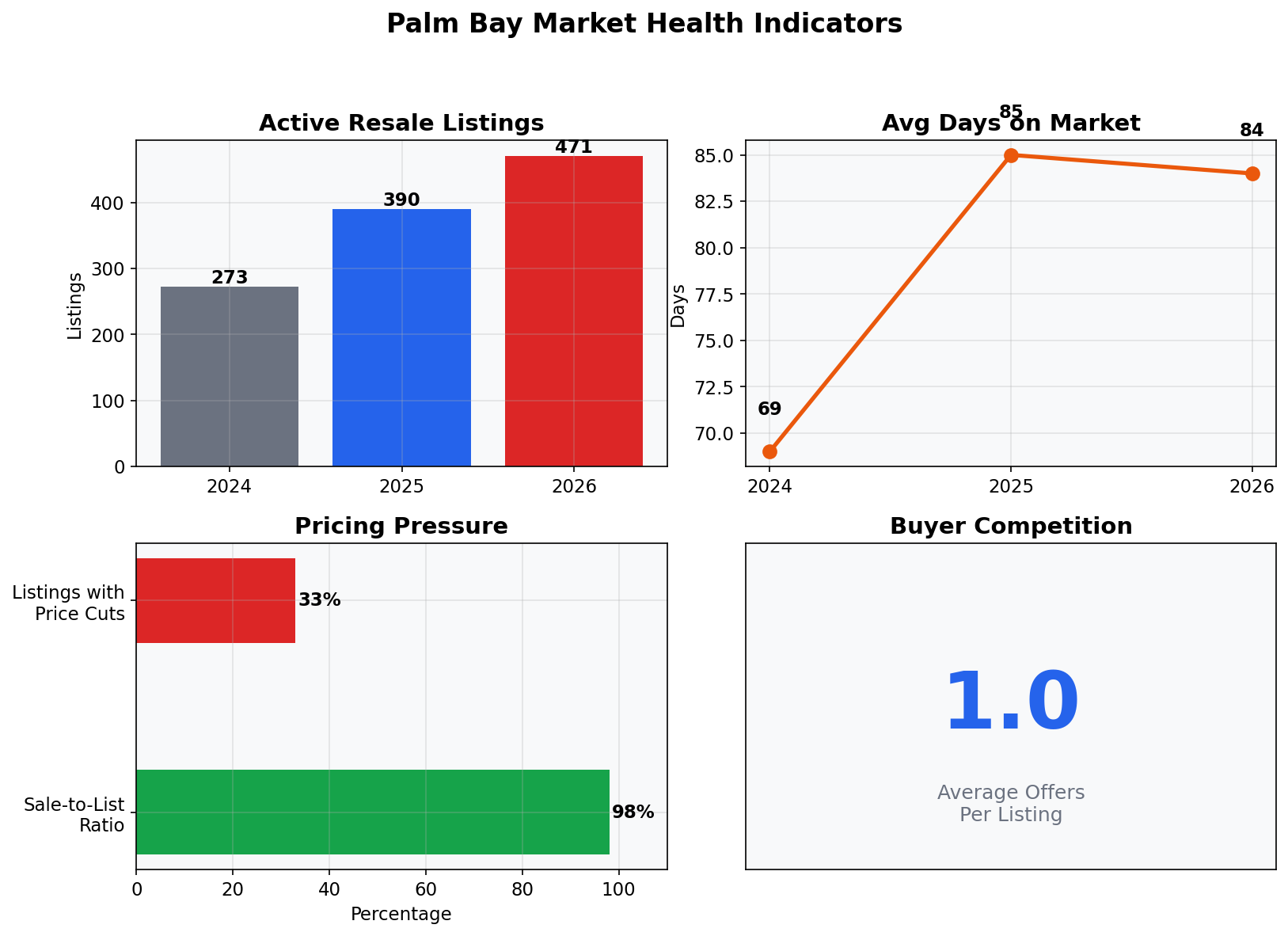
Brevard County’s months of supply sits between 3.7 and 4.4, depending on which data source you prefer. That’s approaching balanced territory. Sale-to-list ratios have settled at 98%, meaning buyers are negotiating again. Sellers who priced aggressively in 2023 are now chasing the market down.
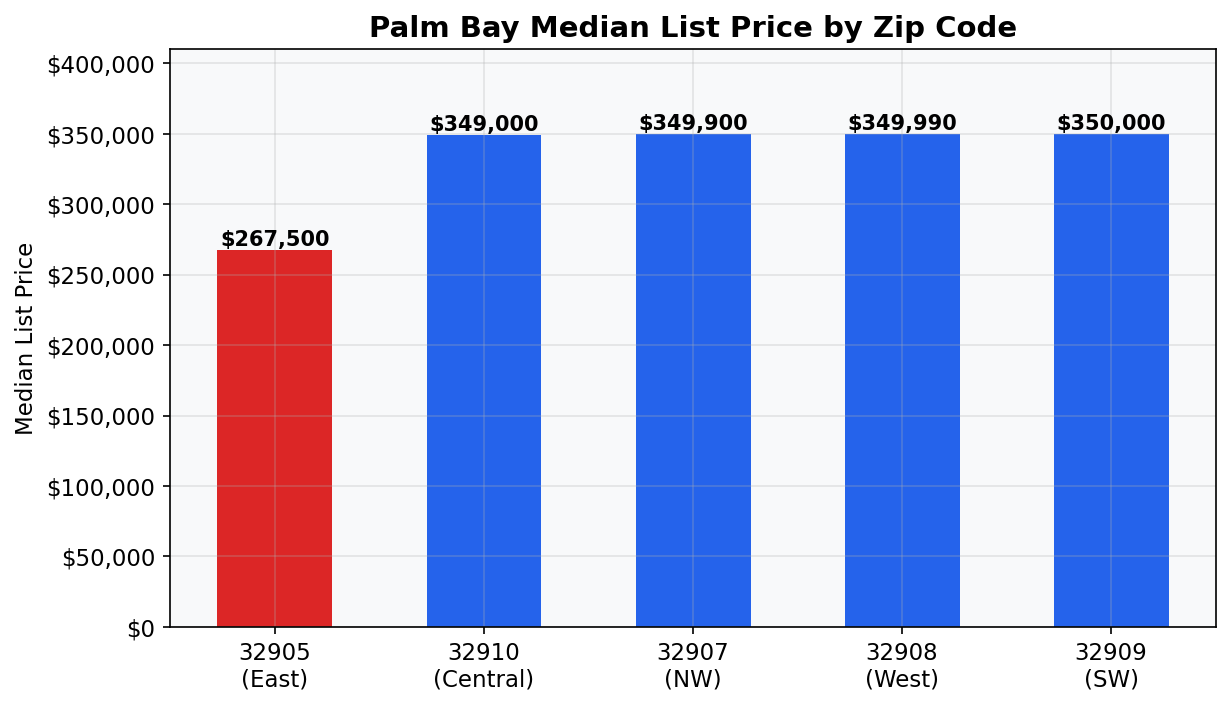
The zip code divide within the city is significant. In 32905, which covers much of the older, eastern part of the city near US-1, the median list price is $267,500. The rest of Palm Bay (32907, 32908, and 32909) clusters between $349,000 and $350,000. Port Malabar’s median sits at $260,000, down 5% year-over-year. If you’re buying in the western growth corridors where the new construction is concentrated, you’re paying $80,000 to $90,000 more than in the city’s older neighborhoods.
According to Reventure’s analysis, Palm Bay homes are still 10.7% overvalued relative to historical norms. That suggests further price declines are likely, especially with inventory climbing and builders competing directly with resale homeowners. One more data point that should concern anyone banking on appreciation: 48% of buyers who searched Palm Bay were looking to leave. That’s not a sign of a market with strong organic demand.
The Builder Invasion
Sixty-two active new construction communities. Let that number sink in.
Lennar is building at Everlands and Tillman Lakes with prices from $301,000 to $400,000. DR Horton has Cypress Bay West in the pipeline with 1,219 single-family homes and 124 townhomes. KB Home is selling in the $300,000 to $362,000 range. These are not small infill projects. These are master-planned communities with thousands of lots, model homes, and sales offices running seven days a week.
For resale homeowners, this is the competition. A buyer choosing between your 15-year-old house that needs a new roof and a brand-new Lennar with a builder warranty, included appliances, and energy-efficient windows is going to take the new build unless your price is meaningfully lower. That dynamic is already showing up in the data. Resale homes sit for nearly three months. New construction in active communities moves faster because buyers finance through the builder’s preferred lender and get rate buydowns.
The builder strategy is straightforward. Palm Bay has cheap land west of I-95, a growing population, and a permitting environment that approves large-scale development. National homebuilders are land-banking thousands of lots and building to demand. When demand softens, they slow starts. When it picks up, they accelerate. Resale homeowners don’t have that flexibility.
Condos and Multi-Family: A Thin Market With a Storm on the Horizon
Palm Bay’s condo and multi-family resale market is small. Only eight active multi-family listings in the entire city, with a median asking price of $627,000. Average condo and co-op list prices jumped 32% year-over-year, from $198,000 to $262,000. But that percentage increase is misleading when the sample size is this small. A handful of higher-priced listings can skew the average dramatically.
The broader context matters more than Palm Bay’s local numbers here. Across Brevard County, condo supply sits at 7.8 months. That’s a buyer’s market. Statewide, Florida’s condo supply has ballooned to 13.2 months, which is distress territory. Half of all condo transactions (51%) are cash deals. That’s not a sign of a healthy lending market for condominiums.
The reason is SB 4-D, the state legislation that followed the Surfside building collapse in 2021. Florida now requires structural inspections, reserve studies, and mandatory reserve funding for condo associations. In older high-rise buildings around the state, this has triggered special assessments ranging from $134,000 to $400,000 per unit. Condo association insurance runs $377 to $438 per month. Owners in some buildings are being assessed more than their units are worth.
Palm Bay gets some insulation from the worst of this because its condo stock is mostly low-rise, newer construction. The city doesn’t have the aging high-rise towers creating distress in South Florida, Fort Lauderdale, and parts of Cocoa Beach. But any buyer looking at a condo in Palm Bay needs to understand the statewide headwinds. Lenders are tightening condo lending standards across the board, and insurance costs are not coming down.
The Rental Market: Flat Rents, Full Pipelines
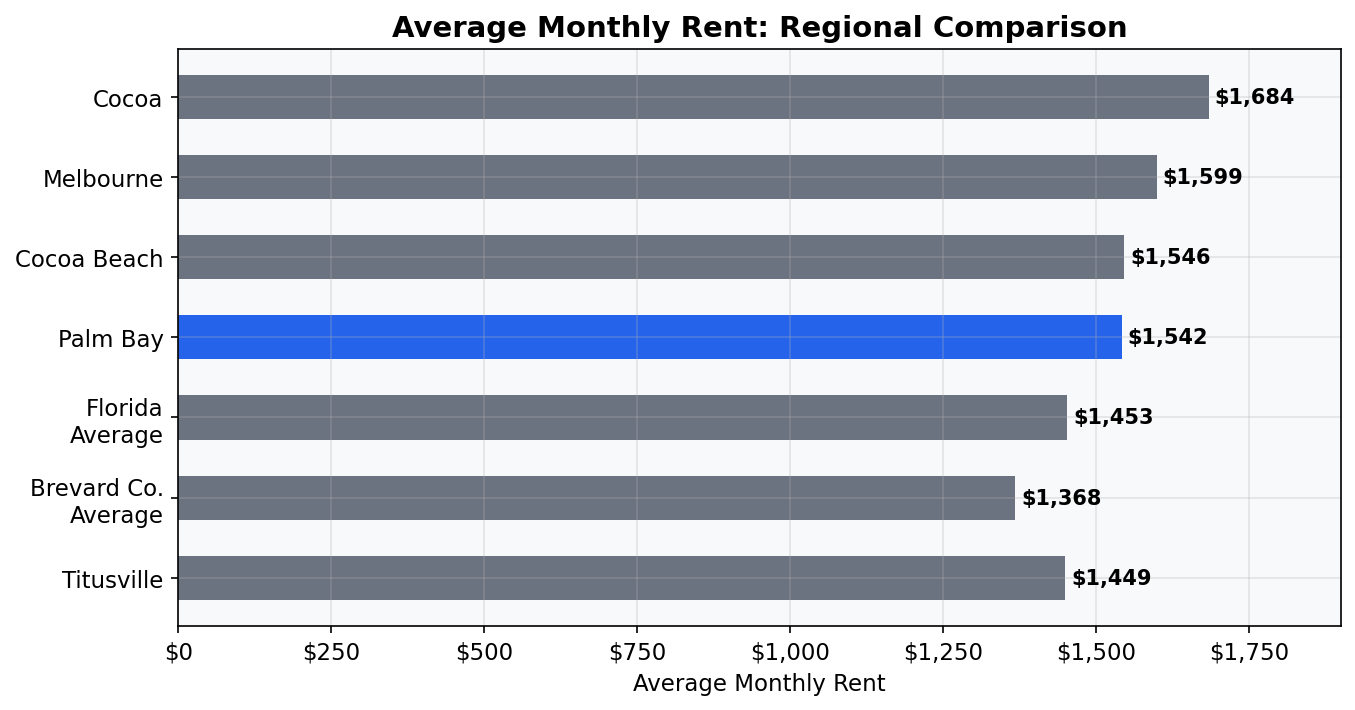
Rents in Palm Bay have flatlined. Depending on which source you use, average rents run between $1,444 (ApartmentList median) and $1,542 (RentCafe average). Year-over-year changes range from negative 1.5% to positive 0.88%. Functionally flat.
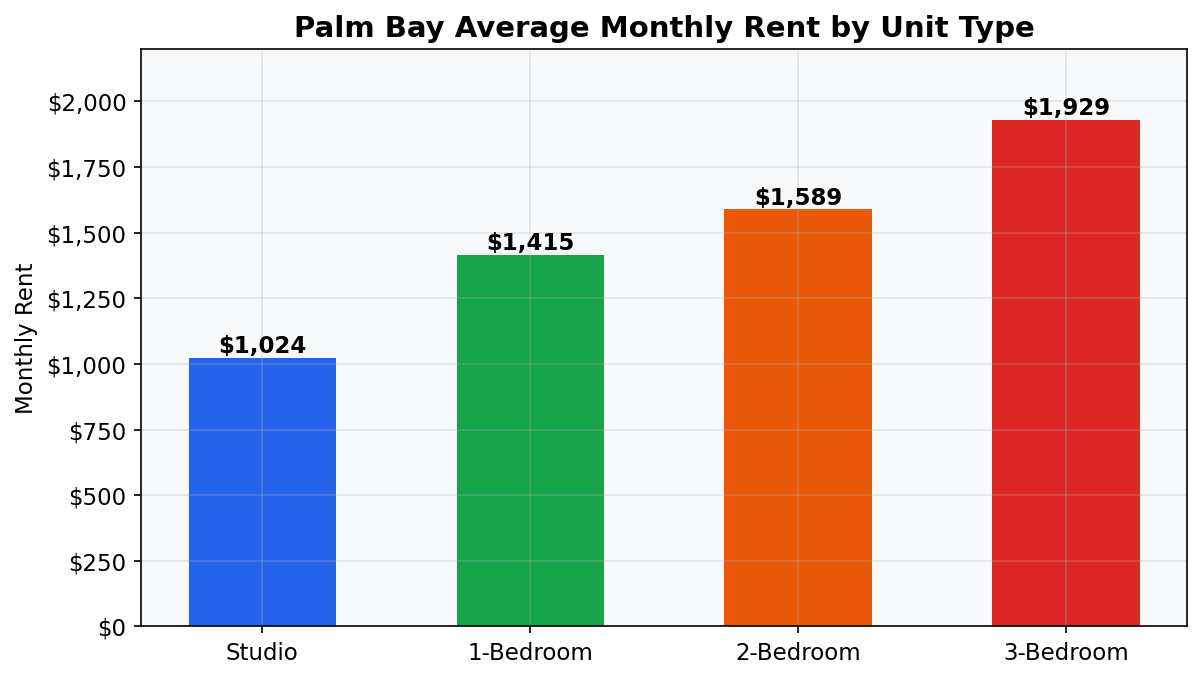
The breakdown by unit type: studios at $1,024, one-bedrooms at $1,415, two-bedrooms at $1,589, and three-bedrooms at $1,929. Palm Bay rents run 12.7% above the Brevard County average. For a city that markets itself on affordability relative to Melbourne and the beaches, that gap is worth watching.
One in four apartments is offering move-in specials. Out of roughly 3,343 total apartment units in the city, between 807 and 843 are advertising concessions like free months or reduced deposits. Landlords don’t give away rent in a tight market. This is softening.
The new supply coming online will add more pressure. Port Malabar, a $100 million luxury apartment project, will deliver 318 units by August 2026 with rents from $1,700 to $3,000. The Havens at Palm Bay will add 266 build-to-rent casita-style units this year. These are market-rate and above. Nobody is building workforce housing at $1,100 a month because the math doesn’t work for developers without subsidies.
The Affordability Wall
Here’s the math that matters.
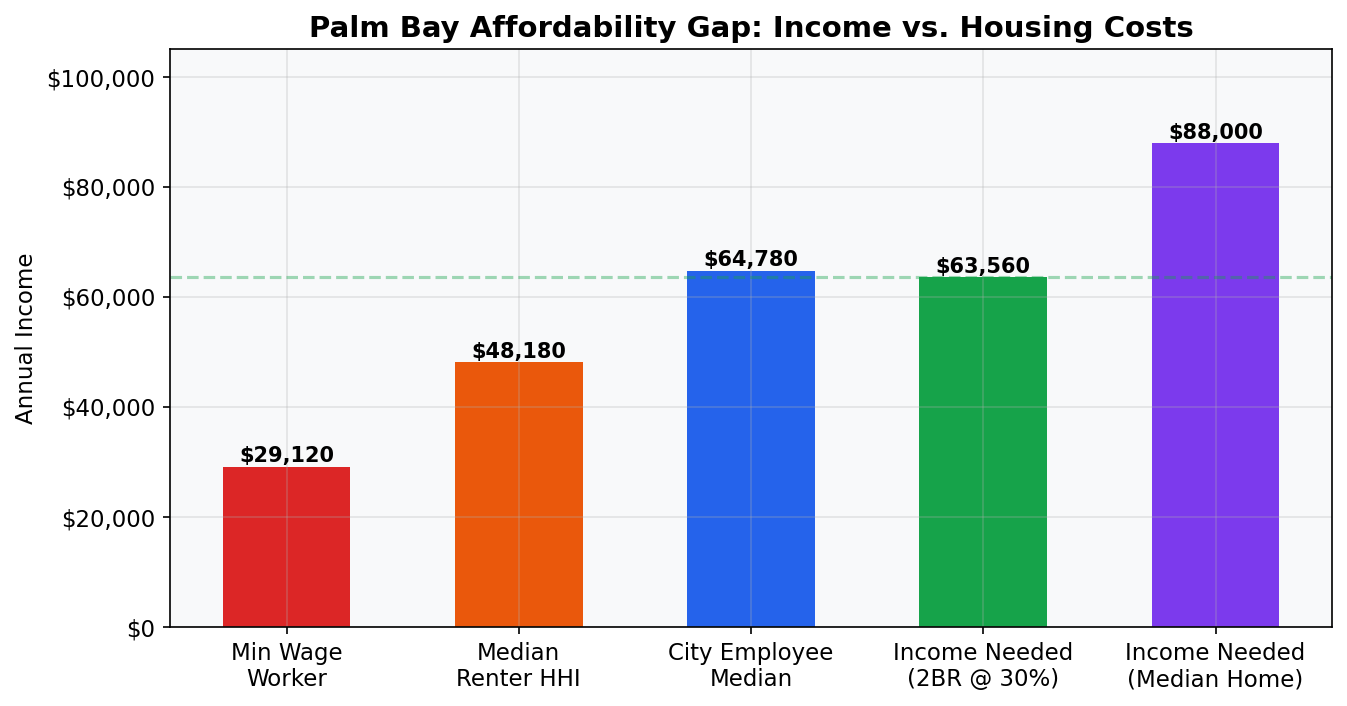
The median renter household in Palm Bay earns $48,180 per year. At current rents, that household spends 37% of gross income on housing. The standard affordability threshold is 30%. Every dollar above that line comes out of groceries, transportation, healthcare, and savings.
A minimum wage worker earning $14 an hour brings home $29,120 annually before taxes. A studio apartment at $1,024 per month requires $40,960 in annual income to meet the 30% threshold. There is no unit type in Palm Bay that a minimum wage worker can afford. Not a studio. Not a room in a shared apartment at listed rates.
The city’s own employees face the same wall. At a median salary of $64,780, a Palm Bay city worker would need to spend roughly 39% of gross income to buy the median-priced home, factoring in current mortgage rates, insurance at $3,815 per year (the Florida average), and property taxes. The people who run the city can’t comfortably afford to live in it.
The Palm Bayer has covered this gap before. The Section 8 waitlist has been closed since July 2020. Average wait time: five years. The city has only 85 Section 8 units and 686 total approved low-income housing units. For a city of 152,000 people where 20.6% of households rent, that’s a rounding error.
The Live Local Act, Florida’s signature affordable housing legislation, has generated 5,427 units statewide under construction. But the act works by offering density and height bonuses to developers who set aside a percentage of units at affordable rates. In a city where land is cheap and zoning already allows density, the incentive structure is weaker. Palm Bay hasn’t seen the same Live Local Act activity as urban cores with tighter land supplies.
The Development Pipeline: 30,000 Units and Counting
The numbers in the development pipeline are staggering.
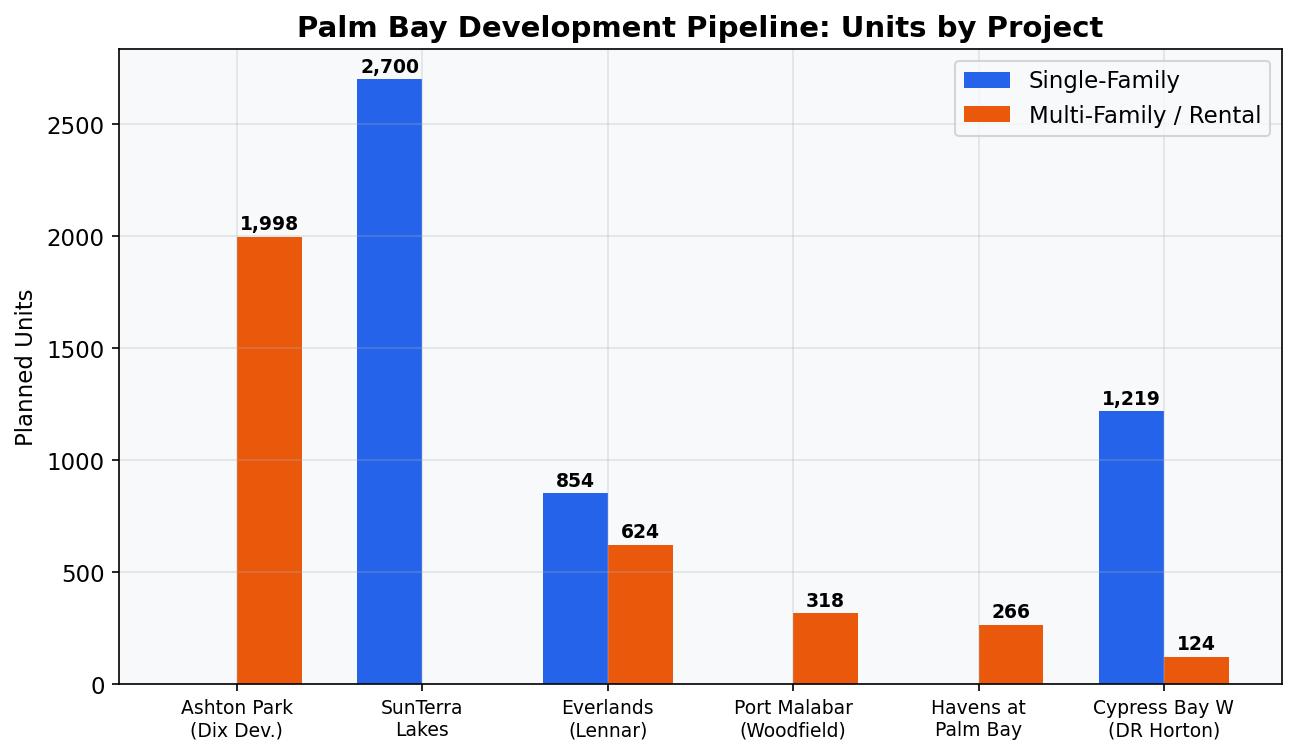
Ashton Park, adjacent to SunTerra Lakes in the city’s southwest growth area, has approval for 1,998 multi-family housing units. The Palm Bayer covered the groundbreaking alongside SunTerra Lakes, which at full buildout will add roughly 2,700 total units including single-family, townhome, and multi-family. Everlands includes 624 multi-family units in addition to its single-family lots. Cypress Bay West adds 1,219 single-family and 124 townhome units. Woodfield brings 318 units. Havens contributes 266.
Add it all up: 9,264 housing units are either approved or under construction in Palm Bay right now. Another 21,133 units are in some stage of review. That’s over 30,000 potential units in the pipeline for a city that currently has around 55,000 total housing units.
If even half of those units get built over the next decade, Palm Bay’s housing stock increases by nearly 30%. That level of supply expansion should, in theory, put downward pressure on both home prices and rents. The question is timing. If all 9,264 approved units deliver into a market that’s already softening, the oversupply could be significant. Builders can throttle back single-family starts. But multi-family developers who’ve already broken ground don’t have that option. Those units are coming whether the market wants them or not.
The Palm Bayer’s development boom analysis from last year laid out the scale. It has only gotten larger since.
What It All Means
Palm Bay’s housing market is in transition. The pandemic-era seller’s market is over. Prices are declining. Inventory is rising. Builders are competing directly with homeowners on price and product. For buyers who’ve been priced out for the last four years, this is the most favorable market since 2020.
For current homeowners, the outlook is mixed. If you bought before 2021, you still have equity. If you bought at the 2022 peak, you’re likely at or below your purchase price, and the combination of rising insurance costs ($3,815 average annually and climbing) and declining values is uncomfortable. The 62 active builder communities aren’t going away.
The rental market is softening but not solving the affordability problem. Rents are flat, not falling, and the new supply coming online is priced at or above current market rates. The luxury apartments at Port Malabar will rent for double what a median-income household can afford. One in four existing apartments is already offering concessions. When the new units hit, that ratio will likely increase.
The affordability crisis is structural. It predates the pandemic. It will outlast the current market correction. Palm Bay’s population is growing at 3.7% annually, which creates demand. But the housing being built is calibrated to what the market will bear, not what residents can afford. Until the city or county develops a meaningful workforce housing strategy with actual units, not studies, not task forces, not advisory boards, the gap between what people earn and what housing costs will persist.
The pipeline will change the supply equation. Whether it changes the affordability equation is a different question entirely.
Sources
Zillow Palm Bay Market Overview (February 2026)
Redfin Palm Bay Housing Market (January 2026)
Realtor.com Palm Bay Market Trends (February 2026)
RentCafe Palm Bay Apartments (March 2026)
ApartmentList Palm Bay Rent Report (February 2026)
Florida Realtors Market Data (January 2026)
Reventure App Market Valuation (February 2026)
City of Palm Bay Development Services (March 2026)
U.S. Census Bureau QuickFacts, Palm Bay (2024 estimates)


