


Palm Bay, FL — When The Palm Bayer published its October 2025 litigation status update, Palm Bay was an active defendant in five federal lawsuits. Four months later, that number has grown to eleven. Four new lawsuits have been filed. One dismissed case was reinstated by a federal appeals court. One equal pay complaint quietly became a five-count discrimination case. A sanctions hearing is set for March 4. One case (the Langevin settlement) has been resolved. The rest are heading toward trial.
A note on sourcing: The facts described in each section are drawn from court filings. They are allegations. No court has ruled on the merits of any active case described below.
The cases below are organized new-first, then updates on previously reported cases. A key-dates table appears at the end.
NEW CASES (Filed After October 2025)
City Cuts Water to 88-Year-Old, Then Refuses to Reconnect
Joseph P. Russoniello is 88 years old. He bought his condominium at The Palms in Palm Bay in 2014. According to a lawsuit filed January 15, 2026, in Brevard County Circuit Court (case 05-2026-CA-012083), he no longer lives there. He alleges he lost his home through a fraudulent foreclosure: a court order he says was issued without any hearing, a forged deed, and nearly $60,000 his son wired to avoid an eviction.
The city’s role in the lawsuit is specific. On October 27, 2025, Palm Bay shut off Russoniello’s water at the request of the man who now claims to own the apartment. Russoniello told the city that a landlord, even a legitimate one, cannot legally order a tenant’s water turned off. The city disagreed and refused to reconnect. That decision is the basis of his claims against Palm Bay, which include breach of contract, emotional distress, defamation, and harassment.
The broader lawsuit names ten defendants, including Russoniello’s own two sons. According to the complaint, an attorney named Mario Garcia called him to an Orlando office and had him sign a deed handing over his apartment for $10, telling him it was a promissory note. The apartment was later sold for $71,000. Russoniello alleges it was worth $140,000. The court has certified him as indigent, meaning he cannot afford the fees. He is representing himself.
As of February 16, 2026, at least one defendant has hired an attorney. No trial date has been set.
Unmarked Car, No Violation, Five Months in Texas: Faulkenberry-Ruiz v. City of Palm Bay
Bryant Lawrence Faulkenberry-Ruiz filed suit in federal court on December 8, 2025 (case 6:25-cv-02345). He is representing himself, and the court waived his filing fees.
His updated complaint, filed January 22, 2026, starts with a traffic stop on March 15, 2025, around 11:00 PM on Waco Blvd SE. According to the complaint, an unmarked black car followed him, then turned on police lights. Officer Kevin Smith approached but never stated what traffic law Faulkenberry-Ruiz had broken. No ticket was ever issued. When Faulkenberry-Ruiz asked for a supervisor, Officer Derek Hollcroft arrived and said, “This is now a criminal investigation.” Faulkenberry-Ruiz was handcuffed. During the arrest, the patrol car door closed on his right arm. Officers then searched his car and his wallet without a warrant or his permission, according to the complaint.
What the complaint describes as happening next was worse than the stop. Faulkenberry-Ruiz was transferred to Texas on a probation hold. That probation had legally ended in 2022. He had documentation. He was still held for five months. While he was in custody in Texas, Florida marked him as a “Failure to Appear” for a court hearing. He had notified the court he was in custody. The record was never fixed. Old traffic citations were relisted as unpaid fines. He lost his job. He lost his driver’s license. The financial damage is ongoing, according to the complaint.
His claims include unlawful stop, false arrest, illegal search, excessive force, and liability against the City of Palm Bay for allowing the pattern to happen. He also names the Brevard County Sheriff for the jail conditions. The case is in its early stages. No trial date has been set.
Man Arrested for Defending His Own Home: Steelman v. City of Palm Bay et al.
Christopher Steelman filed his case in Brevard County Circuit Court (case 05-2025-CA-019339). His updated complaint, filed January 21, 2026, describes the following sequence of events.
On December 18, 2022, Steelman was at his property on Breakneck Circle with a computer technician. His neighbor Richie Chapman, described in the complaint as a drug addict who was drunk, had showed up at Steelman’s property two days in a row. On December 18, Chapman returned with a baseball bat and swung it at guests. Steelman has martial arts training. He took the bat away and held Chapman in a restraint hold until Chapman’s father arrived. According to the complaint, four witnesses confirmed Chapman started the confrontation.
Palm Bay Police arrived without using their sirens, what the complaint describes as a “strategically silent” approach, despite no-trespassing signs posted at the property. Officers drew guns on Steelman in front of his own garage. Then they arrested him for battery, based on Chapman’s complaint.
The state pursued charges for nearly two years. According to the complaint, three witness statements confirming Chapman as the aggressor were left out of the arrest report. The charges were eventually dropped. Steelman is now suing for false arrest, false imprisonment, battery, defamation, and intentional infliction of emotional distress. He cites Florida’s Castle Doctrine and Stand Your Ground law. He alleges the ordeal cost him $6,000 per hour in lost business income when his company was fully operational. He is representing himself.
Court summons were sent to state defendants, including Attorney General James Uthmeier, on February 9, 2026. No trial date has been set.
Developer Sues Over Selective Zoning Enforcement: Deligdish v. City of Palm Bay
The newest lawsuit in the portfolio was filed February 20, 2026, in federal court (case 6:26-cv-00409). Craig Deligdish, M.D. and his company, Palm Bay Medical Office Corporation, own roughly 178 acres inside the Bayside Lakes Planned Unit Development, a large mixed-use development the city approved in 1999. They want to build a self-storage facility on the commercial portion of their land. A recorded covenant agreement, a legally binding document attached to the property, expressly allows self-storage there.
According to the complaint, the city has blocked the project at every step. In December 2024, the city denied a zoning request, then admitted it handled the matter incorrectly and directed plaintiffs to try a different approval process. When plaintiffs submitted a replat (a redrawn map of the property lots required before construction), the city refused to review it. The city said a Preliminary Development Plan, called a PDP, had to be approved first. Plaintiffs say the city’s own code does not actually require that. On October 1, 2025, the City Council voted to deny the PDP application even though plaintiffs had asked for it to be pulled from the agenda and said they would not attend.
The equal protection argument, a legal theory that says the government must treat similarly situated people the same way, centers on this: according to the complaint, at least one other developer in the same Bayside Lakes development received self-storage approval without a PDP, and other property maps in the same development were approved without concurrent PDP review. Plaintiffs allege the city is applying a requirement to them that it does not apply to others in the same situation.
Plaintiffs also invoke two recently passed Florida laws. The first, Senate Bill 180, bars local governments in hurricane-affected areas from adding more restrictive development rules for one year after a hurricane, retroactively applied to August 1, 2024. The second, Senate Bill 784, requires that certain property map submittals be approved through an administrative process, not by a vote of elected officials. Plaintiffs allege the city is using the PDP requirement to get around both statutes.
A required presuit notice, a formal warning required by law before filing certain lawsuits, was delivered to the city January 15, 2026. The city did not respond within the 14-day window. Lead attorney Christian Waugh is board-certified in real estate law. No judge has been assigned and the city has not yet been formally served as of publication.
UPDATES ON PREVIOUSLY REPORTED CASES
MacIntyre: Federal Appeals Court Reinstates Case, New Complaint Due This Week
Scott MacIntyre’s civil rights case was thrown out by the trial court and reported in October as pending on appeal. On December 19, 2025, the U.S. Court of Appeals for the Eleventh Circuit, the federal appeals court that covers Florida, issued a ruling that reinstated nearly the entire case.
Here is what that means in plain terms. MacIntyre brought a civil rights lawsuit against Palm Bay after he alleges officers arrested him without cause in December 2022 while he was riding a Segway, aggravating a pre-existing hernia. The trial court dismissed the case, ruling the officers were protected by qualified immunity, a legal doctrine that shields government officials from lawsuits unless they violated a “clearly established” constitutional right. MacIntyre appealed. The appeals court ruled that everything except one abandoned claim should have survived. The defendants themselves agreed to send everything back to the trial court except that one dismissed claim.
After winning that appeal, MacIntyre replaced his local attorney with two national law firms: Holland & Knight out of Miami and Gibson, Dunn & Crutcher out of Washington, D.C. The city’s defense remains with the City Attorney’s office. Trial is set for March 1, 2027.
One correction from October: there was never an amended complaint in this case before. The trial court dismissed the original complaint, the first document filed, and the complaint due February 27, 2026, will be the first revision ever filed. Holland & Knight and Gibson Dunn are writing it from scratch. That document will define exactly what claims go to trial. Readers should expect a follow-up report as soon as it is filed.
Pedersen: Sanctions Hearing March 4, Trial August 3
The Pedersen case is the most active right now. A hearing is confirmed for March 4, 2026, at 10:00 AM in Courtroom 5D, 401 W. Central Blvd., Orlando. The city filed a motion on January 14 asking the court to sanction, meaning formally punish, the plaintiff’s attorney, Ariel Lett, for conduct during the case. On February 12, the judge issued a formal order directing Lett to appear in person and explain himself. The hearing is confirmed.
The case itself: on September 25, 2020, Jeffery W. Pedersen was in mental health crisis. Palm Bay officers responded, determined he qualified for a Baker Act transport (meaning Florida law authorized officers to take him to a hospital for evaluation), and called for Fire Rescue. When Pedersen resisted, officers tased him and restrained him. Then Sergeant Jessie Eakin arrived and changed the plan. Instead of the hospital, Eakin ordered Pedersen arrested and sent to the county jail. When Officer Samuels questioned that decision, Eakin’s response, according to the complaint, was: “need to write Jeffery up for resisting because we don’t want him just Baker Acted.”
At the jail, corrections Officer Richard Weaver pepper-sprayed Pedersen in the face while Pedersen was in handcuffs. Pedersen went limp. He was taken to Rockledge Regional Medical Center, admitted to the ICU for 16 days, and diagnosed with cardiac arrest, sepsis, and acute kidney failure. He died after the lawsuit was filed. His son is pursuing the case on behalf of his estate.
Trial is set for August 3, 2026.
Enlow: An Informant’s Story, and a Case in Danger
The October update described this case in general terms. The updated complaint, filed January 28, 2026, is detailed, and the current situation in court is precarious.
According to the complaint, in June 2019, Palm Bay Officer Aaron Arndt recruited Lisa Enlow as a witness in a felony theft investigation and explicitly promised her police protection in exchange for surveillance footage and testimony. By August 2020, that promise had been broken. After Enlow asked about her right to obtain written police reports, Lieutenant Jeffrey Spears told her that no officers under his command would respond to her home, and to call “only if they shot” her. The next day, according to the complaint, Spears confirmed: “I told your husband yesterday we weren’t coming out.”
On August 24, Officer David Porter came to her home, not to protect her but to interrogate her about who had told her she was allowed to request written police reports, according to the complaint. On November 4, 2020, shots were fired at her home. Her security system captured the audio. Bullet holes were found in the fence.
Commander John Resh’s response, according to the complaint, was to tell Enlow she was only complaining because she was “a girl and scared.” Chief Nelson Moya and an Internal Affairs officer canceled Enlow’s internal affairs appointments, the formal process for filing a complaint against an officer, and told her to stop talking. City Manager Suzanne Sherman was informed of the shooting, the gender bias, and the evidence problems. According to the complaint, she said she would “trust the Chief” and did nothing.
Lisa and John Enlow allege they were forced to sell the home they had built with their own hands and that the family spent years homeless with minor children.
The lawsuit brings four claims. The first is that Officer Arndt and Lieutenant Spears created a legal duty to protect Enlow by recruiting her as an informant, then violated that duty by withdrawing protection. The second is that Commander Resh violated her equal protection rights through gender bias. The third is that Chief Moya and others violated her First Amendment right to file a complaint. The fourth is that the City itself is liable because City Manager Sherman ratified the officers’ conduct by doing nothing.
The Enlows are representing themselves. The case is in serious trouble on two fronts. On February 6, the court issued an Order to Show Cause, a formal warning, for failing to file a required scheduling document. The response deadline was February 20. No response was filed. On that same day, City Attorney Erich Messenger filed a 14-page motion to dismiss. The motion argues that every single claim is time-barred, meaning the events happened in 2019 and 2020 and the four-year filing deadline had already passed by the time the case was filed in June 2025. If the court agrees with that argument alone, the case is over regardless of how compelling the underlying facts are. The motion raises six additional arguments on top of that.
No trial date has been set.
Forish: What Started as an Equal Pay Case Is Now Much Larger
Stacey Forish’s lawsuit against the Palm Bay Police Department has changed substantially since October. The original complaint filed in March 2025 had one claim: a violation of the Equal Pay Act, the federal law requiring men and women to receive equal pay for equal work. The updated complaint filed September 29, 2025, has five claims across four different laws.
The core allegations remain the same. Forish had 14 years of law enforcement experience in Connecticut when PBPD hired her in February 2023 at pay Step 2. According to the complaint, male officers hired with less experience were placed at Step 4 after meeting directly with Chief Mariano Augello to negotiate their starting salaries. When Forish asked to negotiate, she was told she could not. Union Official Jorge Negron told her in writing in April 2024 that it was “not likely female police officers would receive pay equity” from PBPD. Union President Anthony Sacco then informed her that the Chief and City Manager had told the union: pursue Forish’s pay case, and the city would refuse to sign a new contract, putting every officer’s raise at risk. The union backed down. According to the complaint, a second female officer, Halley Branch, was paid the same low rate despite having six years of Colorado law enforcement experience.
The updated complaint adds four things the original did not include. First, Forish alleges she applied for a specialty assignment within PBPD, that her score was the highest of all applicants, and that a lower-scoring male officer was given the position. Second, her male comparators, Officers Cary Griffin and Nicholas Hall, were both 31 years old. Forish was born in 1975, making her 48 to 49 during her time at PBPD. She is now also alleging age discrimination, not just sex discrimination. Third, after Forish passed her certification exam and received a pay bump based on her experience, PBPD restructured the pay scale one month later and cut her premium down to 3%. It was never restored. Fourth, Forish alleges the situation became intolerable and that she was forced out, what the law calls a constructive discharge, on November 15, 2024.
The five active claims are: Equal Pay Act, Title VII sex discrimination, Florida Civil Rights Act sex discrimination, federal age discrimination (ADEA), and Florida Civil Rights Act age discrimination. Before filing the Title VII and state claims, Forish was required by law to file complaints with the EEOC and the Florida Commission on Human Relations and receive a formal Right to Sue letter. She did.
The City filed an Answer with defenses rather than a motion to dismiss. That makes Forish the only case in this portfolio where the city chose to defend the facts rather than try to get the case thrown out on a technicality. Combined with five stacked claims and a forced departure from employment, the potential damages here are likely the largest of any case we are tracking.
Mediation, a required negotiation session before trial, is due by April 9, 2026. Trial is set for February 1, 2027.
Maloof: No New Activity, Trial November 2
Karen Maloof’s case against Officer Cody Spaulding continues with no changes since October. Spaulding filed a probable cause affidavit, the sworn document officers file when requesting an arrest warrant, in December 2022 accusing Maloof of grand theft. His own affidavit noted the demand letter he sent to identify the suspect was mailed to an address Google Maps showed as “the middle of a roadway.” According to the complaint, he never contacted Maloof at her actual Atlanta address, never noted that the photo provided by the actual thieves did not match Maloof’s driver’s license photo, and filed the affidavit the next day anyway.
Maloof had never been to Palm Bay. On May 19, 2023, federal officers with assault weapons and police dogs surrounded her at Hartsfield-Jackson International Airport as she was boarding a flight to Scotland for her 27th anniversary. She spent three days in a Georgia jail. All charges were dropped May 31, 2023.
The City of Palm Bay and PBPD were dismissed from the case in June 2025. The case continues against Spaulding individually on a claim of malicious prosecution, meaning he is alleged to have filed charges he either knew were false or had no reasonable basis to file. Trial is set for November 2, 2026.
BRIEF UPDATES
Meyers v. City of Palm Bay, Public Comment Restriction Still in Effect
The lawsuit challenging Palm Bay’s October 2025 policy restricting public comments to residents, property owners, and utility customers is still pending in Brevard County Circuit Court (case 05-2025-CA-055899). Prior coverage is available at Palm Bay Sued Over Public Comment Policy.
The city filed a motion to dismiss on November 25, 2025, arguing that the Florida Sunshine Law, the state’s open meetings law, does not apply to public comment periods because no official vote or action takes place during that part of the meeting. The plaintiff’s attorney, from Weber, Crabb & Wein (a St. Petersburg firm that specializes in sunshine law), filed a 22-page motion for summary judgment on January 23, 2026, asking the court to rule in the plaintiff’s favor without a full trial. Both motions are pending. No ruling has been issued, no court order has paused the policy, and city council meetings have continued under the challenged restriction for four months. If the plaintiff wins, Florida law requires the city to pay his attorney’s fees.
Mullenax and Pittman, Code Enforcement Appeal, No City Response in Four Months
Clint Mullenax and Angela Pittman are appealing a code enforcement order (case 05-2025-AP-051233) that fined them for maintaining an illegal driveway on the right-of-way, the strip of public land in front of their Toluca Street SE home. They removed the driveway before the deadline. The city’s own photographs, taken August 29, 2025, show it gone. The special magistrate, the hearing officer who decides code enforcement cases, still found a continuing violation at the September 10 hearing because the disturbed soil had not been restored. Mullenax and Pittman did not attend the hearing.
Their 17-page appeal brief makes three arguments: the written violation notice never mentioned soil restoration; restoring the soil without a city permit would itself violate the same ordinance that cited them in the first place; and the city’s own photos contradict the finding of a continuing violation. The daily fines are paused while the appeal is heard. As of February 20, 2026, the city has not filed a response, four months after the appeal brief was served. This is the lowest-priority case in the portfolio but illustrates how far code enforcement disputes can travel through the court system.
RESOLVED
Langevin v. City of Palm Bay settled. Full coverage at Langevin Lawsuit Settled, Council Vote Pending.
UPCOMING KEY DATES
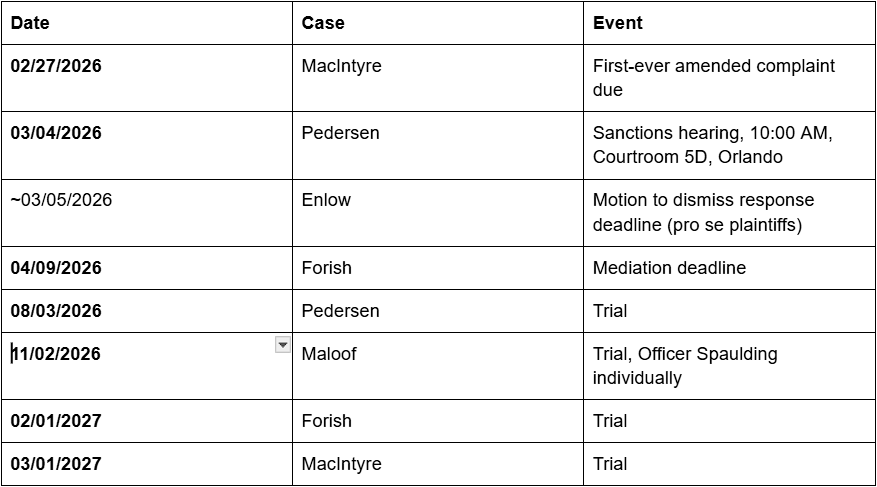
Sources
MacIntyre v. City of Palm Bay et al., 6:24-cv-00988, PACER MDFL
Pedersen v. City of Palm Bay et al., 6:24-cv-02250, PACER MDFL
Maloof v. City of Palm Bay et al., 6:25-cv-00197, PACER MDFL
Enlow et al. v. City of Palm Bay et al., 6:25-cv-00964, PACER MDFL
Forish v. City of Palm Bay Police Dept., 6:25-cv-00375, PACER MDFL
Faulkenberry-Ruiz v. State of Florida et al., 6:25-cv-02345, PACER MDFL
Deligdish et al. v. City of Palm Bay, 6:26-cv-00409, PACER MDFL
Steelman v. City of Palm Bay et al., 05-2025-CA-019339, BECA Brevard County
Russoniello v. Joanna Rey et al., 05-2026-CA-012083, BECA Brevard County
Meyers v. City of Palm Bay, 05-2025-CA-055899, BECA Brevard County
11th Circuit Opinion, MacIntyre v. City of Palm Bay, Case No. 25-11089 (Dec. 19, 2025)
Langevin Lawsuit Settled, Council Vote Pending, The Palm Bayer
Data sourced from PACER (Public Access to Court Electronic Records) and BECA (Brevard County Clerk of Courts). Research conducted February 19-20, 2026.


