


Palm Bay, FL — Most residents have never read the Land Development Code. That doesn’t mean it hasn’t affected their lives. The LDC determines what gets built next to your house, whether your street can handle the traffic a new subdivision will dump on it, and who gets notified when a developer files a rezoning application for land three blocks away. The City of Palm Bay is now updating that code again, and the public input window opens in ten days.
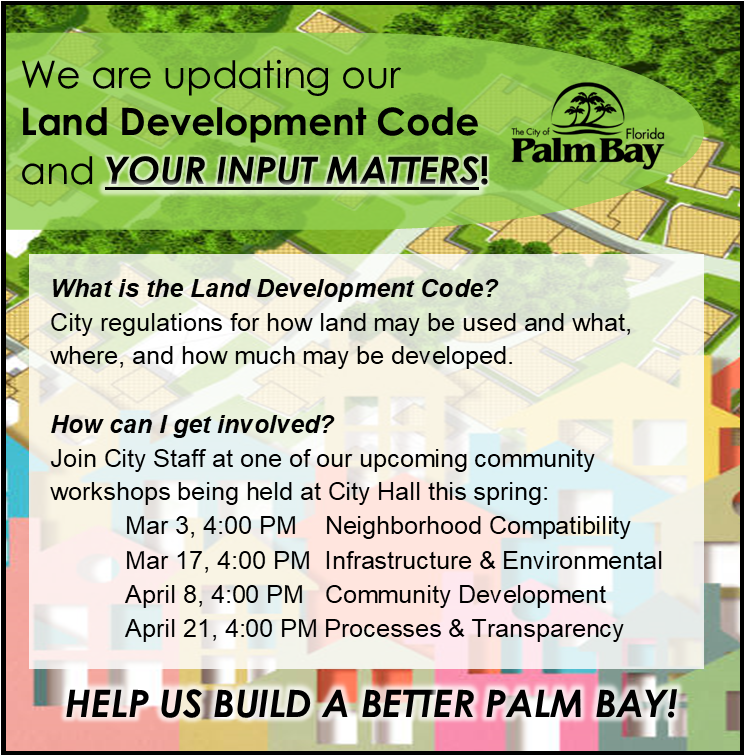
Four community workshops are scheduled at City Hall this spring. The first is March 3 at 4:00 PM. If you’ve ever complained about flooding from a neighbor’s fill, wondered why apartments keep going up in single-family neighborhoods, or wanted to know why you never got a heads-up when a big development broke ground nearby — these workshops are the forum where those issues are actually on the table.
What the Land Development Code Actually Does
The LDC is the operating manual for development in Palm Bay. It specifies which uses are permitted in which zoning districts, what setbacks and lot sizes apply, how traffic impacts are evaluated before a project gets approved, and what developers must do to protect trees, manage stormwater, and notify neighbors. If the Comprehensive Plan is the city’s vision, the LDC is the enforcement mechanism.
Per Florida Statute 163.3202, municipalities are required to keep the LDC consistent with their adopted Comprehensive Plan. Palm Bay adopted its “Vision 2045” Comprehensive Plan in 2023, which required a complete rewrite of the code. That Phase 1 rewrite was adopted by City Council in September 2024 via Ordinance 2024-33. You can read The Palm Bayer’s coverage of that process here and here.
Phase 2 Is a “Cleanup” — But the Issues Are Real
Phase 2 is not a wholesale rewrite. City staff identified errors, omissions, and conflicts that emerged after six months of applying the new code, and Phase 2 corrects them. Some of those corrections are procedural. Others have direct impact on residents.
The definition of “fill” — what qualifies as fill material under the LDC — was debated and amended. This matters to anyone who has watched a new construction project raise the grade of an adjacent lot and redirect stormwater onto their property. The workshop on Infrastructure and Environmental (March 17) will address exactly that kind of concern.
The notification radius for rezonings is another live issue. Currently, courtesy notices go to property owners within 500 feet of a proposed development. Residents and some council members have argued that 500 feet is inadequate for large-scale projects that will affect traffic, drainage, and neighborhood character across a much wider area. City staff acknowledged that expanding the radius to 750 or 1,000 feet would increase costs — but the alternative is residents finding out about major developments after approvals are already in place. The Processes and Transparency workshop on April 21 is where this gets discussed.
State Law Is Reducing Local Control — Which Makes This More Urgent
Florida House Bill 381, adopted in 2024, removed the City Council’s authority to vote on subdivision plats in public hearings. That approval process now runs through city staff administratively, on a defined timeline. The intent was to speed housing construction statewide. The effect in Palm Bay is that one more category of development decision is no longer subject to a public Council vote.
The Live Local Act compounds that shift. It allows developers proposing affordable housing components to bypass local zoning restrictions and Comprehensive Plan designations entirely. The city’s ability to condition or deny those projects is significantly limited. These are state preemptions — the city cannot simply opt out. But the LDC still governs everything the state hasn’t preempted, and the specifics of how local processes are written matters considerably. What gets retained in the code, and how precisely it’s drafted, determines how much review authority Palm Bay keeps.
The Workshop Schedule
All four workshops are at City Hall, 120 Malabar Road SE. All start at 4:00 PM. The 4:00 PM time slot is during normal work hours — if you can’t attend in person, the online Neighborhood Compatibility Survey takes about two minutes and is open now.
Processes & Transparency
The survey focuses on Chapter 173 and 174 of the LDC — zoning districts and compatibility standards. It asks residents to rank what factors matter most when new development goes in next to an existing neighborhood, and what types of housing or commercial development they’d prefer to see nearby. It’s the lowest-friction way to get your position on record before these workshops close.
What Happened at the Planning and Zoning Board
The P&Z Board has already reviewed two Phase 2 textual amendments earlier in the process. In April 2025, the board approved changes to Chapter 172 (Development Review Procedures) on a 6-1 vote and Chapter 171 (Definitions) on a 5-1 vote. Public commenters at that meeting raised concerns about easing development standards and the timing of land use decisions relative to public input. You can read The Palm Bayer’s coverage of that meeting here.
These workshops are the public’s next opportunity in that process. The Growth Management Department is coordinating the effort. More information is available on the City’s Growth Management page and the Land Development Planning division.
The Bottom Line
The LDC touches every development decision in Palm Bay. Phase 2 is being framed as a technical cleanup, and much of it is. But the notification radius debate, the definition of fill, the erosion of Council’s role in plat approvals, and the community development framework being written into code right now will shape how this city grows for years. The workshops are open to the public. The survey is online. Both close out before the amendments go to final vote. This is the window.


